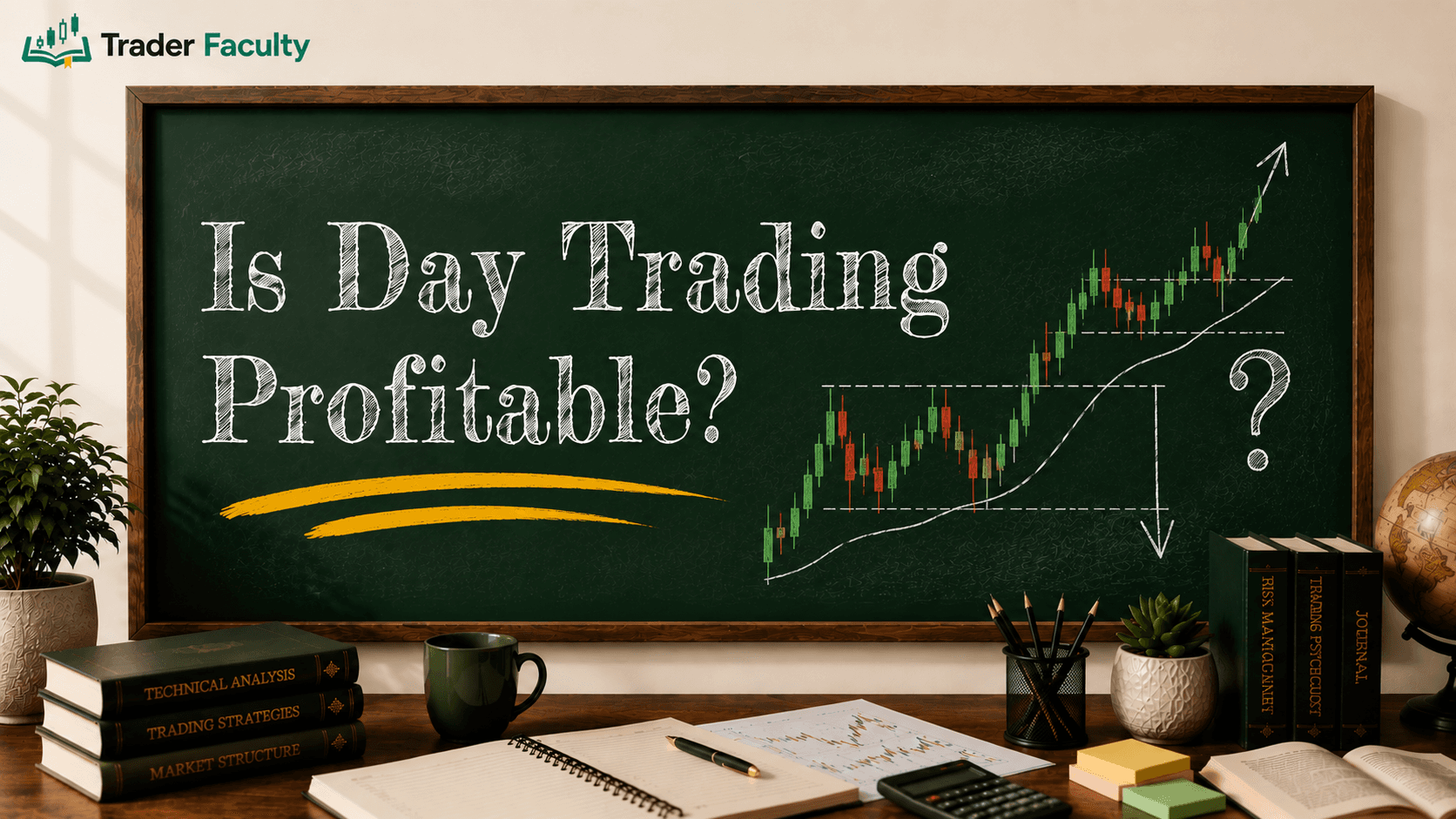
Is Day Trading Worth It? Risks, Costs, and Realities
Discover if day trading is worth it. Learn about real success rates, execution costs, and capital requirements. Read the full guide.
By Trader Faculty Team
Direct Answer
Day trading is the practice of buying and selling financial instruments within the same trading session to profit from intraday price movements. While it offers complete autonomy, over 90% of retail day traders experience net financial losses due to transaction friction, psychological stress, and high failure rates. For most retail participants, longer-term frameworks like swing trading yield a better balance of risk and reward.
Day trading is the practice of buying and selling financial assets within the same trading day to profit from short-term price movements, closing all open positions before the market closes.
While online videos often market intraday execution as a quick path to financial independence, high failure rates, execution costs, and psychological stress make it one of the hardest ways to trade.
This guide breaks down retail performance data, transaction friction, capital rules, and alternative trading approaches to help you decide if day trading fits your financial goals.
Quick Takeaways
- Empirical research indicates that over 90% of retail day traders lose money over time due to high execution costs and lack of a systematic statistical edge.
- Transaction costs like bid-ask spreads, commissions, and order execution slippage compound rapidly across frequent trades, eroding gross profits.
- US stock market regulations require day traders executing four or more intraday trades within five business days to maintain a $25,000 minimum account equity.
- Day trading is a demanding, full-time skill that requires continuous screen time, dynamic risk rules, and strict discipline rather than a source of passive income.
- Alternative approaches like swing trading or range trading allow market participants to capture larger trends with significantly lower execution stress.
The Reality of Day Trading Success Rates
Day trading is rarely profitable for the average retail market participant. Academic studies tracking thousands of retail day trading accounts over multi-year periods show that between 90% and 97% of individual day traders lose money over the long run. According to official regulatory guidance from the US SEC, retail day traders typically experience high financial losses in their first few months of trading, and many never achieve sustained profitability.
Most retail participants fail because they treat day trading as discretionary gambling rather than a probabilistic business. They face structural disadvantages compared to institutional firms that deploy high-frequency trading (HFT) algorithms—automated trading systems designed to execute orders in milliseconds—and benefit from direct market access. Furthermore, retail traders often suffer from emotional biases, such as revenge trading after a drawdown, which quickly depletes trading capital.
The small percentage of consistently profitable day traders succeed by applying strict risk control, managing dynamic position sizing, and preserving capital across adverse market regimes.
The Hidden Costs That Undermine Intraday Profits
To understand whether day trading is worth it, you must calculate total transaction friction. High execution frequency means explicit and implicit trading costs compound far faster than in longer-term investing styles.
Total Transaction Friction = Direct Brokerage Fees + Bid-Ask Spread Costs + Slippage
Direct broker fees include per-trade commissions, software platform subscriptions, and real-time exchange market data fees. However, the implicit market costs usually do the most damage:
- Bid-Ask Spreads: The spread—that is, the price difference between what buyers are willing to pay and what sellers are willing to accept—acts as an immediate drag on every trade. Entering and exiting a position incurs this cost twice.
- Slippage: Slippage happens when your order fills at a price different from what you expected, especially during periods of high price volatility or low market liquidity.
- Short-Term Taxes: In many tax jurisdictions, profits from holdings under one year are taxed at higher short-term capital gains rates compared to long-term investment rates.
Structural Rules and Capital Requirements
Capital constraints play a major role in determining whether intraday trading is practical. In the US equity market, the Financial Industry Regulatory Authority enforces the Pattern Day Trader rule.
While day trading is legal, regulatory limits apply: any margin account executing four or more intraday trades within five business days is classified as a pattern day trader. This classification requires the account holder to maintain a minimum equity balance of $25,000 at all times. Falling below this limit restricts the account from executing further day trades until the balance is restored.
Intraday leverage also presents a double-edged sword. Margin accounts allow traders to control positions up to four times their cash balance during market hours. While leverage increases potential gains from tiny price changes, it accelerates losses just as fast. A small adverse price swing can trigger a margin call—a broker demand to deposit additional cash or liquidate positions immediately—destroying an undercapitalized account.
Day Trading vs. Alternative Trading Styles
Evaluating whether day trading fits your situation requires comparing it against longer-term execution approaches.
| Feature | Day Trading | Swing Trading | Range Trading |
|---|---|---|---|
| Holding Period | Minutes to hours (no overnight) | Days to weeks | Hours to days |
| Screen Time | High (4–8 hours daily) | Medium (1–2 hours daily) | Medium (1–2 hours daily) |
| Transaction Friction | Very High (frequent spreads) | Low to Moderate | Moderate |
| Overnight Risk | Zero (positions closed) | Present (earnings/gap risk) | Present (breakout risk) |
| Minimum Capital | High ($25,000 for US stocks) | Flexible | Flexible |
Transitioning to longer-term frameworks like swing trading or range trading often provides a better risk-to-reward ratio for part-time market participants. Longer holding periods let price moves develop, reducing the percentage of profits eaten up by transaction spreads and platform fees.
Common Beginner Day Trading Mistakes
Beginners frequently fall into predictable execution traps that drain their account equity:
- Trading Without a Defined Edge: Entering trades on social media tips or intuition without backtesting an entry and exit rule set.
- Poor Risk-to-Reward Ratio: Taking small profits too early while letting losing trades run in the hope that price turns back to breakeven.
- Revenge Trading: Increasing position size immediately after a losing trade to quickly recover capital, leading to compounding drawdowns.
- Ignoring Volatility Shifts: Applying fixed profit targets during market regimes with low liquidity or narrow range conditions.
Is Day Trading Worth It for You?
Determining if day trading aligns with your personal circumstances requires an honest evaluation of your capital, time, and emotional control.
- Capital Readiness: Do you have dedicated risk capital—money you can lose entirely without affecting your living expenses or financial security?
- Time Availability: Can you spend full market sessions analyzing live charts and managing active orders without distraction?
- Systematic Mindset: Are you comfortable making fast, rule-based decisions without letting fear or greed alter your risk limits?
If you lack full-time screen access or risk capital, developing a systematic framework for longer timeframes offers a more practical path forward.
Conclusion
Day trading can offer financial autonomy for a small minority of disciplined market participants, but the low empirical success rate, high execution costs, and significant emotional pressure make it unsuited for most retail investors. Success requires far more than predicting chart patterns; it demands rigorous capital allocation, continuous risk control, and an objective acceptance of market uncertainty.
Before committing real capital to high-frequency intraday trades, focus on developing a clear market edge, understanding risk management, and testing your execution across different market environments. Learn more about structuring a cohesive approach in our trading strategies guide.
Frequently Asked Questions
Is day trading profitable for beginners?
Day trading is rarely profitable for beginners. Academic research shows that 90% to 97% of retail day traders lose capital over extended periods due to market friction, lack of execution discipline, and emotional biases.
How much money do you need to start day trading?
In the US stock market, the Pattern Day Trader (PDT) rule requires traders using margin accounts to maintain a minimum balance of $25,000. In other asset classes like forex or futures, initial requirements may be lower, but sufficient risk capital is necessary to withstand drawdowns.
Is day trading legal?
Yes, day trading is legal in most jurisdictions worldwide. However, regulatory authorities impose specific rules on leverage, capital requirements, and margin limits to protect market integrity and retail investors.
Can you make a living off day trading?
A small minority of disciplined traders make a living off day trading by treating it as a probabilistic business with defined risk controls. However, relying on intraday profits for primary living expenses introduces immense psychological pressure that often compromises risk management.
What is the main difference between day trading and swing trading?
Day trading involves opening and closing all positions within a single market session, eliminating overnight gap risk. Swing trading holds positions across multiple days or weeks to capture larger price trends, requiring far less continuous screen time.
Keep learning
Build Your Trading System
Turn scattered tactics into one system you can actually follow.
8 lessons quiz
Build your systemThe Trader Faculty Team writes and reviews every guide together — pairing hands-on market experience with a curriculum-first approach to trading education. One good syllabus, taught in the order that makes you better.