Straddle Option Strategy: How to Trade Volatility Events
Discover how a straddle option strategy works, how to calculate breakevens, and how to trade volatility events. Read the full guide.
By Trader Faculty Team
Direct Answer
A straddle option strategy is a market-neutral options trading position formed by simultaneously buying or selling an at-the-money call option and an at-the-money put option with the exact same strike price and expiration date. Traders use long straddles to profit from large price swings in either direction, while short straddles profit when the underlying price stays within a range set by the premium collected.
You don't need to guess which way a stock will move to use a straddle. You need it to move far enough, or in the case of a short straddle, not very far at all.
Many traders turn to options during major earnings releases or economic announcements hoping to profit from a massive stock move. However, buying a straddle requires paying two premiums at once, which introduces strict breakeven boundaries and severe exposure to time decay and volatility drops.
This guide breaks down how long and short straddles work, how to calculate breakevens, and how to manage the hidden risks of trading volatility events.
Quick Takeaways
- A long straddle involves buying an at-the-money (ATM) call and an ATM put at the same strike and expiration to profit from sharp price swings in either direction.
- A short straddle involves selling both contracts to collect premium. It profits when the price stays between the two breakeven points and earns the most if the price closes right at the strike at expiration.
- Long straddles feature defined loss (the total premium paid) but require significant price movement to overcome the upfront debit.
- Implied volatility crush (IV crush) can cause long straddle trades to lose money even if the underlying asset makes a sizable move.
- Rapid daily time decay (theta decay) steadily erodes the total value of both options legs as expiration approaches.
What Is a Straddle Option Strategy?
A straddle option strategy is a neutral strategy designed to trade volatility rather than market direction. Instead of forecasting whether an asset will rise or fall, a straddle trader bets on how much or how little the asset will move before expiration.
The strategy combines two separate contract legs into a single combined trade position:
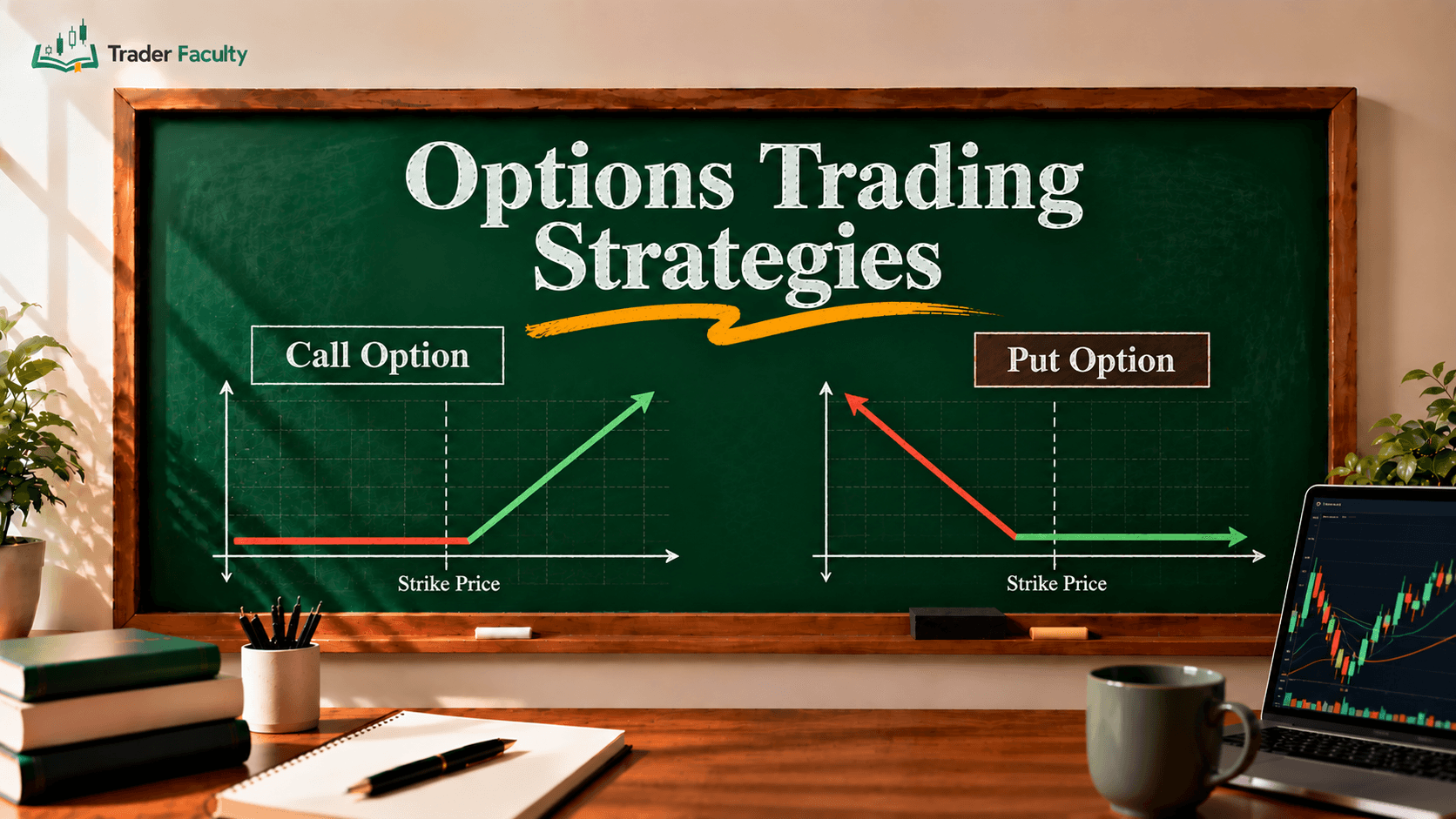
- An At-The-Money (ATM) Call Option (giving the buyer the right to buy the asset)
- An At-The-Money (ATM) Put Option (giving the buyer the right to sell the asset)
Both options must use the exact same strike price—typically the strike closest to the current market price—and the exact same expiration date. Because you hold both sides of the market at the same strike, the directional delta of the position initially cancels out, leaving you directionally neutral at trade entry.
How a Long Straddle Works
A long straddle is created by buying both an ATM call and an ATM put. You pay two upfront premiums (the net debit) to open the trade.

Because you own both contracts, the position profits if the underlying price jumps significantly higher (making the call valuable) or drops significantly lower (making the put valuable).
Breakeven Calculations
Because you pay for two options instead of one, the stock must move far enough in either direction to cover the combined upfront debit. A long straddle has two distinct breakeven points at expiration:
- Upper Breakeven: Strike Price + Total Premium Paid
- Lower Breakeven: Strike Price - Total Premium Paid
Example: Suppose Stock XYZ trades at $100. You buy a 30-day $100 Call for $3.00 and a 30-day $100 Put for $3.00.
- Total Cost (Debit): $3.00 + $3.00 = $6.00 per share ($600 total contract cost)
- Upper Breakeven: $100 + $6.00 = $106.00
- Lower Breakeven: $100 - $6.00 = $94.00
If XYZ moves to $112 by expiration, the call option is worth $12.00, while the put option expires worthless ($0.00). Subtracting your initial $6.00 cost leaves a net profit of $6.00 per share ($600). However, if XYZ stays between $94 and $106 at expiration, the trade results in a partial or total loss.
Maximum Profit and Maximum Loss
- Maximum Loss: Defined and capped at the total premium paid. The maximum loss occurs if the underlying price closes exactly at the strike price at expiration, leaving both options worthless.
- Maximum Profit: Theoretically unlimited on the upside (as a stock can rise indefinitely) and substantial on the downside (capped only by the asset price reaching $0).
Long Straddle vs. Short Straddle
While a long straddle seeks large price moves, a short straddle takes the opposite view. A short straddle seller receives cash upfront by selling both an ATM call and an ATM put, betting that the underlying market will remain quiet.

| Strategy Feature | Long Straddle | Short Straddle |
|---|---|---|
| Trade Execution | Buy ATM Call + Buy ATM Put | Sell ATM Call + Sell ATM Put |
| Upfront Cash Flow | Net Debit (Pay cash) | Net Credit (Receive cash) |
| Market Bias | High Volatility (Direction neutral) | Low Volatility / Rangebound |
| Maximum Profit | Unlimited (Upside) / Substantial (Downside) | Limited to Net Premium Received |
| Maximum Risk | Capped at Total Premium Paid | Unlimited (on the upside) |
| Primary Enemy | Time Decay (Theta) & Volatility Drop | Sharp Explosive Price Moves |
Selling a short straddle carries severe structural risks. If the underlying price explodes in either direction beyond the breakeven points, losses accrue rapidly. Because an asset's price can rise infinitely, an uncovered short call inside a short straddle carries unlimited risk exposure.
The Hidden Risks: Time Decay and IV Crush
Buying a long straddle sounds appealing to beginners because you do not need to guess market direction. However, straddles can be difficult trades to win because two pricing forces work against the buyer: Theta (Time Decay) and Vega (Implied Volatility).
1. Double Daily Time Decay (Theta Bleed)
Every option contract loses extrinsic value as it approaches expiration. Because a long straddle contains two long options legs, you suffer double the daily time decay.
If the underlying stock stays sideways for even a few days, the combined value of both options degrades rapidly, eroding your account balance even without an adverse price move.
2. The Implied Volatility (IV) Crush Trap
Implied volatility measures expected future price movement. Before major corporate events—such as quarterly earnings reports or FDA drug announcements—demand for options spikes, driving up implied volatility and making option contracts expensive.
The IV Crush: Immediately after the news is released, market uncertainty drops to zero. Implied volatility collapses instantaneously.
If you buy a long straddle right before earnings, you buy options when their prices are artificially inflated by high IV. Even if the stock jumps 5% after earnings, the sudden drop in implied volatility can cause both the call and put prices to shrink so dramatically that the entire position loses money.
Common Mistakes Beginners Make
- Buying Straddles Immediately Before News Events: Overpaying for inflated implied volatility right before an earnings event almost always leads to a post-announcement loss due to IV crush.
- Ignoring the Double Premium Drag: Forgetting that breakeven levels are twice as far away as a single option trade. The market must make an unusually strong move just to break even.
- Holding Long Positions All the Way to Expiration: Waiting for expiration exposes your contracts to severe accelerated time decay during the final two weeks.
- Selling Short Straddles Without a Risk Plan: Writing naked straddles without defined exit rules and adequate margin buffers can lead to severe account drawdowns. Keep in mind that a stop-loss order can't protect you from a price gap — if a stock opens far beyond your stop, your order may fill at a much worse price, and losses on the short call remain theoretically unlimited.
Conclusion
The straddle option strategy offers active traders a defined framework for capitalizing on extreme market volatility without picking a specific price direction. While buying a long straddle caps your maximum monetary loss, winning requires sufficient market movement to overcome double option premiums, persistent daily time decay, and sudden changes in implied volatility.
To explore how options mechanics fit into a broader trading framework, review our general guide to trading strategies, start with the fundamentals of day trading for beginners, or explore lower-risk market-neutral alternatives like the strangle strategy.
Frequently Asked Questions
What is the main purpose of a long straddle option strategy?
The main purpose of a long straddle is to profit from high market volatility without needing to predict whether the underlying asset price will move up or down. As long as the price makes a sharp move beyond either breakeven point before expiration, the trade can generate a net profit.
How do you calculate the breakeven points for a long straddle?
A long straddle has two breakeven points. The upper breakeven point is calculated by adding the total combined premium paid to the option strike price. The lower breakeven point is calculated by subtracting the total combined premium paid from the strike price.
What is the difference between a straddle and a strangle option strategy?
Both strategies are market-neutral options combinations. A straddle uses the exact same at-the-money strike price for both the call and put options. A strangle uses out-of-the-money strike prices (a higher call strike and a lower put strike), making strangles cheaper to purchase but requiring a larger price move to reach breakeven.
Why do long straddles lose money during earnings announcements?
Long straddles often suffer from implied volatility crush (IV crush) after an earnings call. Option premiums inflate prior to major news due to uncertainty. Once the announcement occurs, market uncertainty disappears, causing implied volatility and option values to drop rapidly even if the stock price moves.
Is a short straddle a safe options trading strategy for beginners?
No, short straddles are high-risk trades unsuited for beginners. Selling an uncovered call inside a short straddle carries theoretically unlimited loss potential if the underlying asset price rallies aggressively against the position.
Keep learning
Build Your Trading System
Turn scattered tactics into one system you can actually follow.
8 lessons quiz
Build your systemThe Trader Faculty Team writes and reviews every guide together — pairing hands-on market experience with a curriculum-first approach to trading education. One good syllabus, taught in the order that makes you better.