What Is the Difference Between Stocks and Bonds?
Discover what is the difference between stocks and bonds, including payout rules and risks. Read the full guide.
By Trader Faculty Team
Direct Answer
The primary difference between stocks and bonds lies in ownership versus debt. Owning stocks gives investors fractional equity ownership in a corporation with potential capital appreciation and discretionary dividends, whereas buying bonds makes investors creditors who receive contractual interest payments and principal repayment at maturity.
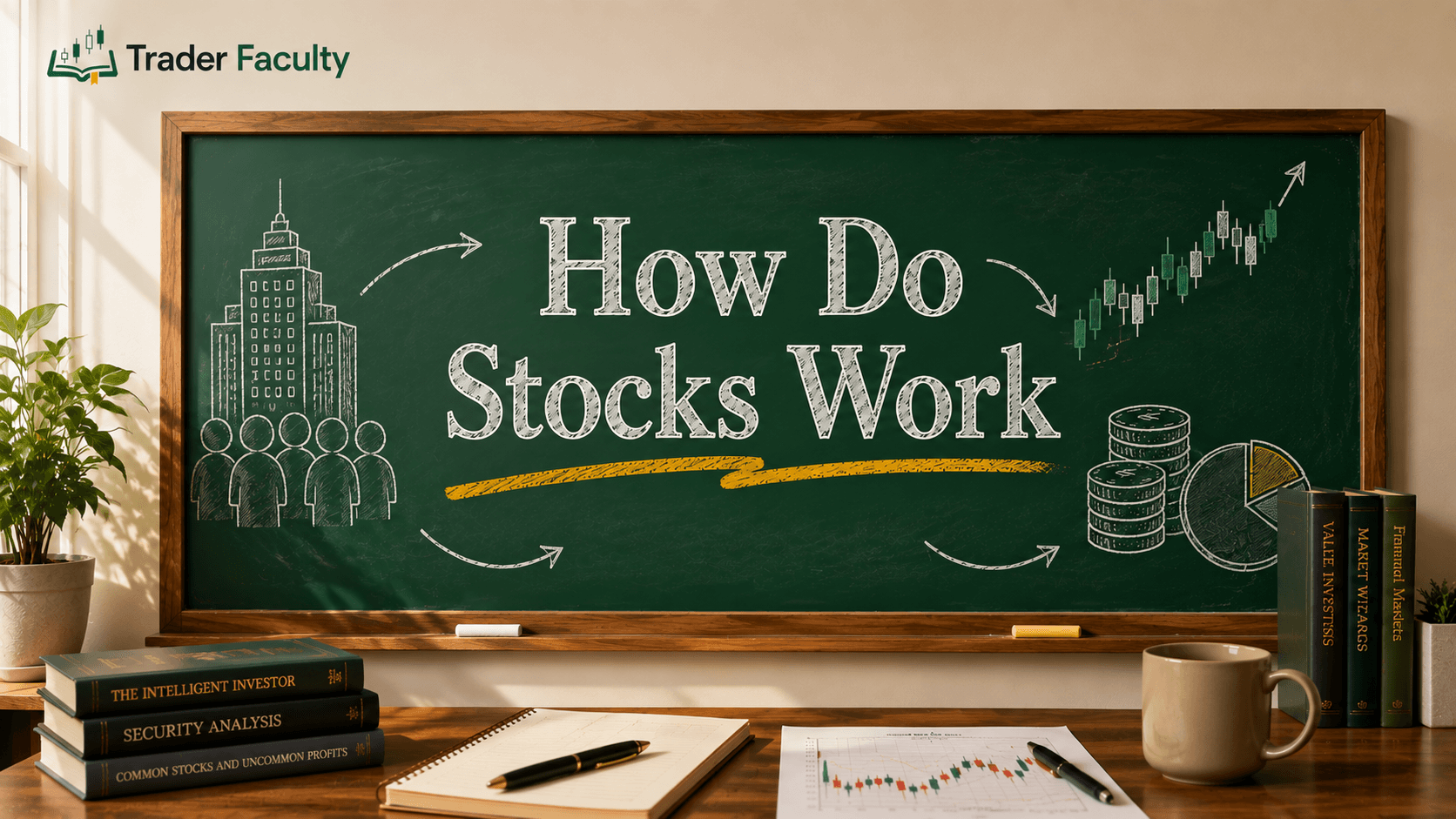
When exploring what is the difference between stocks and bonds, it comes down to one core distinction: stocks represent fractional equity ownership in a corporation, whereas bonds represent a debt loan made by an investor to a corporate or government borrower.
When deciding where to allocate capital, many beginners struggle to balance the explosive growth potential of equities against the steady income offered by fixed-income assets. Grasping what is trading across traditional financial markets requires a clear understanding of how these two foundational assets function.
This guide breaks down their structural mechanics, cash flow differences, liquidation priorities, and practical applications for managing risk.
Quick Takeaways
- Stocks grant equity ownership with potential upside and voting rights, while bonds are debt obligations that pay fixed interest and return principal at maturity.
- Bondholders hold higher claim priority than stockholders during corporate liquidation or bankruptcy proceedings.
- Stock returns derive from share price appreciation and discretionary dividends, whereas bond returns come from contractual coupon interest.
- Stock prices react primarily to corporate earnings growth, while bond prices move inversely to benchmark interest rates.
Equity vs. Debt: The Core Structural Difference
The fundamental distinction between stocks and bonds lies in ownership versus lending.
When you purchase shares of a stock, you acquire a piece of legal ownership (equity) in that business. As a shareholder, you participate directly in the company's long-term corporate growth or decline. Equity holders typically receive voting rights for major corporate decisions, such as electing the board of directors. However, your financial return is completely tied to how well the business performs over time—there are no guarantees of profit or capital recovery.
Conversely, buying a bond means acting as a lender (creditor). You are providing capital to an issuing entity—such as a public corporation, municipality, or sovereign nation—in exchange for periodic interest payments and the full return of your loan amount at a specified date. Bondholders hold no ownership stake in the organization and have no voting rights regarding corporate management.
Shares of stock have no expiration date; they remain active as perpetual assets as long as the underlying corporation remains solvent and publicly listed. Bonds feature a defined maturity date ranging from several months to several decades, at which point the issuer must repay the principal balance.
While decentralized digital asset structures gained attention after interest grew around who Satoshi Nakamoto was and how trustless networks operate, global finance continues to rely heavily on these two core debt and equity instruments.
How Stocks and Bonds Generate Returns
Stocks generate returns through capital appreciation and discretionary dividends, while bonds yield returns through scheduled interest payments and principal recovery at maturity.
Investors who purchase stocks aim to buy shares at a lower valuation and sell them at a higher price as the issuing company expands its earnings and revenue. Additionally, profitable corporations may distribute a portion of their post-tax profits back to shareholders through dividends.
Crucially, dividend payments are discretionary—a company's board of directors can reduce, pause, or completely eliminate dividends at any time based on strategic priorities or cash flow constraints.

Bond cash flows operate under a strict contractual arrangement. When an investor purchases a traditional coupon bond, the issuer is legally bound to pay periodic interest—known as the coupon rate—at predetermined intervals until the instrument reaches maturity. Upon maturity, the face value (par value) of the bond is returned to the investor.
The distinction between stock dividends and bond coupons comes down to legal obligation. Failing to pay a promised bond coupon triggers a legal debt default, which can force the corporate issuer into restructuring or bankruptcy. Conversely, skipping a stock dividend payment carries no legal fault, even though it often triggers a drop in share price due to negative market sentiment.
Risk Profiles and Bankruptcy Liquidation Priority
Stocks carry higher price volatility and residual risk, whereas bonds face interest rate risk, credit default risk, and inflation erosion.
Stocks are generally higher-volatility assets that react rapidly to quarterly earnings reports, macroeconomic indicators, management guidance, and overall market sentiment. Because common stock returns depend entirely on unpromised future earnings growth, equity price fluctuations can be broad and sudden.
While bonds are generally less volatile than equities, they carry distinct risk factors that every trader should understand. Secondary market bond prices share an inverse relationship with benchmark interest rates: when central banks raise interest rates, existing bond prices fall because newer issues enter the market with higher yields.
Bonds also carry credit default risk (the risk that the issuer defaults on interest or principal) and inflation risk (the risk that rising consumer prices erode the real purchasing power of fixed coupon payments), as outlined in the SEC's Investor.gov overview of bonds.
The structural divide between equity and debt becomes most critical during corporate restructuring. If a company enters bankruptcy, its remaining assets are liquidated according to a strict legal priority hierarchy.
Secured lenders and senior bondholders are satisfied first. Unsecured bondholders follow next in line. Common stockholders sit at the absolute bottom as residual claimants, receiving compensation only if funds remain after every creditor is fully paid.
Key Differences Side-by-Side: Bonds vs Stocks
Comparing bonds vs stocks side-by-side highlights how legal status, cash flow structures, and risk drivers differ across both asset classes.
| Feature | Stocks (Equity) | Bonds (Debt) |
|---|---|---|
| Legal Status | Fractional Owner / Shareholder | Creditor / Lender |
| Primary Cash Flow | Discretionary Dividends | Contractual Coupon Payments |
| Capital Return | Capital Gains (Uncapped Upside) | Return of Principal at Maturity |
| Maturity Date | None (Perpetual Asset) | Fixed Maturity Date |
| Voting Rights | Yes (Common Stockholders) | No |
| Bankruptcy Priority | Bottom (Residual Claimants) | Top / Senior Claimants |
| Primary Sensitivity | Corporate Earnings & Market Sentiment | Benchmark Interest Rates & Credit Ratings |
| Volatility Profile | Moderate to High | Low to Moderate |
Why the Stock-Bond Dynamic Matters for Traders
Tracking the interplay between equities and fixed-income markets provides traders with valuable signals regarding economic expansion, market sentiment, and central bank policy trends.
Capital shifts continuously between equity and debt markets depending on macroeconomic conditions. When bond yields rise rapidly, corporate borrowing costs increase, which often depresses stock valuations by raising the discount rate applied to future corporate earnings.
Monitoring the relationship between short-term and long-term bond yields (the yield curve) gives traders an early indicator of economic expectations. An inverted yield curve—where short-term yields surpass long-term yields—has historically signaled economic slowdowns or impending recessions. Equities often react with heightened volatility during these yield curve shifts.
Balancing capital between stocks and bonds allows traders to manage portfolio risk effectively. During periods of severe equity market distress, capital frequently flows into government bonds (a "flight to quality"), providing a stabilizing buffer for multi-asset portfolios.
Common Beginner Mistakes
Beginner traders often suffer avoidable losses by misjudging how equity volatility and fixed-income risks function in real-world market conditions.
Treating Government Bonds as Completely Risk-Free
Assuming sovereign debt cannot lose money is a common misunderstanding. While sovereign default risk may be negligible for major economies, secondary market bond prices drop significantly when interest rates rise sharply.
Assuming Stock Dividends Function Like Bond Coupons
Expecting corporate stock dividends to remain guaranteed in all economic climates leads to mismanaged risk. A company facing financial pressure can cut its dividend overnight without defaulting on any legal obligation.
Ignoring Interest Rate Transmissions to Equities
Overlooking how central bank rate changes impact equity valuations causes traders to misjudge stock pullbacks during inflationary policy cycles.
Conclusion
Understanding the difference between stocks and bonds is essential for building a grounded market perspective. Equities offer unlimited growth potential through fractional company ownership, balanced by higher price volatility and lower claim priority during liquidation. Debt instruments provide structured contractual income and principal protection at maturity, governed primarily by interest rate trends and issuer creditworthiness.
By recognizing how capital moves between debt and equity markets, traders can construct balanced risk frameworks and better navigate shifting macro conditions.
Frequently Asked Questions
Can you lose money on bonds?
Yes, investors can lose money on bonds. Although bonds are generally less volatile than stocks, their market values drop when central bank interest rates rise. Additionally, secondary market prices fluctuate before maturity, and corporate issuers can default on contractual interest or principal repayments.
Do bonds pay dividends like stocks?
No, bonds do not pay dividends. Instead, bonds generate income through fixed or floating interest payments known as coupons. Stock dividends are discretionary corporate profit distributions approved by a board of directors, whereas bond coupon payouts are legally binding debt obligations that issuers must fulfill.
Why are stocks considered riskier than bonds?
Stocks are considered riskier because equity holders receive no guaranteed cash flows and sit at the bottom of the liquidation hierarchy during corporate bankruptcy. Stock prices also experience higher market volatility driven by fluctuating corporate earnings, whereas senior bondholders hold higher legal priority for capital recovery if a business fails.
How do interest rates affect stocks and bonds differently?
Benchmark interest rate increases directly reduce existing bond prices in secondary markets to align yields with newer issues. For stocks, higher interest rates increase corporate borrowing costs and raise discount rates used in valuation models, which can compress equity prices across broader stock markets.
Is it better to own stocks or bonds in a trading portfolio?
Neither asset class is universally better; the ideal choice depends on individual risk tolerance, investment horizon, and market strategy. Stocks offer higher growth potential through capital appreciation for growth-focused accounts, while bonds provide regular income generation and lower volatility to balance multi-asset portfolios.
The Trader Faculty Team writes and reviews every guide together — pairing hands-on market experience with a curriculum-first approach to trading education. One good syllabus, taught in the order that makes you better.