What Is Day Trading Options? Rules, Risks, and Strategies
Learn how day trading options works, from FINRA's intraday margin rules to option Greeks and risk controls. Read the full guide.
By Trader Faculty Team
Direct Answer
Day trading options involves buying and selling call or put contracts within the same trading session to try to profit from intraday price moves. Traders typically close positions before the market closes to avoid overnight risk. In the U.S., margin accounts need at least $2,000 in equity under FINRA's current intraday margin rules, and your broker may require more.
It means buying and selling option contracts within the same trading session to try to profit from short-term price moves, without holding positions overnight.
Some traders are drawn to high leverage and quick intraday price action, only to find that contract decay and execution costs can erode capital quickly.
This guide explains how intraday options work, FINRA's current margin rules for frequent trading, pricing dynamics, and the risk controls that matter most. If you've searched for "day trading options meaning," it covers that too, with day trading options explained from rules to risk controls. Options are leveraged and you can lose your entire premium, so treat everything here as education, not advice.
Quick Takeaways
- This approach involves closing call and put positions before the market close to avoid overnight gap risk (price jumps between one day's close and the next day's open).
- In the U.S., FINRA's current rules require at least $2,000 in equity to trade on margin, with intraday margin requirements applying during the day, and brokers may require more.
- Option contract pricing depends on stock direction, intraday Delta sensitivity, and rapid Theta time decay during market hours.
- Wide bid-ask spreads (the gap between buy and sell prices) create execution friction, and limit orders can help control slippage.
- A common guideline is to limit risk on any trade to 1–2% of your account balance to help manage fast drawdowns.
What Is Day Trading Options?
It's the practice of opening and closing option positions, either calls or puts, within the same trading day. Unlike traditional stock investing or long-term options strategies, day traders close contracts before the day ends, which avoids exposure to after-hours earnings reports or unexpected geopolitical gaps.
When you're day trading, your objective is to capture price swings in the contract's premium rather than own the underlying shares. Buying a call option gives you the right to buy the stock at a set price, so it tends to gain value if the stock rises. A put option tends to gain value when the stock falls.
- CALL CONTRACT ---> Gains premium value as underlying stock RISES
- PUT CONTRACT ---> Gains premium value as underlying stock FALLS
Day traders rarely exercise an option to take delivery of 100 shares of stock. Instead, they usually close the contract with an opposing trade (selling a long call or buying back a short call), locking in the difference between the entry and exit premium prices. Options can offer more leverage than stocks, because a small move in the underlying asset can create a larger percentage move in the option premium. The same leverage can amplify losses when price moves against you, and you can lose your entire premium.
Market Rules: Account Minimums and Settlement Requirements
Active options traders need to understand the margin and settlement rules that apply to their accounts. In the U.S., account type and trading frequency determine how much capital you need and how your broker applies margin.
FINRA adopted new intraday margin standards in Rule 4210 that replaced the old Pattern Day Trader (PDT) rules, including the day trade count and the $25,000 minimum equity requirement. The change took effect June 4, 2026, per FINRA Regulatory Notice 26-10, and brokers can phase in implementation until October 20, 2027. Under FINRA's investor guide to frequent intraday trading, margin accounts need at least $2,000 in equity and intraday margin requirements apply, and your broker may require more, so confirm your firm's current terms.
Traders with smaller accounts often choose cash accounts, where you must pay for securities in full with settled funds. Options trades generally settle on a T+1 cycle (trade date plus one business day). That means you can only reuse settled cash the next business day, and trading with unsettled funds can trigger violations such as free-riding or good faith violations.
| Account Type | Minimum Equity Requirement | Trade Limit Rules | Settlement Cycle |
|---|---|---|---|
| Margin Account | $2,000 minimum (your broker may require more) | Intraday margin requirements apply | Margin borrowing allowed |
| Cash Account | No fixed minimum | Limited by settled funds | T+1 settlement (generally) for options |
How Option Pricing Affects Intraday Trades
Trading options intraday requires an understanding of how option prices move relative to time and volatility. Pricing models rely on measures known as the Greeks to quantify contract price changes:
- Delta: Measures how much an option's premium changes for every $1.00 move in the underlying stock price. A call with a 0.50 Delta increases by $0.50 if the stock rises by $1.00.
- Gamma: Measures the rate of change of Delta. High Gamma means Delta can move quickly, which can speed up options profits or losses during fast moves.
- Theta: Represents time decay—the rate at which an option loses value as expiration approaches.
- Vega: Measures contract sensitivity to changes in implied volatility.
For day traders, Theta decay is a constant factor. Short-dated options lose time value throughout the trading day, even if the underlying stock price stays flat. Holding an option through a multi-hour sideways market can gradually erode its premium.
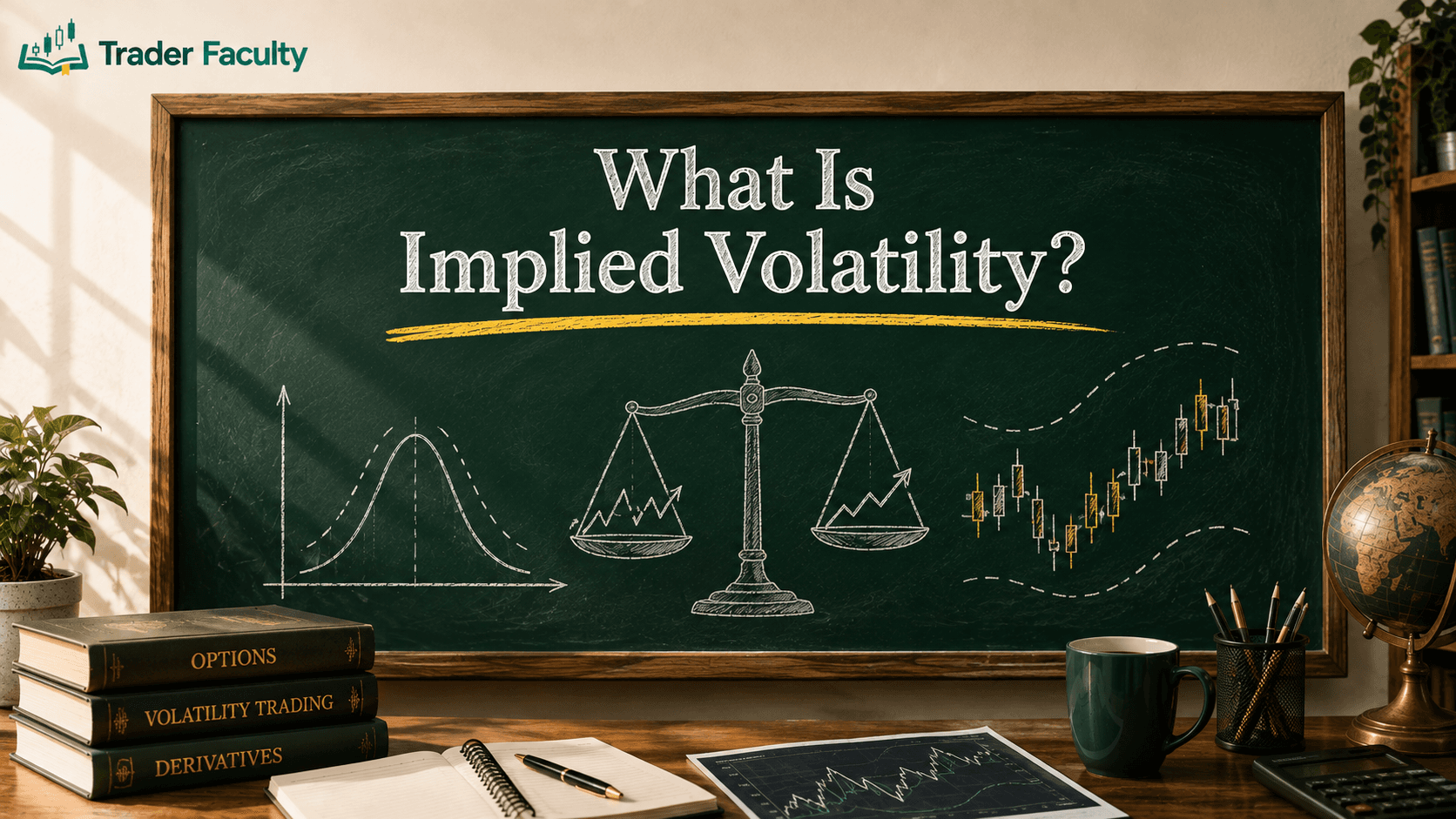
Implied volatility (IV, the market's expectation of future price swings) also affects intraday pricing. Before planned events like earnings releases or economic announcements, IV often rises, which can lift option premiums. Once the news is out, IV can drop quickly, a scenario known as "IV crush." Day traders who buy expensive options right before news can lose money even if they guess the stock's direction correctly.
Key Factors for Selecting Option Contracts
Success in short-term options trading depends heavily on contract selection. Selecting the wrong strike price or expiration date introduces unnecessary friction and exposure to time decay.
To evaluate potential option contracts, focus on liquidity metrics before entering a position:
- Bid-Ask Spread: Look for tight spreads (for example, within $0.01 to $0.05). With wide spreads, you start the trade at an immediate loss.
- Daily Volume: High contract volume can signal active trading interest and smoother executions.
- Open Interest: High open interest (the number of outstanding contracts) can indicate established liquidity.
Selecting strike prices involves balancing Delta sensitivity against cost. Rough ranges often cited:
- In-the-Money (Delta roughly 0.60–0.80) = Higher cost, lower decay risk
- At-the-Money (~0.50) = Balanced move, moderate decay
- Out-of-the-Money (Delta roughly 0.20–0.40) = Lower cost, higher decay risk
At-the-Money (ATM) options provide balanced sensitivity (~0.50 Delta) relative to cost. In-the-Money (ITM) options behave more like stock positions with higher Deltas (roughly 0.70+), offering lower exposure to time decay but requiring more capital per contract.
Expiration selection matters too. Zero-days-to-expiration (0DTE) contracts offer cheap premiums and high leverage, but their rapid Theta decay can lead to fast losses. Some newer traders look at weekly options expiring in 3 to 7 days for more manageable price swings.
Strategic Frameworks and Common Day Trading Approaches
Day traders use various approaches depending on market structure, momentum signals, and individual risk tolerance. The examples below are for study, not recommendations, and none is guaranteed to work.
Momentum Breakout Trading: Traders identify key support or resistance levels on intraday charts (5-minute or 15-minute timeframes). One example is a trader who buys an at-the-money call when price breaks above resistance on heavy volume, hoping to capture the move. Breaking below support might lead another trader to consider a put instead.
Scalping Intraday Swings: Scalping involves holding contract positions for minutes or seconds to capture small price changes. Scalpers often focus on highly liquid mega-cap stocks or index options and exit as soon as they see a quick gain.
Execution Discipline: Limit vs. Market Orders: Market orders can cause slippage in options, because they fill at the prevailing ask price when buying or the bid price when selling. Limit orders can help you control the price you pay, though they may not fill.
Practical Risk Management for Intraday Options
Because options carry high embedded leverage, risk management is essential. Without firm capital allocation limits, a brief market drop can wipe out a large part of your account.
- Position Sizing: Many traders limit risk to 1% to 2% of total account capital on a single options trade.
- Contract Stop-Loss Rules: Some traders set stop-loss levels based on both underlying stock support levels and percentage drop thresholds on contract premiums (for example, exiting if contract value falls 15–20%).
- Daily Drawdown Limits: Some traders set a maximum daily loss cap (for example, 3% of account value) and stop trading for the session once they reach it, to avoid emotional decisions.
Here's a simple example with a $10,000 account and a 1% ($100) risk limit. If you buy one contract at a $2.00 premium ($200 total) and plan to exit if the premium falls to $1.50, your planned loss is $50. If the premium drops to zero instead, you'd lose the full $200, so both your exit rule and position size matter. These numbers are for illustration only.
Contrast this approach with broader instruments like FX options trading, where volatility and session liquidity rules can vary across global currency sessions.
Common Beginner Mistakes in Intraday Options
New options traders often fall into operational traps that can erode capital:
- Chasing Out-of-the-Money (OTM) Contracts: Cheap OTM options look attractive to beginners, but low Deltas and high Theta decay mean these contracts can lose value quickly if the underlying asset doesn't make a large, immediate move.
- Ignoring Wide Bid-Ask Spreads: Trading illiquid options means paying a large spread on entry and exit, which can consume a big share of potential profits.
- Holding Through Volatility Crushes: Buying options right before earnings releases or economic announcements exposes traders to sudden drops in implied volatility, which can shrink contract values even if the directional view was correct.
- Over-Leveraging Account Balance: Buying too many contracts relative to account size can turn minor pullbacks into large account losses.
Conclusion
Day trading options takes a balance of technical chart analysis, order execution discipline, and firm risk limits. While options provide leverage and flexible strategic choices, contract decay and execution costs remain challenges, and you can lose your entire premium. Past performance doesn't guarantee future results. To build a solid foundation before committing active trading capital, focus on liquid contracts, manage risk conservatively, and explore our complete introductory guide to day trading for beginners.
Frequently Asked Questions
What is day trading options?
Day trading options is the strategy of entering and exiting option positions within a single trading day. Traders seek to profit from rapid changes in contract premiums without holding positions overnight, which avoids exposure to after-hours price gaps.
How much money do you need to day trade options?
FINRA's investor guidance says margin accounts need at least $2,000 in equity, and intraday margin requirements apply when you trade on margin during the day. Your broker may require more. Cash accounts have no margin minimum but are limited by settled funds under T+1 settlement.
Is day trading options riskier than day trading stock?
Yes, options day trading adds complexity beyond directional stock movement. Option premiums are subject to rapid time decay (Theta) and changes in implied volatility (IV crush), which can cause contract values to drop quickly even if the underlying stock moves in your favor.
What is the best option contract to day trade?
Day traders often look for liquid contracts with tight bid-ask spreads, high trading volume, and high open interest. Some prefer At-the-Money (ATM) or slightly In-the-Money (ITM) contracts expiring in 3 to 7 days to balance Delta sensitivity against time decay, but there's no single best contract.
Can you lose more than you invest when day trading options?
When you buy a long call or long put, your maximum loss is limited to the premium you paid, though you can lose all of it. Selling unhedged short options or trading complex margin spreads can expose you to losses larger than your initial deposit.
Keep learning
What is Trading?
New to this? Start from the beginning and learn what to trade.
8 lessons quiz
Start with the basicsThe Trader Faculty Team writes and reviews every guide together — pairing hands-on market experience with a curriculum-first approach to trading education. One good syllabus, taught in the order that makes you better.