What Is Anchoring Bias? How Price Anchors Risk Your Capital
Discover how anchoring bias distorts trade management and entry price traps. Read the full guide.
By Trader Faculty Team
Direct Answer
Anchoring bias is a psychological heuristic (a mental shortcut) where a trader relies too heavily on an initial price, such as an entry price or a past high, when making later trading decisions. It can distort risk evaluation, which may lead traders to hold losing positions or cut profits early based on arbitrary reference points instead of current market conditions.
A trader buys a stock at $100 per share. Soon after, conditions shift and the stock drops to $80. Instead of re-evaluating the company, the trader refuses to sell and repeats one thought: "I just need it to get back to $100 so I can break even."
This reaction comes from a psychological trap: a single number, often an entry price, distorts how you see the market and can lead to costly mistakes.
Quick Takeaways
- Anchoring bias occurs when traders rely too heavily on an initial piece of information, such as an entry price or a past high, when they make decisions.
- Your purchase price doesn't matter to the market; asset prices move on current supply, demand, and economic conditions.
- Anchoring can lead to the "breakeven trap," where traders hold losing positions for too long instead of taking a planned loss.
- Reducing this bias usually takes preset risk controls (like stop-loss orders), process-based execution, and reviewing charts without staring at your account profit and loss.
What Is Anchoring Bias in Trading?
Anchoring bias is a cognitive bias where a person relies too heavily on an initial piece of information, known as the "anchor," to make later judgments or estimates. In financial markets, the anchor is usually a specific price. Once an anchor is set in your mind, new data tends to be judged against that original figure instead of on its own merits.
The concept comes from behavioral economics (the study of how psychology affects financial choices). Psychologists Amos Tversky and Daniel Kahneman described "adjustment from an anchor" as one of three judgment heuristics (mental shortcuts) in their 1974 paper, Judgment under Uncertainty: Heuristics and Biases, published in Science. They noted that these shortcuts are often useful but can lead to systematic errors.
If you're looking for the anchoring bias definition in trading terms, it describes how traders fixate on past prices rather than current market conditions. The core issue is that it creates a psychological gap between subjective expectations and objective market mechanics:
- Subjective Price Anchors: Personal reference points, such as your purchase price, a profit target, or your account balance. These numbers carry emotional weight for you, but they don't move the market.
- Objective Technical Levels: Market-generated reference points. Examples include support and resistance zones (price areas where buyers or sellers have often stepped in), volume profile nodes (price levels with heavy past trading), and moving averages (averages of recent prices). These levels reflect buying and selling pressure across the whole market.
Here's the anchoring bias meaning in plain terms: financial markets don't know or care where you entered a trade.
How Anchoring Bias Works: Common Price Traps

This bias shows up in several recurring patterns across stock, forex, and crypto markets. Spotting them is the first step toward keeping them out of your trading.
1. The Entry Price Anchor (The Breakeven Trap)
The most common form is fixating on the exact price at which you bought (or sold short, meaning you sold first hoping to buy back lower). When a trade moves into a floating loss (an open trade that's currently down), the entry price turns from a simple record into a psychological deadline.
Traders caught in this trap often say: "I will close this trade as soon as it gets back to breakeven."
By focusing on the entry anchor, you stop assessing risk. If the market structure has broken down, holding out for a return to breakeven can expose your account to large downside risk.
2. The Peak Profit Anchor
Another common variation appears when a trade becomes profitable, reaches a high, and then starts to reverse. Say a long trade peaked at a $1,000 floating profit and then pulled back to $300. An anchored trader may see it as "down $700" instead of up $300.
Because your mind anchored to the peak, closing at $300 can feel like accepting a $700 loss. You hold on, hoping price returns to the high, and often watch the remaining profit turn into a loss.
3. The 52-Week High/Low Anchor
Traders and retail investors often anchor to a stock's 52-week high or low, or to other historical extremes.
Here's an anchoring bias example of this: an asset drops 60% from its peak. An anchored trader may assume it's now "cheap" or "discounted" simply because it traded higher in the past. But if the company's financial health or macro conditions have deteriorated, the old high is an irrelevant anchor, and the asset may well drop further.
Why Price Anchors Are Dangerous for Capital
This bias isn't just theoretical; it can undermine risk management and your statistical edge (the small advantage a strategy may have over many trades).
Distorted Risk-to-Reward Ratios
Sound trading depends on positive expected value (a positive average result per trade over many trades). When you anchor to a price target or entry point, you may ignore exit signals. That can distort your planned risk-to-reward ratio (potential gain compared with potential loss), since you may let losses run and cut winners early out of fear.
Stop-Loss Tampering
When you're anchored to an entry point, it's hard to accept a realized loss. That often leads to moving, widening, or removing a stop-loss order (an order that exits your trade at a preset price). The pull of the anchor can turn small, planned losses into account-threatening drawdowns (drops from your account's peak value).
Inability to Adapt to Market Regimes
Markets move between trending and rangebound (sideways) conditions. Anchoring can lock your mental model into old price ranges, which makes it harder to adapt when the market shifts into a strong trend or a new regime (a lasting change in market behavior).
Psychological Anchors vs. Technical Market Levels
To trade well, you need to separate your internal reference points from external market realities. The table below compares the two.
| Feature | Subjective Price Anchor | Objective Technical Level |
|---|---|---|
| Origin | Personal trade execution (e.g., buy price) | Market volume, price action, and order flow |
| Market Impact | No direct influence on price | Reflects where many participants have bought and sold |
| Flexibility | Static and emotionally rigid | Dynamic; updates as new data forms |
| Relevance | Relevant only to your individual account | Relevant to all market participants |
| Primary Risk | Drives emotional holding of losing trades | Clear invalidation rules when levels break (a level is "invalid" once price closes beyond it) |
How to Overcome Anchoring in Your Trading
You can't eliminate cognitive biases entirely, because human brains rely on shortcuts. However, you can build processes that keep anchoring from driving your execution.
1. Trade the Chart, Not Your P&L
When evaluating open positions, look at the chart patterns and volume instead. Try not to check your floating profit-and-loss (P&L) window constantly, because the dollar amount you're gaining or losing has no bearing on where price goes next. Ask yourself: "If I had no position in this market right now, would I enter based on this setup?" If the answer is no, holding the trade may be an anchored response.
2. Automate Exit Execution with Hard Stops
A common defense against anchors is placing a hard stop-loss order with your broker the moment you enter a position. By defining your maximum acceptable risk before taking the trade, you cut down on mid-trade negotiation.
If price reaches your stop level, the order triggers automatically, which removes the pull of trying to "get back to even." Keep in mind that stops can fill at a worse price (slippage) in fast or gapping markets. So they limit risk but don't guarantee a specific exit price.
3. Reset Market Perception Periodically
To keep old anchors from clouding current decisions, clear your charts regularly. Strip away old lines, levels, and notes, and rebuild your analysis from scratch. This forces you to re-process current market context instead of leaning on stale visual anchors.
4. Practice Systemic Trade Execution
Shift your focus from single trade outcomes to following a repeatable trading system. When your process, not price prediction, defines success, individual price points lose their emotional grip.
Conclusion
Overcoming anchoring bias takes a mindset shift: your entry price is a historical event, not a market support level. Successful execution depends on trading current market reality instead of waiting for past prices to return.
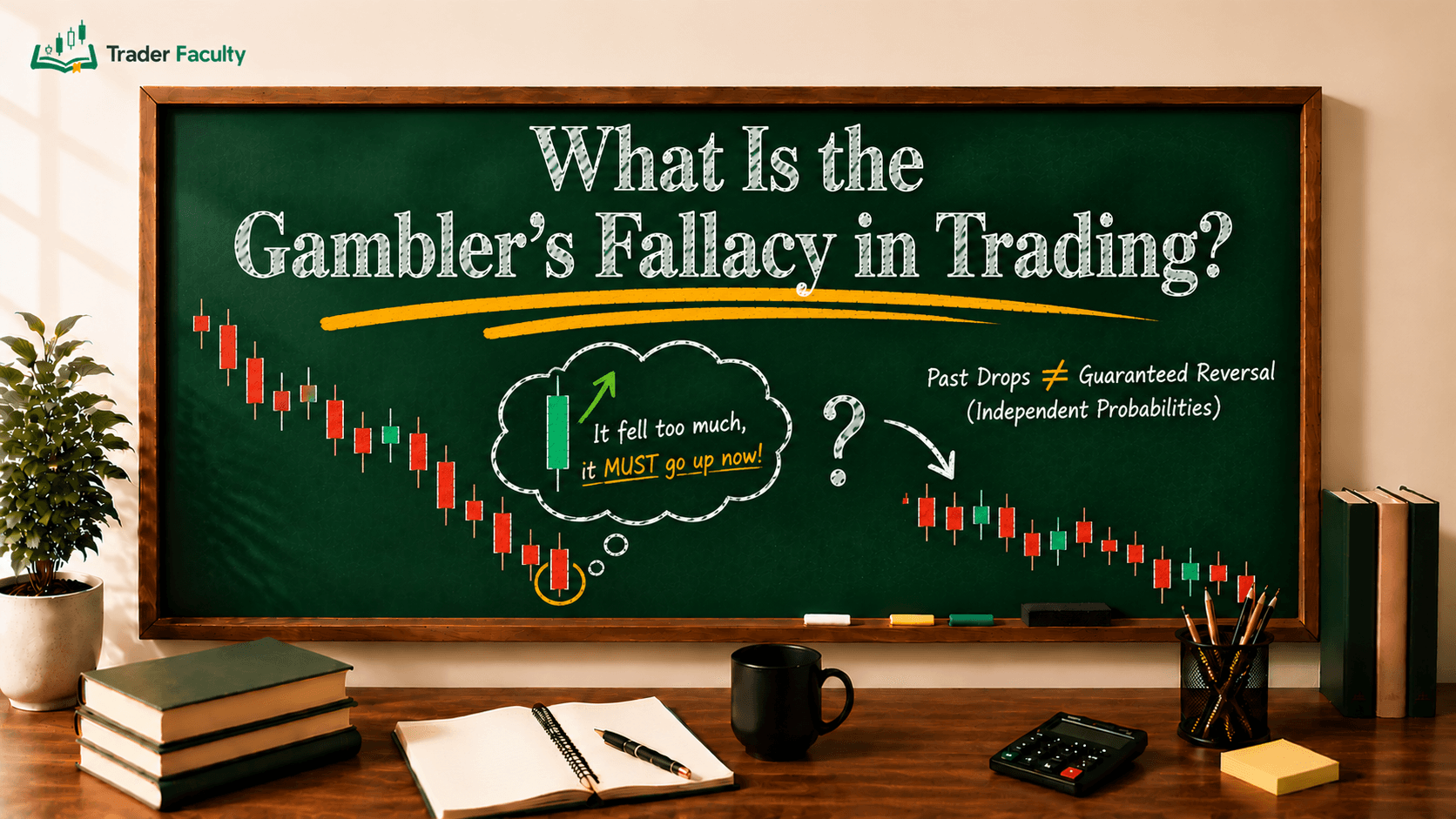
By using preset risk controls, hard stop-loss orders, and objective price structures instead of floating P&L, you can reduce the pull of psychological price anchors. This guide is educational, not financial advice, and no technique removes the risk of loss. Continue building your psychological foundation with core concepts in trading psychology and avoiding related cognitive pitfalls like the gambler's fallacy.
Frequently Asked Questions
What is a common example of anchoring bias in trading?
A classic example is buying a stock at $100, watching it drop to $80, and refusing to sell because you're waiting for it to return to $100 so you can break even. The entry price acts as an anchor that keeps you from judging current risk objectively.
How does anchoring bias differ from confirmation bias?
Anchoring occurs when a trader fixates on a specific number, such as an entry price or 52-week high, when judging value. Confirmation bias (seeking out information that supports your existing position while ignoring conflicting evidence) is different: it's about which information you look for, not which number you cling to.
Why do traders anchor to their entry price?
Traders often anchor to entry prices because of loss aversion, the tendency to feel the pain of a loss more strongly than the pleasure of an equivalent gain. Fixating on the entry price lets a trader treat a floating loss as temporary until it's realized.
Can technical indicators create price anchors?
They can if you rely on static levels or old reference points too rigidly. Tools like moving averages or volume profiles update with market data, while psychological anchors are personal reference points that have nothing to do with market mechanics.
What is the most effective way to reduce anchoring?
You can't remove cognitive biases completely, but preset risk controls such as stop-loss orders placed at entry can reduce mid-trade negotiation with yourself. Reviewing charts without your account profit-and-loss balance in view can also help you stay objective.
Keep learning
Trader Mindset
Strategy is the easy part. Sticking to it is the hard part.
6 lessons quiz
Start Trader MindsetThe Trader Faculty Team writes and reviews every guide together — pairing hands-on market experience with a curriculum-first approach to trading education. One good syllabus, taught in the order that makes you better.