Trade Management: How to Control Open Positions
Learn how trade management protects open trades using stop-loss, trailing stop, and scaling rules. Read the full guide.
By Trader Faculty Team
Direct Answer
Trade management covers every rule and action a trader uses to monitor, adjust, and close an active position after an entry order fills. It includes setting initial stop-loss and take-profit levels, using break-even or trailing stops, and deciding whether to scale in or out as price moves. Clear exit rules help keep emotions out of live trading, though no order type can prevent slippage or overnight price gaps.
Trade management is the set of rules and actions you use to control an open trade from the moment your order fills until the position closes.
Many beginners spend hours finding a good entry, only to freeze or improvise once real money is on the line. Fear makes them close winners too early, while hope tempts them to widen a stop-loss when price moves against them. This guide covers the core tools for controlling open positions, how active and passive styles compare, and the costly mistakes you need to avoid.
Quick Takeaways
- Pre-trade planning decides your position size and entry, while trade management controls what happens after the trade is live.
- Moving a stop-loss to break-even or taking partial profits reduces open risk, but both trade-offs can cut your average winner short.
- Stop orders don't protect against overnight price gaps or slippage in fast or low-liquidity markets.
- Writing down your exit rules before you enter a trade can help reduce emotional tinkering when price moves.
What Is Trade Management in Trading?
Trade management is everything you do to monitor, adjust, and exit an active position after your entry order executes.
Traders often mix up pre-trade planning with live position control. Pre-trade risk management happens before you click buy or sell — it includes choosing your setup, calculating your position size, and setting your maximum dollar loss. Trade management, by contrast, begins the second your trade opens, focusing on how you protect capital and capture gains as price moves.
Think of pre-trade planning like mapping out a flight route before takeoff. Managing the live trade is how you adjust altitude and fuel once you are in the air and facing real weather. You can't control where the market goes next, so your job is to follow clear rules for how you respond to price movement.
Core Trade Management Tools and Order Types
Traders use specific order types and position adjustments to limit downside exposure and lock in open gains. Every tool solves one problem while creating a new trade-off.
Stop-Loss and Take-Profit Orders
A stop-loss is an automatic order that closes your trade if price hits a preset loss level. A take-profit is a limit order (an order to buy or sell only at a specific price or better) that closes your trade at a preset gain.
These two orders form the foundation of exit control, yet they behave differently under pressure. According to FINRA, a stop order converts into a market order once the stop price is reached, meaning your actual fill price can be worse during fast swings or overnight price gaps. In low-liquidity markets (markets with few active buyers and sellers), slippage — the gap between your expected price and your actual fill price — can turn a small planned loss into a larger one.
Break-Even Stops
A break-even stop means moving your stop-loss from its original loss level to your exact entry price once price moves in your favor.
The upside is peace of mind: if price reverses, you exit near zero instead of taking a full loss. The trade-off is that normal price noise often dips back to your entry point before the main trend continues. Moving your stop to break-even too soon frequently knocks you out of trades that would have hit your target.
Trailing Stops
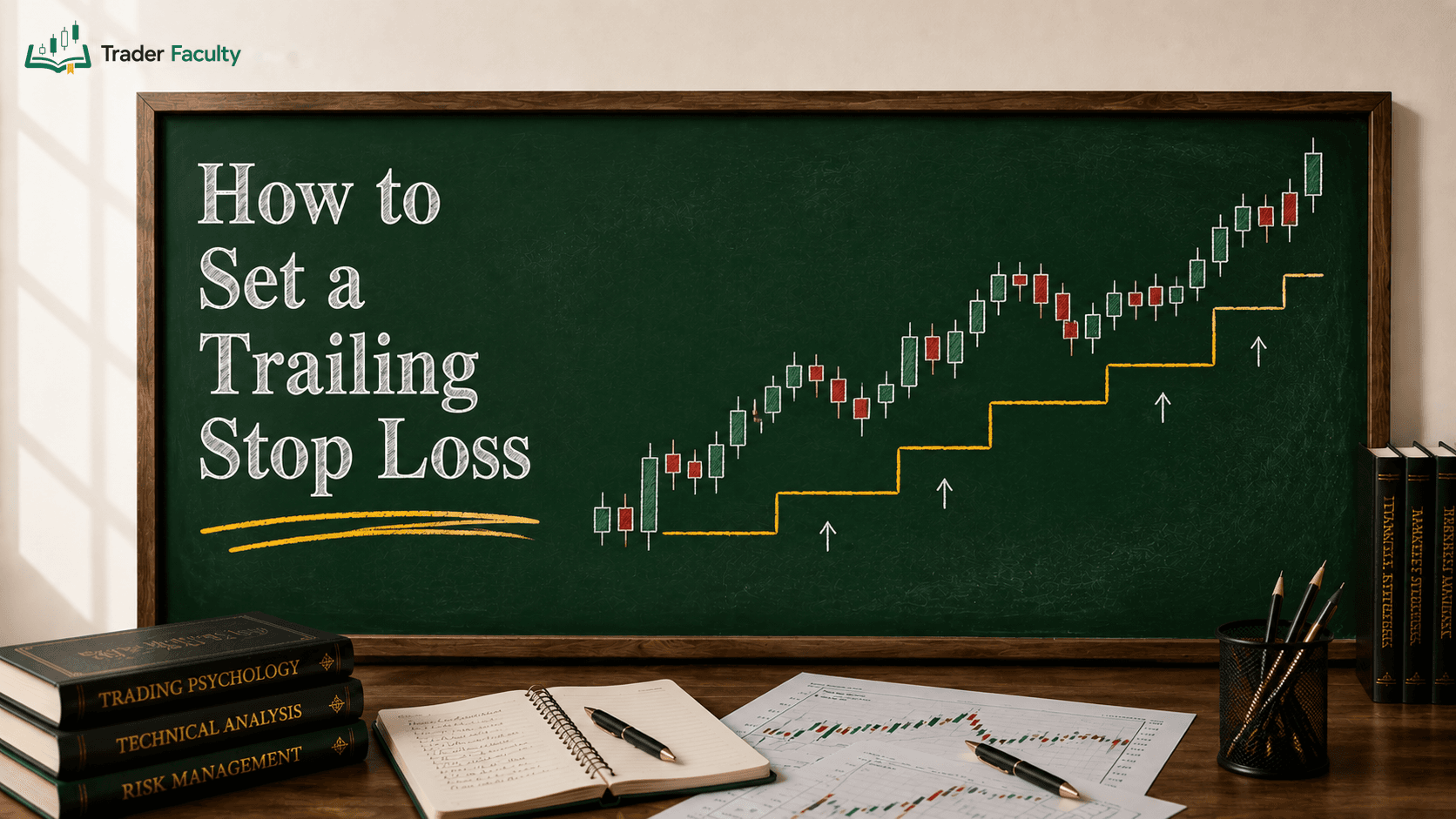
A trailing stop is a dynamic stop-loss order that follows price at a set distance or chart level as the trade moves in your favor, but stays locked in place if price pulls back.
Trailing stops let you stay in strong trends without capping your upside at a fixed target. However, in choppy, sideways markets, a tight trailing stop gets triggered easily by routine price swings. Like standard stop orders, a trailing stop is still vulnerable to price gaps.
Scaling Out and Scaling In
Scaling out means closing part of your open position at an initial profit target while leaving the rest open to run. Scaling in means adding more size to an existing position as price confirms your direction.
Scaling out puts real money in your account early and lowers the stress of holding a full position. The catch is mathematical: you cut your position size right before the biggest part of the move happens, which shrinks your average winning trade. Scaling in increases your profit potential on strong trends, but adding size also raises your risk if price suddenly reverses.

Active vs. Set-and-Forget Trade Management
Traders generally handle open positions in one of two ways: leaving initial orders untouched or adjusting them as new price data arrives.
Neither style is automatically better. Your choice depends on your strategy timeframe, market volatility (how fast and far prices swing), and how well you handle watching live price movement.
| Approach | How It Works | Key Trade-Off |
|---|---|---|
| Set-and-Forget | You set your stop-loss and take-profit at entry and make zero changes until one triggers. | Removes emotional errors, but can't adapt if market conditions shift mid-trade. |
| Rule-Based Active | You adjust stops or scale out only when price hits pre-planned chart or risk milestones. | Balances protection with structure, though frequent adjustments can reduce net gains. |
| Discretionary Active | You judge price action in real time and exit or adjust based on live market feel. | Flexible in fast news environments, but carries the highest risk of impulse mistakes. |
Changing your position size mid-trade also changes the math behind your strategy. Models like the Kelly criterion calculate ideal stake sizes based on fixed win rates and reward-to-risk ratios (how much you aim to gain for each dollar you risk). When you repeatedly close winners early or alter your position size on the fly, your real-world reward-to-risk ratio shifts away from your tested numbers.
Step-by-Step: How to Build a Trade Management Plan
A reliable plan for open trades is written before you enter the market, not improvised while watching every price tick (the smallest upward or downward price movement of a market).
- Mark your invalidation point first. Decide the exact price level that proves your trade idea wrong, and place your initial stop-loss just beyond it before entering.
- Choose your exit method before entry. Decide whether you will use a fixed take-profit target, a trailing stop, or a mix of both based on how the market normally moves.
- Define any mid-trade triggers in advance. If you plan to move to break-even or scale out, tie that action to a clear milestone — such as price reaching a 1-to-1 or 2-to-1 reward-to-risk level — rather than a gut feeling.
- Step away between decision points. Once your orders are live, avoid staring at lower-timeframe charts (charts where each bar covers a short period, such as one minute) so you don't interfere with your own plan.
Common Trade Management Mistakes
Most open-trade failures happen when fear or greed overrides a pre-planned exit rule.
Widening your stop-loss is one of the fastest ways to damage an account. Moving a stop further away to give a losing trade more room turns a small, controlled loss into an oversized hit. If price reaches your invalidation level, the trade idea is wrong and should close.
Choking winners too early happens when you rush to move your stop to break-even or close the whole trade after a tiny gain. While locking in a small profit feels safe, cutting winners short leaves you with tiny gains that can't cover your normal losses over time.
Over-managing every price swing leads to constant tinkering. Watching one-minute candles (bars that each cover one minute) on a swing trade (a trade held for days or weeks) tricks you into reacting to random noise instead of the bigger trend.
Conclusion
Strong trade management turns a messy, emotional process into a repeatable routine once a position is open, because pre-planned stop-loss and target rules can help you avoid widening losses or cutting good trades short. Remember that every exit tool carries a trade-off between locking in gains and giving a trade room to breathe, and no stop order can prevent price gaps. To see how live position control fits into your wider account protection rules, explore our complete guide to risk management in trading. Trading always carries the risk of losing money, so treat everything in this guide as educational information rather than financial advice.
Frequently Asked Questions
What is the difference between risk management and trade management?
Risk management happens mostly before you enter a trade, covering account limits, setup selection, and position sizing. Managing the trade begins the moment your order fills and focuses on how you monitor, adjust, and exit that live position. Both work together to protect your capital from unexpected market swings.
Should I move my stop-loss to break-even?
Moving a stop-loss to your entry price can reduce open downside risk if price reverses, which gives many traders peace of mind. However, moving it too early often causes routine price swings to knock you out of winning trades before they reach your target. Always tie break-even moves to a clear chart level or reward-to-risk milestone.
What is scaling out in trading?
Scaling out means closing part of your open position at an early profit target while leaving the rest open to capture a larger move. It locks in partial gains and lowers stress, but it also shrinks your position size before the biggest price move happens, reducing your average winner.
Is set-and-forget better than active trade management?
Neither approach is universally better. Set-and-forget trading leaves your initial stop-loss and take-profit untouched, which prevents emotional mistakes during normal price noise. Active management adjusts exits based on pre-planned market milestones, which works well in trending markets if you follow strict rules instead of impulse.
Why is over-managing trades bad for performance?
Watching every small price tick often triggers fear and greed, causing traders to close winning trades too early or widen stop-loss orders on losing trades. Over time, cutting winners short and letting losers grow breaks your strategy's reward-to-risk math even when your initial entries are solid.
Keep learning
Risk & Money Management
One good article won't save your account. A risk framework will.
7 lessons quiz
Start the courseThe Trader Faculty Team writes and reviews every guide together — pairing hands-on market experience with a curriculum-first approach to trading education. One good syllabus, taught in the order that makes you better.