What Is an Order Book? How Market Depth Works
Learn what an order book is and how exchange market depth reveals live buyer and seller demand. Read the full guide.
By Trader Faculty Team
Direct Answer
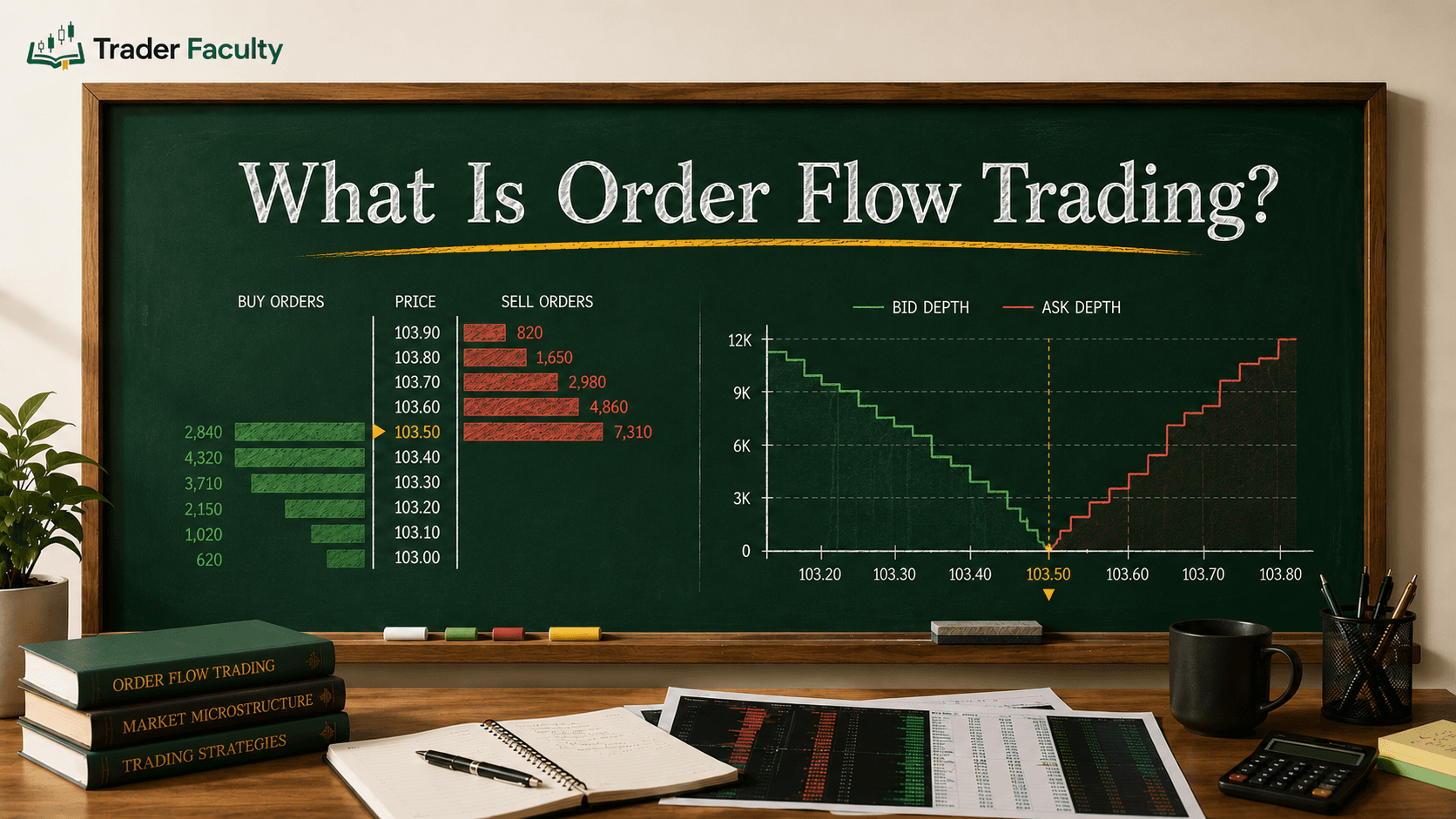
An order book is a real-time electronic ledger managed by a financial exchange that displays all active buy limit orders (bids) and sell limit orders (asks) for a specific asset, organized by price level. It enables traders to measure Depth of Market liquidity, analyze live supply and demand, and observe how price-time priority matching algorithms execute trades.
An order book is an exchange's real-time electronic ledger that lists all active buy and sell limit orders for a specific financial asset, organized by price level. It displays the exact quantities traders are willing to trade at specific price points.
Watching line charts or candlestick patterns shows you where price has been, but it doesn't tell you much about where market liquidity sits right now. Many new traders place trades without realizing that price moves only when resting buy and sell orders get filled. Understanding how bids, asks, and market depth fit together helps you see real-time supply and demand dynamics before you place an order.
Quick Takeaways
- Order books show resting limit orders, dividing market interest into buy orders (bids) and sell orders (asks).
- Market orders execute instantly against resting limit orders, consuming liquidity from the top of the book.
- The gap between the highest bid and the lowest ask is the bid-ask spread, which measures market tightness.
- Displayed liquidity can change in milliseconds because traders can modify or cancel limit orders before execution.
What Is an Order Book?
An order book is a continuously updated database managed by an exchange matching engine. Whether you trade stocks, futures, or cryptocurrency, every public exchange relies on an order book to collect, organize, and match trade requests from market participants around the world.
The book divides market liquidity into two distinct sides:
- Bids (Buy Side): Represents all open limit orders from buyers. Bids sit on the left side (or lower section) and are ranked from the highest price a buyer is willing to pay down to lower prices.
- Asks or Offers (Sell Side): Represents all open limit orders from sellers. Asks sit on the right side (or upper section) and are ranked from the lowest price a seller is willing to accept up to higher prices.
- Order Size: The total number of shares, contracts, or coins available at each price level.
When looking at price data, traders choose between two detail levels. Level 1 data shows only the highest bid and the lowest ask, often called the top of the book. Level 2 data, also known as Depth of Market (DOM), displays multiple price levels above and below the current price, revealing the full stack of resting orders.
How an Order Book Works: The Matching Engine
An exchange matching engine processes incoming orders using fixed mathematical rules. To understand how price moves, you must distinguish between two basic market roles: liquidity providers and liquidity takers.
Limit orders act as liquidity providers. When you place a limit order, your trade sits in the order book until another trader agrees to transact at your chosen price. Market orders act as liquidity takers. When you submit a market order, you instruct the exchange to execute your trade instantly at the best available price currently resting in the book.

Exchanges execute trades using a system called price-time priority. This algorithm follows two main steps:
- Price Priority: The highest bid price and the lowest ask price always get filled first.
- Time Priority: If multiple traders place orders at the exact same price level, the order that arrived first gets executed first.
The difference between the lowest ask price ($100.01 in the table above) and the highest bid price ($100.00) is the bid-ask spread. In this case, the spread is $0.01. Highly liquid markets feature tight spreads with large quantities at every price level, while illiquid markets suffer from wider spreads and thin order depth.
Reading Order Flow and Market Depth

Order flow refers to the continuous stream of incoming buy and sell transactions as they hit resting orders in the book. While the static order book shows resting limit orders waiting to be filled, order flow tracks active market orders taking liquidity in real time.
Combining market depth with live order flow helps traders spot immediate supply and demand imbalances. For example, if large market buy orders rapidly sweep through multiple ask levels while buyers rebuild higher bids, upward price momentum often follows.
Traders use specialized platforms to analyze these live liquidity stacks. Using chart software like TradingView lets you view Depth of Market ladders and depth charts directly beside price action, making it easier to track changes in bid and ask volume as key technical levels are tested.
What the Order Book Shows — and What It Misses
While market depth provides valuable visibility, relying solely on displayed order volumes can lead to false assumptions. The visible order book reflects public intentions, but it does not tell the full story of market liquidity.
| Visible Order Book Data | What the Order Book Misses |
|---|---|
| Resting public limit orders | Market orders executed instantly |
| Publicly displayed bid/ask volume | Hidden orders and iceberg orders |
| Active price levels and spreads | Dark pool liquidity and off-exchange trades |
| Real-time cancellations and additions | Off-book institutional block trades |
Centralized exchange rules enforced by regulators like the U.S. Securities and Exchange Commission require public display of open customer limit orders, but institutions often use specialized order types to limit market impact.
An iceberg order splits a large institutional trade into smaller visible pieces. For example, a firm wanting to buy 10,000 contracts might display only 100 contracts in the public book. As soon as that 100-contract piece fills, another 100 contracts reload automatically. A trader looking only at displayed depth would see a thin order book, unaware that massive buy demand sits behind the scenes.
Furthermore, large traders sometimes place big limit orders far above or below the market to create a false impression of support or resistance. They cancel these fake order walls right before price reaches them, a deceptive tactic known as spoofing.
Common Order Book Mistakes
Understanding market depth requires avoiding common beginner errors when interpreting live quotes:
- Assuming Order Walls Are Unbreakable: Big limit orders sitting in the book do not guarantee that price will bounce. Traders can cancel orders at any millisecond, and aggressive market orders can absorb large limit blocks fast.
- Confusing Resting Depth with Executed Momentum: High bid volume shows intent to buy at a specific price, but it does not mean aggressive buyers are actively driving price higher. Always check if market orders are filling those price levels.
- Ignoring Off-Peak Hours: Order books become thin during market closes or low-volume trading sessions. In thin markets, relatively small market orders can sweep through multiple price levels, causing sudden price slippage.
Conclusion
An order book gives you a transparent, real-time window into resting market supply and demand across exchange price levels. By showing where buyers and sellers place limit orders, market depth helps you evaluate market liquidity, monitor bid-ask spreads, and understand how matching engines process trades.
When combined with real-time order flow analysis, market depth reveals how aggressive market orders interact with resting limit depth. Remember that displayed orders can be canceled instantly and iceberg orders hide true trade size behind public quotes.
As you expand your overall set of trading tools, combining order book context with sound risk management will help you make more informed entry and exit decisions. Trading financial markets always carries the risk of losing capital, so treat order book reading as an educational tool to enhance your market understanding rather than a standalone trading guarantee.
Frequently Asked Questions
How do you read an order book?
Reading an order book involves reviewing two main sections: bids on the buy side and asks on the sell side. Bids are ranked from the highest price buyers are willing to pay down, while asks are ranked from the lowest price sellers will accept up. Comparing the volume of orders at each price level shows relative market depth and potential supply or demand imbalances.
What is the difference between bid and ask in an order book?
The bid represents the highest price a buyer is currently willing to pay for an asset, whereas the ask (or offer) is the lowest price a seller is willing to accept. The difference between these two figures is known as the bid-ask spread. Tight spreads typically signal high market liquidity, while wide spreads indicate lower liquidity and higher potential transaction costs.
What is Depth of Market (DOM)?
Depth of Market (DOM), also called Level 2 market data, is a visual tool that displays the cumulative volume of resting limit orders sitting at price levels above and below the current market price. DOM ladders help traders evaluate where major liquidity rests, allowing them to gauge immediate supply and demand depth beyond top-of-book prices.
What is order flow in trading?
Order flow is the continuous sequence of market orders executing against resting limit orders in the order book. While the static order book displays orders waiting to be filled, order flow tracks aggressive, live transactions as they take liquidity in real time. Analyzing order flow helps traders identify buying or selling momentum as trades execute.
Can an order book be manipulated by fake orders?
Yes, traders can be misled by large resting limit orders that are placed with no intention of execution. This deceptive practice, known as spoofing, involves stacking large order walls to create a false impression of support or resistance. Manipulative traders cancel these orders right before price reaches them, causing sudden market shifts.
Keep learning
Setting Up Your Trading Setup
Set up your broker, platform, and demo the right way.
8 lessons quiz
Set up your toolsThe Trader Faculty Team writes and reviews every guide together — pairing hands-on market experience with a curriculum-first approach to trading education. One good syllabus, taught in the order that makes you better.