How Confirmation Bias Affects Trading: Examples and Fixes
Learn how confirmation bias distorts chart analysis and trade management. Discover 4 practical fixes. Read the full guide.
By Trader Faculty Team
Direct Answer
Confirmation bias in trading is the psychological tendency to seek out, interpret, and remember market data that supports a pre-existing trade thesis while ignoring contradictory risk signals. This cognitive pattern leads traders to alter technical parameters, ignore stop-loss levels, and hold losing positions. It is managed through systematic rule enforcement, objective journaling, and structured pre-trade audits.
The standard confirmation bias definition describes the psychological tendency to seek, interpret, and recall information in a way that confirms your pre-existing beliefs or hypotheses.
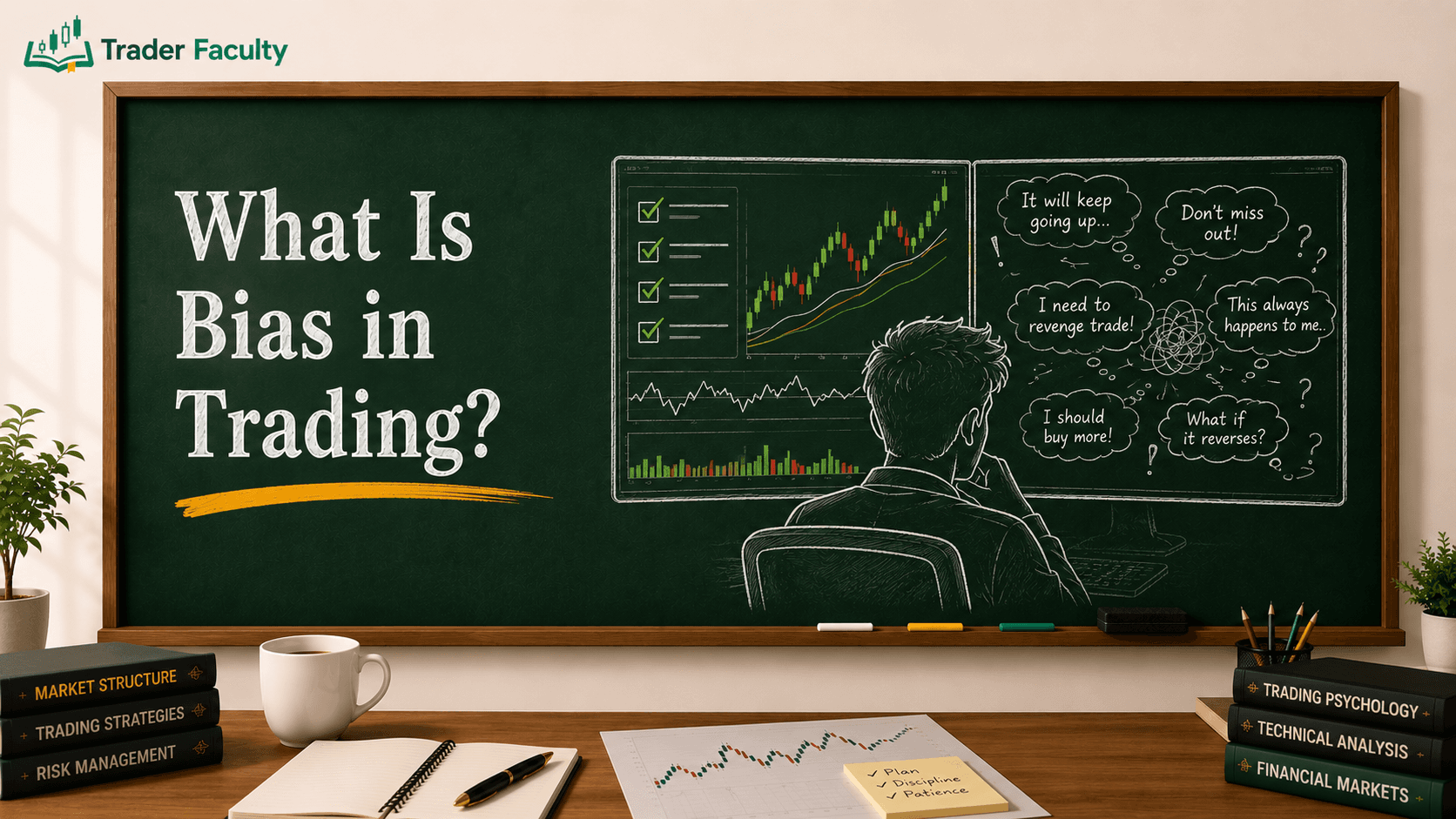
In financial markets, this cognitive habit poses a constant threat to capital. Traders often form a market bias—whether bullish or bearish—and then spend their time gathering evidence to prove themselves right. Instead of evaluating price action neutrally, they filter out valid risk signals and double down on flawed positions.
Understanding how trading psychology influences decisions is essential for long-term consistency.
Quick Takeaways
- This bias leads traders to seek out information that agrees with their existing trades while ignoring warning signs.
- Selective data filtering, indicator tweaking, and social media echo chambers are common ways this bias corrupts market analysis.
- Overcoming this psychological trap requires systematic rules, active search for disconfirming evidence, and pre-defined execution plans.
- Neutralizing bias doesn't eliminate market risk, but it builds a disciplined, repeatable trading process.
What Is Confirmation Bias in Trading?
It occurs when a trader selectively processes market data to support a current trade or opinion, while ignoring or discounting evidence that contradicts it.
The concept originates from cognitive psychology and was notably demonstrated by Peter Wason in 1960, as summarized in Britannica's overview of Wason's research. Wason showed that people naturally test their ideas by looking for proof they're right, rather than trying to prove themselves wrong.
In a trading context, this bias manifests across three distinct behavioral stages:
- Selective Gathering: Searching only for headlines, analyst views, or indicators that align with your open position.
- Selective Interpretation: Reading ambiguous price action or neutral news events as strong bullish or bearish proof.
- Selective Recall: Remembering past winning trades where you held through a drawdown (a drop from your account's peak value), while forgetting the times that same behavior wiped out your account.
When this bias takes over, chart analysis becomes an exercise in self-justification.
How Confirmation Bias Corrupts Trading Decisions
The bias rarely presents as an obvious mistake. Instead, it subtly creeps into daily technical and fundamental workflows, warping how you view market structure.
1. Indicator Cherry-Picking and Timeframe Manipulation
When a trade moves against you, the bias prompts you to look for a reason to stay in the position. You might switch from a 15-minute chart where price is breaking down to a 4-hour chart that still shows a long-term uptrend. If your primary oscillator (a momentum indicator that moves between set high and low levels) shows an oversold signal, meaning selling may be overdone, you might ignore three other momentum tools showing a strong breakdown. Traders often cycle through indicators until they find the single tool that offers a "buy" or "sell" signal matching their desired bias.
2. Social Media Echo Chambers
Modern trading platforms and social media groups accelerate psychological bias. A trader stuck in a losing long trade will often visit forums like X, Reddit, or Discord to find other traders who are also bullish. Surrounding yourself with agreeing voices creates a false sense of security. It replaces objective risk management with crowd validation.
3. Filtering Fundamental News
When fundamental data releases contradict an open trade, biased traders quickly dismiss the information. A negative earnings report or rate decision gets brushed aside as "priced in" or "manipulated by institutions." Meanwhile, a minor positive headline is treated as definitive proof that the original trade thesis is correct.

Confirmation Bias Examples in Real Trading
Examining how this bias plays out in practical scenarios highlights how easily it distorts execution.
Example 1: The Stubborn Bull
Imagine a trader who buys an asset at $100 based on a clean breakout. Shortly after entry, unexpected economic data drops, and price falls back below support to $92. A disciplined rule set dictates taking a small loss at $95.
Instead, the trader begins searching online for bullish commentary. They find a blog post predicting a long-term target of $150. Focusing entirely on this single optimistic forecast, the trader ignores the broken technical levels and holds through a deeper drop to $70. The desire to be right overrides the rule to protect capital.
Example 2: Curve-Fitting Technical Analysis
Consider a technical trader using moving averages to guide trend entries. After entering a short position, price moves upward against the entry point. To avoid admitting the setup failed, the trader adjusts the length of their moving average from 20 periods to 50 periods, and then to 200 periods.
Because the market was in a longer-term downtrend, the 200-period line still sits above the current price, so the rally now looks like it's "testing resistance" rather than breaking out. By altering the parameters mid-trade, the trader invents a justification to stay in a losing position.
4 Practical Strategies to Reduce Confirmation Bias
Removing this bias completely is difficult because it is a natural human cognitive trait. However, you can build structural guardrails into your trading process to neutralize its effect on your capital.

1. Build a "Devil's Advocate" Checklist
Before opening any position, force yourself to write down three reasons why the trade could fail. If you are looking to go long, actively look for key resistance levels, bearish chart patterns, or negative fundamental drivers. If you can't find valid counter-arguments, you're likely not looking hard enough. Studying classic trading psychology books can help you learn how professional managers structure these objective pre-trade audits.
2. Pre-Define Hard Exit Rules
One of the riskiest times to analyze a market is when you already have money on the line. Emotions distort perception. Define your exact entry price, stop-loss level, and profit target before placing the order. Once the trade is live, execute strictly according to those parameters without changing indicators or timeframes mid-trade.
3. Maintain a Process-Oriented Journal
Keep a record of your trading rationale, including chart screenshots at the moment of entry. Document why you entered, what risk signals were present, and whether you followed your plan. Reviewing your trades weekly allows you to spot patterns of bias—such as moving stop-losses or ignoring counter-signals—and correct them systematically.
4. Implement a Media Blackout During Live Trades
Once you enter a position, close social media feeds, chat rooms, and public forums. Focus exclusively on objective price action relative to your pre-planned levels. Removing external noise prevents you from seeking crowd validation when price fluctuates.
Common Beginner Pitfalls Related to Cognitive Bias
Beginner traders often confuse confirmation bias with healthy trading conviction.
| Factor | Healthy Conviction | Biased Thinking |
|---|---|---|
| What it's based on | A tested edge and predefined risk limits | Ego and emotional attachment |
| When you hold the trade | Through normal market noise | Through objective structural failure |
| How you treat new data | Weigh it against your plan | Filter out anything that disagrees |
Another common pitfall is doing research after entering a trade. Unbiased market research happens before capital is committed. Searching for news or analyst projections after you are already positioned almost always leads to selective gathering.
Conclusion
Confirmation bias isn't a personal failure; it's a default human cognitive trait designed to avoid emotional discomfort. In financial markets, however, seeking comfort over reality leads to mismanaged risk and severe drawdowns. By building rule-based entry models, actively looking for reasons your trade could fail, and sticking to strict trade management rules, you can protect your capital from subjective bias.
Frequently Asked Questions
What is confirmation bias in simple terms?
In plain terms, the confirmation bias meaning is the natural human habit of focusing only on information that agrees with your current belief while ignoring evidence that proves you wrong.
What is a real-world example of confirmation bias in trading?
A common example occurs when a trader holds a losing position past their stop-loss level and begins searching social media forums or news feeds specifically for optimistic opinions. By fixating on a single bullish commentary while ignoring broken technical support, the trader rationalizes staying in a losing trade.
How does confirmation bias differ from cognitive dissonance?
Cognitive dissonance is the mental discomfort felt when holding two conflicting beliefs or encountering data that contradicts your position. The bias acts as a coping mechanism that resolves that discomfort by filtering out the conflicting data so you can maintain your original belief.
Can technical analysis prevent confirmation bias?
Technical analysis alone does not prevent it because traders often manipulate indicators, adjust chart timeframes, or redraw trendlines until the chart matches their desired outlook. Preventing bias requires strict, pre-defined trading rules rather than flexible chart interpretation.
What is the most effective way to reduce confirmation bias?
One widely used approach is a "Devil's Advocate" checklist that you complete before entering a trade. By forcing yourself to identify three valid technical or fundamental reasons why the trade could fail, you counteract the cognitive tendency to look only for supporting evidence.
Keep learning
Trader Mindset
Strategy is the easy part. Sticking to it is the hard part.
6 lessons quiz
Start Trader MindsetThe Trader Faculty Team writes and reviews every guide together — pairing hands-on market experience with a curriculum-first approach to trading education. One good syllabus, taught in the order that makes you better.