What Are Maker Taker Fees? How Exchange Pricing Works
Learn what maker taker fees are, how order types trigger them, and how to manage trading costs. Read the full guide.
By Trader Faculty Team
Direct Answer
Maker taker fees are a two-tier exchange pricing structure that rewards orders adding liquidity to the order book with lower fees or rebates, while charging higher fees to orders that immediately remove liquidity. Whether you pay the maker or taker rate depends on how your order executes on each trade rather than your account type.
Maker taker fees are a pricing model that trading venues use to charge lower fees, or occasionally pay small rebates, to orders that add liquidity to the order book. Orders that remove liquidity immediately pay higher fees.
If you've ever placed two same-size trades on one platform and noticed that one cost noticeably more in fees, you've seen this model in action. Understanding how maker taker fees work helps you control your transaction costs, avoid accidental overcharges, and choose the right order type for your goals. Below, you'll learn how liquidity drives exchange pricing, why certain limit orders still pay taker fees, and how to calculate the real cost of your trades.
Quick Takeaways
- Your order behavior on each individual trade—not your account type—determines whether you pay the maker or taker fee.
- Maker orders sit on the order book waiting to be filled, which adds liquidity and earns a lower fee rate.
- Taker orders match immediately against existing orders on the book, removing liquidity and triggering a higher fee.
- A limit order priced at or better than the current market price fills right away and is charged the taker fee, not the maker fee.
- Chasing small maker fee discounts with slow-filling orders can cause you to miss fast-moving trades altogether.
What Are Maker Taker Fees?
Maker taker fees are the two-tier transaction charges that electronic exchanges apply based on whether your order adds depth to the market or takes existing depth away. To understand why these two fees exist, you first need to see how an electronic order book (the live digital list of all open buy and sell orders for an asset) works.
Every active market relies on liquidity, which measures how quickly and easily you can buy or sell an asset without causing a sharp jump in its price. Exchanges need a deep pool of open buy and sell orders so traders can enter and exit positions smoothly. To encourage traders to post those waiting orders, venues split participants into two roles on every single trade:
- Market makers: You act as a maker when you place an order that does not execute right away. Instead, your order rests on the order book, adding a new price and quantity for other traders to match against later.
- Market takers: You act as a taker when you place an order that matches immediately with an order already sitting on the book, removing that available supply or demand from the market.
Think of it like a local farmers' market. A farmer who sets up a stall and displays apples with a price sign is making the market—without that stall, no one could shop. A customer who walks up, grabs a bag of apples, and pays the listed price is taking from the market. Because the exchange wants plenty of stalls stocked with goods, it rewards the maker with a discount and charges the taker a convenience fee for instant service.
How Maker and Taker Orders Work (Maker Taker Fees Explained)
The order type you select when placing a trade and the price you set decides whether your order rests on the book as a maker or executes immediately as a taker. You don't apply for a "maker account" or a "taker account"; you can be a maker on your morning trade and a taker on your afternoon trade.
Here is how the two main order types interact with maker taker fees explained in practice:
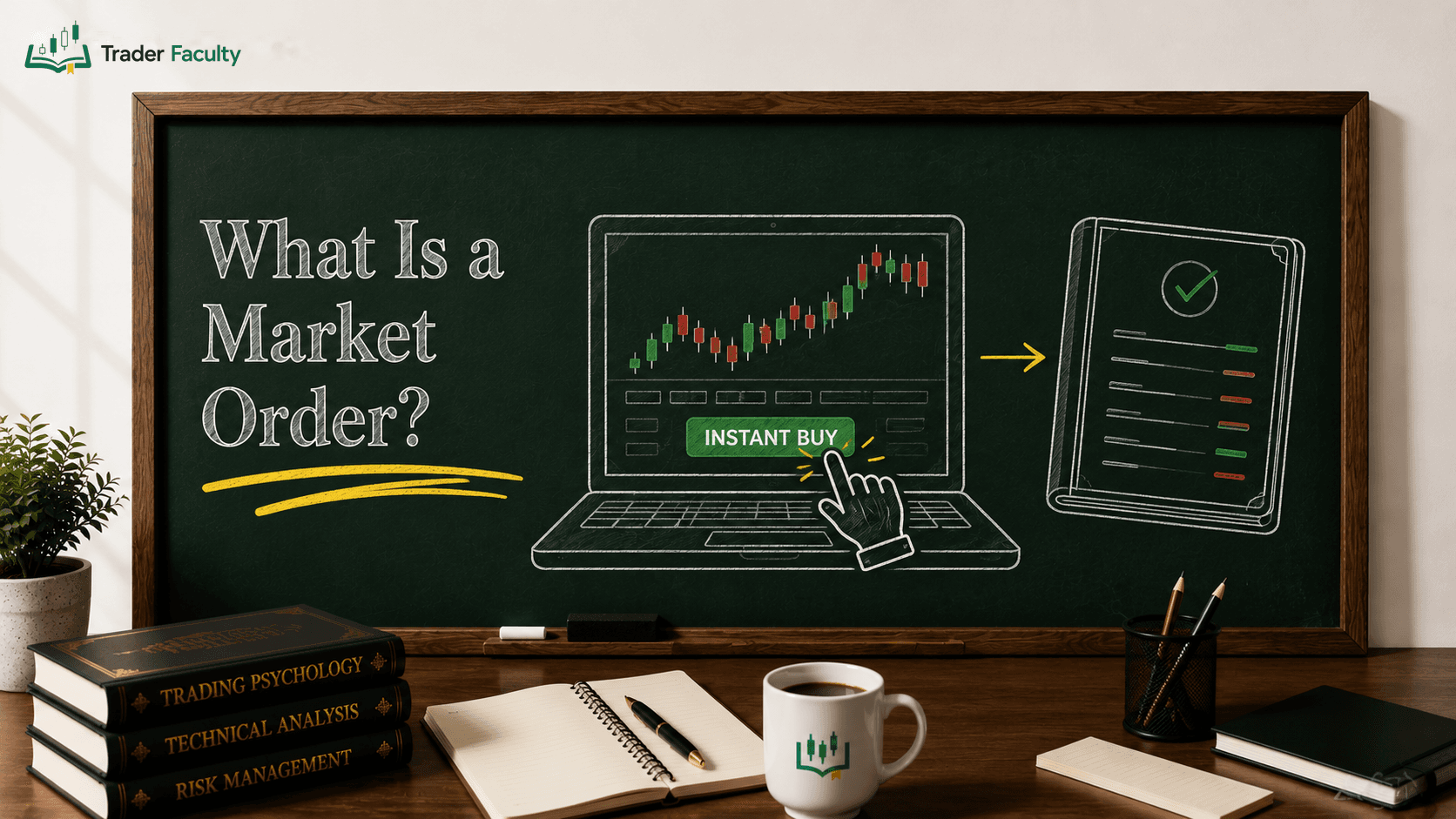
- Market orders always pay the taker fee: A market order (an instruction to buy or sell immediately at the best available current price) fills right away. To do that, it crosses the bid-ask spread (the gap between the highest price a buyer will pay and the lowest price a seller will accept). Because it removes resting orders from the book, a market order is always a taker order.
- Resting limit orders pay the maker fee: A limit order (an instruction to buy or sell only at your chosen price or better) becomes a maker order when you price it away from the market. For example, if a stock or coin is trading at $50.00 and you place a limit buy order at $49.50, your order can't fill yet. It sits on the order book waiting for price to drop, adding liquidity.
- Marketable limit orders pay the taker fee: Many beginners assume every limit order automatically qualifies for the lower maker rate. That's false. If an asset is trading at $50.00 and you place a limit buy order at $50.10—or right at the lowest current seller's price of $50.00—your order matches instantly against existing sellers. Because it fills immediately and removes liquidity, the exchange charges you the taker fee.
Some electronic venues offer a "post-only" option on limit orders. If you turn on post-only, the exchange will automatically cancel your order rather than fill it immediately as a taker, protecting you from accidentally paying the higher rate.
Maker vs. Taker Fees: Side-by-Side Comparison and Real Dollar Math
Comparing maker and taker charges side by side shows how even a tiny percentage difference adds up over dozens of trades. While exact schedules vary widely across exchanges, brokers, and asset classes, the structural trade-off remains the same.
| Feature | Maker Order | Taker Order |
|---|---|---|
| Order Book Effect | Adds liquidity (rests on book) | Removes liquidity (fills instantly) |
| Typical Order Type | Resting limit order | Market or marketable limit order |
| Cost & Speed Trade-Off | Lower fee, but risk of non-fill | Higher fee, but immediate fill |
To see how this affects your balance, imagine a $10,000 purchase on a spot exchange that charges a hypothetical 0.10% maker fee and a 0.20% taker fee. These rates are examples, not a quote from any exchange:
Maker Fee = $10,000 × 0.0010 = $10.00
Here, your trade size of $10,000 is multiplied by the 0.10% maker rate (0.0010), costing you $10.00 to open the position.
Taker Fee = $10,000 × 0.0020 = $20.00
Here, the same $10,000 trade size is multiplied by the 0.20% taker rate (0.0020), costing you $20.00—twice as much for the exact same position size.
If you enter and exit that $10,000 trade using taker orders both ways, your round-trip cost is $40.00. Using resting maker orders both ways cuts your round-trip cost to $20.00. On some stock exchanges, high-volume makers even receive a maker rebate, a small cash payout per share that's typically funded by the fees takers pay. Nasdaq's published trading price list shows these add-liquidity rebates and the volume tiers behind them.
Many retail stock brokers advertise zero-commission trading by routing orders through wholesalers via payment for order flow (compensation a broker receives for directing client orders to a specific market maker). That means retail traders usually don't see direct exchange maker-taker fees on their statements.
Why Exchanges Use Maker-Taker Pricing
Exchanges use maker-taker pricing because deep, active order books attract more traders and keep markets orderly. When makers are rewarded with lower fees, they compete to post buy and sell orders closer to the current market price. That competition narrows the bid-ask spread and reduces slippage—the difference between the price you expect when placing an order and the actual price at which your trade fills.
Most electronic exchanges also layer volume tiers on top of their base maker-taker schedule. Under this system, the venue tracks your trading volume over a set period, often a month. As your volume crosses higher thresholds, both your maker fee and your taker fee can drop. A new retail trader might pay a hypothetical 0.10% maker and 0.20% taker, while a high-volume firm might pay far less.
Common Maker-Taker Fee Mistakes Beginners Make
Trying to save money on fees without understanding order execution can easily cost you more than the fee discount itself. Keep an eye out for three common traps when managing your order costs:
- Assuming every limit order gets the maker rate: Placing a limit buy order above the current market price guarantees you will not pay more than your limit, but it fills immediately against resting sellers. Always check where the current best bid and ask sit before expecting a maker fee.
- Chasing a tiny fee discount while missing a fast move: If price is rising fast, a resting limit order below the market may never fill. You'd save about $10 in taker fees but miss the move. Saving 0.10% in fees means nothing if you miss a 5% move, or end up chasing the price higher out of frustration.
- Ignoring round-trip fees on short-term trades: If you trade often for small price targets, taker fees on both entry and exit can eat up a large share of your gross gain. Always include both sides in your break-even math.
Conclusion
Maker taker fees reward patience with lower costs while charging a premium for immediate execution, but neither role is automatically better. Resting maker orders help keep costs low when you can wait for price to come to you, while taker orders give you immediate entry or exit when speed matters more than the fee. Before placing your next order, decide whether your priority is price control or instant execution, and build your broader foundation step by step as you learn how to start trading. Trading always carries the risk of losing money, so treat everything in this guide as educational background for your own research rather than personal financial advice.
Frequently Asked Questions
What is the difference between maker and taker fees?
Maker fees apply when you place a resting order that adds new liquidity to an exchange's order book and waits to be filled. Taker fees apply when you place an order that matches immediately against an existing order on the book, removing liquidity. Because exchanges want deep order books, taker fees are almost always higher than maker fees.
Why are maker fees lower than taker fees?
Exchanges rely on resting limit orders to keep markets active and narrow the gap between buy and sell prices. By offering lower fees or small rebates to market makers, trading venues attract more waiting orders. Takers pay a higher fee in exchange for the convenience of immediate order execution at current market prices.
Does a limit order always get a maker fee?
No, a limit order only earns the maker fee if it sits on the order book before filling. If you set a limit buy price at or above the lowest current seller's price—or a limit sell price at or below the highest buyer's price—it executes immediately, removes liquidity, and incurs the taker fee.
What is a maker rebate in trading?
A maker rebate is a small cash payout or fee credit paid by certain exchanges to traders whose resting orders add liquidity to the book. Rather than paying a transaction fee, the maker receives a tiny fraction of a percent per trade, typically funded by the fees that market takers pay.
Are maker taker fees used in stocks or only crypto?
Maker taker pricing is used across many electronic markets, including stock exchanges, futures venues, and cryptocurrency exchanges. However, many retail stock brokers absorb or bypass direct exchange fee schedules through zero-commission routing models, so everyday stock traders often see maker-taker schedules most clearly on direct-access or crypto platforms.
Keep learning
Trading 101
Know the mechanics cold before you risk a single cent.
8 lessons quiz
Start Trading 101The Trader Faculty Team writes and reviews every guide together — pairing hands-on market experience with a curriculum-first approach to trading education. One good syllabus, taught in the order that makes you better.