What Is a Market Order? A Beginner's Guide to Instant Execution
Learn how market orders work, interact with order books, and how to avoid costly slippage traps. Read the full guide.
By Trader Faculty Team
Direct Answer
A market order is an instruction given to a broker to buy or sell a financial asset immediately at the best available current price. While it guarantees the trade will execute instantly, it offers no control over the final execution price. Traders use them when speed is prioritized over price precision.
A market order is an instruction to buy or sell a financial asset immediately at the best available current price. It prioritizes speed of execution over price control, ensuring your trade fills instantly.
Many beginners use market orders because they are simple, especially when trying to chase a fast-moving stock or crypto token out of fear of missing out. However, relying blindly on instant execution can lead to unexpected transaction costs. This guide covers how market orders interact with the order book, when to use them safely, and how to avoid costly execution traps within your Trading Foundations.
Quick Takeaways
- A market order ensures you enter or exit a trade instantly, but your final fill price may differ from the last quoted price.
- Market orders work best in highly liquid markets with tight spreads, whereas thin order books expose you to significant execution risks.
- Placing a market order requires crossing the bid-ask spread, which pays an immediate execution premium to buy at the ask or sell at the bid.
What Is a Market Order?
When you trade financial assets, you must decide what you care about more: getting the trade executed right now or getting a specific price. A market order chooses execution right now.
When you click "buy" or "sell" using a market order, your broker does not wait around for a better price. The order goes straight to the exchange and matches with whoever is standing at the front of the line ready to trade with you.
The primary advantage is certainty of execution. If you need to exit a losing position immediately to preserve capital, a market order is your fastest tool. The trade-off is that you forfeit control over the price. The price you see on your screen when you click the button is simply the last historical transaction; it is not a guarantee of your personal fill price.
How Market Orders Work: Inside the Order Book
To understand how market orders execute, you need to look behind the clean interface of your brokerage app and into the exchange order book. The order book is a live ledger containing two lists: buyers waiting at specific prices (bids) and sellers waiting at specific prices (asks).
Market orders do not wait in line; they actively consume the resting orders left by other traders.
- Market Buy Orders: Match instantly with the lowest available sell price (the Ask) in the order book.
- Market Sell Orders: Match instantly with the highest available buy price (the Bid) in the order book.

Asset class liquidity drastically alters this dynamic. In highly liquid environments—like major forex currency pairs or mega-cap tech stocks during regular trading hours—the difference between the bid and ask is tiny, often a fraction of a cent. In these markets, your market order fills almost exactly at the displayed price.
However, in thin environments like small-cap stocks or exotic altcoins, the order book is sparse. If you place a large market buy order, it will "eat" through the lowest ask, then the next highest ask, and continue upward until the entire order is filled. This forces your average entry price much higher than expected.
Market Orders vs. Pending Orders
As you develop different types of trading strategies, you will realize that market orders are only one tool in your execution toolkit. When you want to control your entry or exit price precisely, you turn to pending orders.
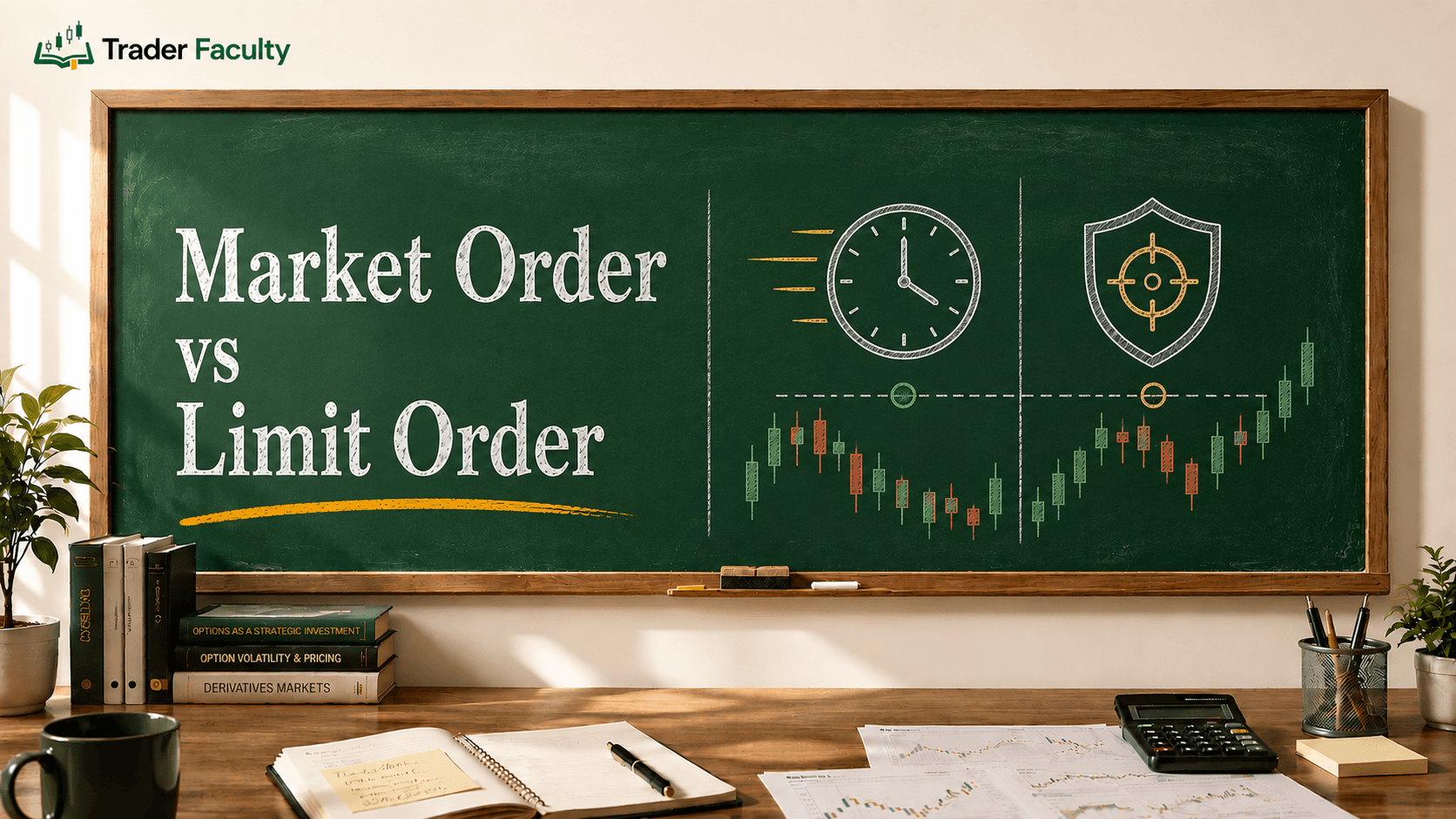
The most common alternative is a limit order, which instructs your broker to execute a trade only at a specific price or better. While a market order guarantees execution speed, a limit order guarantees price protection.
To understand the broader spectrum of pending orders, look at how traders map out their entries using a buy limit or a buy stop:
- Buy Limit: An order placed below the current market price. You use this when you believe the price will drop temporarily to a support level before bouncing back up.
- Buy Stop: An order placed above the current market price. You use this when you want to buy a breakout, entering the market only after the price proves it has upward momentum.
When comparing a buy limit vs buy stop, the core difference comes down to your structural approach to value: a limit order looks to buy a discount, while a stop order looks to buy confirmed market velocity.
Many traders also combine these pending order types into a single OCO order, which links a limit order and a stop order together so that filling one automatically cancels the other.
The Structural Risks: Slippage and Gaps
Because market orders prioritize immediate execution, they leave you fully exposed to structural market anomalies. The two most common risks are execution slippage and price gaps.
Understanding Slippage
If you use market orders during periods of low liquidity or high volatility, you will experience slippage in trading. Slippage is the difference between the price you expected to get based on your screen display and the actual price at which your trade executes.
If the market moves faster than your broker can route your order to the exchange, or if there are not enough resting limit orders to fill your position size at the current quote, your fill price slips to less favorable levels.
Market Gaps
Market gaps occur when an asset's price jumps directly from one quote to another without any trading occurring in between. This is frequent when regular stock market hours open after a weekend, or when major macroeconomic reports are released. If you leave a market order pending during a market close, or trigger one during a major news event, your order will execute at the first available price when trading resumes—even if that price is miles away from the previous close.
Common Market Order Pitfalls to Avoid
Execution mistakes are entirely structural and preventable if you follow a few basic operational rules.
- Trading the Open: The first 15 to 30 minutes of the stock market session are notoriously chaotic. Order flow is heavy, spreads are wide, and prices swing erratically. Avoid using market orders during the open; use limit orders to protect your execution capital.
- Illiquid Assets: Never use market execution on low-volume micro-cap stocks, out-of-the-money options options contracts, or minor crypto tokens. The thin order books will cause massive, costly slippage. If you need certainty that your order either fills completely or not at all, consider using a fill or kill order instead of a plain market order.
- High-Impact News Events: When the Federal Reserve announces interest rate changes or employment data drops, algorithmic liquidity pulls out of the market instantly. Spreads widen drastically. A market order placed during these seconds can result in catastrophic fills.
Conclusion
Understanding the mechanics of a market order ensures you treat execution as a tactical decision rather than a matter of convenience. Market orders are unmatched when you need an immediate entry into a highly liquid market or a guaranteed emergency exit from a failing position. Active traders who rely on frequent market orders should choose day trading platforms engineered for low-latency routing and Level II order book visibility. However, protecting your capital requires mastering price control through pending orders as you figure out how to start trading systematically.
Because market orders add slippage on every trade, frequent traders should also check is day trading worth it once execution costs are counted.
Frequently Asked Questions
Why would a trader choose a market order over a limit order?
A trader chooses a market order when priority is placed on execution speed rather than price precision. This is crucial during emergency exits where cutting a loss immediately matters more than saving a few cents on the fill. Limit orders can leave you stranded if the market moves away rapidly without hitting your target.
Does a market order execute immediately if the market is closed?
No, a market order placed while the exchange is closed will not execute immediately. Instead, it rests in the broker's system until the market opens for the next regular session. It will then execute at the opening market price, exposing you to significant overnight price gaps and high volatility.
Can you lose money due to a market order's execution price?
Yes, you can lose money if a market order executes at a price far worse than the displayed quote. This occurs due to slippage during high volatility or inside thin order books. Because a market order demands instant fill, it consumes whatever prices are available, which can immediately amplify your trading costs.
Is a market order a good choice for day trading volatile crypto or small-cap stocks?
Generally, no. Volatile crypto tokens and small-cap stocks often have thin order books and wide bid-ask spreads. Using a market order in these environments forces your trade to eat through multiple price layers, causing severe slippage that drastically worsens your entry or exit price and damages profit margins.
What is the difference between market order execution and a market quote?
A market quote shows the last historical transacted price or the current best bid and ask prices on your screen. Market order execution is the actual processing of your trade on the exchange. In fast markets, the price you are filled at can vary significantly from the quote you saw when clicking.
Keep learning
Trading 101
Know the mechanics cold before you risk a single cent.
8 lessons quiz
Start Trading 101The Trader Faculty Team writes and reviews every guide together — pairing hands-on market experience with a curriculum-first approach to trading education. One good syllabus, taught in the order that makes you better.