Risk Management in Trading: The Complete Tactical Guide

Direct Answer
Risk management in trading is the structured framework used to identify, evaluate, and mitigate financial exposure to prevent catastrophic portfolio losses. It relies on systematic tools like exact position sizing, hard stop-loss placement, and managed risk-to-reward ratios to protect capital. Implementing these parameters ensures a trading system can survive market volatility and realize its long-term edge.
Risk management in trading is the structured process of identifying, analyzing, and mitigating potential financial losses to protect your capital. It is the defensive foundation that ensures your survival in the financial markets, allowing your trading strategy enough time and runway to realize its long-term statistical edge.
Many developing traders spend months chasing high-win-rate chart patterns, only to watch a single unmanaged loss wipe out weeks of profitable progress. If you do not control your exposure, market volatility will eventually control your account balance. This guide serves as the ultimate structural map for your capital preservation ecosystem, breaking down the core mechanics of risk mitigation and directing you through the exact learning sequence required to trade systematically.
Quick Takeaways
- Survival precedes profitability; without structured capital preservation rules, a single market anomaly can cause terminal account damage.
- Position sizing is the most critical element of risk management, determining how much you lose rather than where you enter.
- Stop-loss orders are mandatory structural constraints, but they do not guarantee execution prices during periods of extreme market slippage.
- Maintaining a positive mathematical expectancy requires keeping a strict alignment between your win rate and your risk-to-reward parameters.
The Core Pillars of Trade Risk Management
To manage risk systematically, you must treat your account balance like a business operating fund. Professional capital preservation rests upon three foundational mechanisms that dictate how much you risk, how you limit damage, and how you evaluate potential payoffs.
Position Sizing: Controlling Your Absolute Exposure
The cornerstone of trade risk management is determining how much capital is allocated to a single trade. Most retail failures occur because position sizing is based on emotional confidence rather than objective account percentages.
A standard professional framework involves limiting your risk exposure to a maximum of 1% to 2% of your total account equity on any single trade setup. By keeping allocations uniform, you insulate your capital from the structural impact of consecutive losses. Position sizing dictates the boundaries of your trade before execution begins.
- Deep Dive: Learn the exact mechanics of asset allocation and capital distributions in our comprehensive guide on position sizing in trading.
Stop Losses: Your Automated Structural Escape Hatch
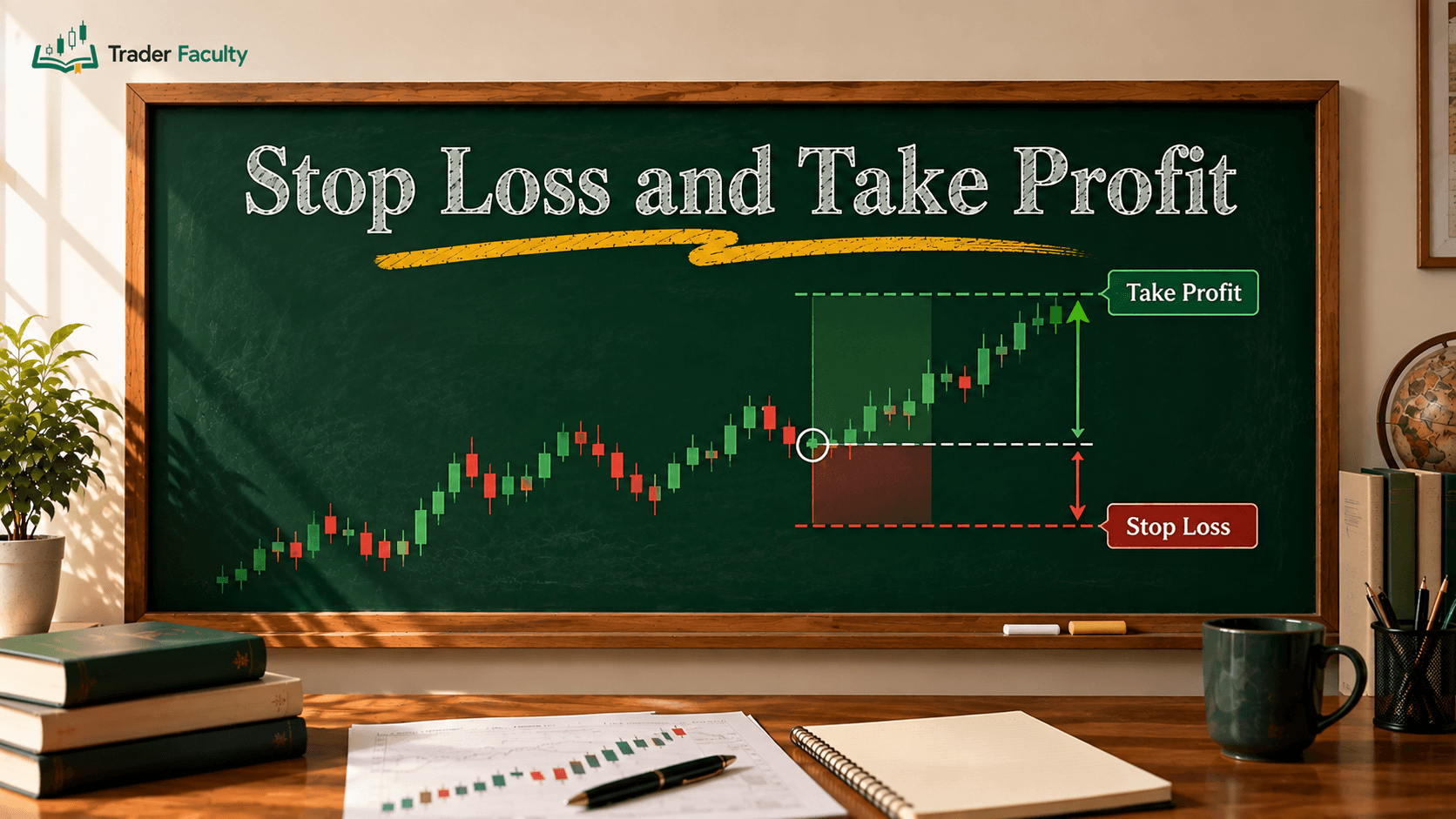
A stop-loss order is a programmed instruction submitted to your broker to liquidate a position once price breaches a pre-calculated invalidation point. It acts as an absolute constraint on human emotion, removing your ability to hold onto a losing trade out of hope.
Setting a stop loss must always be dictated by the structural realities of the chart—such as technical support, resistance, or volatility thresholds—rather than a random dollar amount. However, you must account for real-world execution risks; under highly volatile conditions or weekend market gaps, your broker may suffer execution slippage, filling your order at a less favorable price than your exact trigger line.
- Deep Dive: Discover how to pick invalidation zones and choose between structural, volatility, or time-based exits in our structural walkthrough on stop losses.
Risk-to-Reward Ratio: Defining Your Expectancy
The risk-to-reward ratio evaluates the distance from your entry price to your stop loss relative to the distance from your entry to your profit target. It determines the structural efficiency of your trading system.
If you risk $100 to make $200, you are trading with a 1:2 risk-to-reward ratio. Operating with an asymmetrical ratio allows your trading account to sustain a win rate below 50% while remaining completely profitable over a large sample of trades. If your risk-to-reward ratio is too narrow, your win rate must remain impossibly high to offset regular losses.
- Deep Dive: Learn how to calculate mathematical expectancy and optimize your profit targets using our guide on the risk-reward ratio.
Advanced Risk and Money Management Mechanics
Once you grasp the fundamental baseline rules of capital protection, you must implement dynamic tools to manage ongoing market exposure and protect realized open profits.

Dynamic Risk Reduction via Trailing Stops
As a trade moves in your favored direction, your risk management requirements shift from minimizing initial exposure to safeguarding unrealized open profits. A trailing stop is an adaptive order that automatically steps higher (in a long trade) or lower (in a short trade) behind the current market price.
Using trailing mechanisms allows you to secure profits while giving the asset room to develop macro trends. This eliminates the psychological urge to exit trades prematurely out of fear while substantially reducing your downside risk once the stop moves past your break-even point, though execution risks such as slippage during high volatility can still result in a fill below your intended level.
- Deep Dive: Master standard technical and volatility-based trailing methods by reading our tactical guide on how to set a trailing stop loss.
Account Insulation and Maximum Drawdown Architecture
Managing individual trade parameters is meaningless if your total portfolio exposure is left unchecked. You must track and cap your max drawdown—the peak-to-trough decline in your equity curve during a specific trading period.
Establishing a fixed max drawdown threshold (e.g., a 10% structural account ceiling) forces you to halt trading, re-evaluate your system, or downsize your risk parameters when your strategy falls out of sync with current market conditions. It provides a macro safety barrier that protects you from catastrophic sequence-of-returns risk (the danger of experiencing large losses early in a strategy's life, before compounding can offset them).
- Deep Dive: Learn how to monitor equity curves and construct drawdown recovery plans in our specialized breakdown on max drawdown.
Asset Class Considerations: Forex Risk Optimization
While the mathematical principles of trading and risk management remain universal, individual asset classes feature unique structural variables that impact how you calculate size and manage exposure.
In the foreign exchange market, currency movements are measured in pips, and contract volumes are distributed as lots. To execute accurate trade risk management in forex, you cannot rely on generic dollar allocations; you must convert your absolute percentage risk into accurate position parameters based on specific currency pairs.
| Parameter | Operational Definition | Tactical Application |
|---|---|---|
| Account Equity | Absolute liquid value of your trading wallet. | Serves as the math baseline for the 1% risk allocation rule. |
| Stop-Loss Distance | Total pips between entry price and invalidation. | Dictates the sizing multiplier based on market structure. |
| Pip Value | Monetary worth of a single pip move per unit. | Shifts depending on whether the USD is the base or quote asset. |
| Lot Size Allocation | The actual transaction volume sent to your broker. | The mathematical output required to lock in your exact risk ceiling. |
Failing to calibrate your lot configurations to match your precise stop-loss pip distance leads to uneven asset exposure, creating scenarios where a single loss can outweigh multiple structured wins.
- Deep Dive: Step through the exact mathematical equations used to calibrate position volumes across different currency pairs in our tutorial on how to calculate lot size in forex.
Common Risk Management Pitfalls to Avoid
Even well-designed risk management trading systems fail in practice when execution slips due to psychological bias rather than flawed strategy. Avoiding these three critical errors will instantly place you ahead of the majority of market participants.
1. Moving Stop Losses Mid-Trade
The absolute destruction of capital preservation occurs when a trader pulls their stop loss further away as the market approaches it. This behavioral bias stems from loss aversion—an emotional refusal to accept an initial small loss. Moving your stop transforms a calculated business expense into an open-ended financial gamble.
2. Revenge Trading and Account Over-Leveraging
Following a series of losses, the emotional urge to aggressively recapture lost capital frequently takes over. Traders double their position sizes or ignore risk thresholds entirely to "make the money back." This compounding risk profile accelerates drawdowns, often turning minor corrections into absolute capital liquidation.
3. Ignoring Structural Market Correlation
If you enter long positions across three different currency pairs or tech stocks that all move in tandem with the same underlying market factors, you do not have three independent trades. You have one massive trade with triple the risk. Failing to adjust your position sizing for highly correlated assets creates structural vulnerabilities across your entire portfolio.
Conclusion
Systematic risk management trading is not an optional accessory to a strategy; it is the core engine that determines whether you survive long enough to build real wealth. By mastering position sizing, utilizing stop-loss boundaries responsibly, keeping your risk-to-reward profiles asymmetrical, and adapting your parameters to the specific volatility of your asset class, you protect your portfolio from emotional decision-making.
Frequently Asked Questions
What is the golden rule of risk management in trading?
The foundational rule followed by professional traders is to never risk more than 1% to 2% of total account equity on any single trade setup. Keeping your absolute risk allocation small ensures that a normal sequence of consecutive losses will not cause critical or irreversible damage to your trading wallet.
Why do most retail traders fail at risk management?
Retail failures typically stem from behavioral biases like loss aversion and overconfidence, which manifest as moving stop losses mid-trade or revenge trading with excessive leverage. Additionally, many beginners ignore correlation risk, over-allocating capital to multiple assets that move in tandem.
Does a stop-loss order protect against all trading risks?
While a stop-loss is a mandatory risk containment tool, it does not offer absolute protection against market anomalies like slippage or weekend gaps. Under extreme volatility or low liquidity conditions, your broker may execute your order at the next available market price rather than your exact target threshold.
How does the risk-reward ratio impact my trading profitability?
Your risk-reward ratio dictates your system's mathematical expectancy. Operating with an asymmetrical ratio, such as 1:2, means you target twice the profit relative to what you are risking. This structural buffer allows your account to remain net profitable even if your win rate drops below 50%.
Why is position sizing considered more important than entry timing?
Entry timing only determines where you enter a trade, whereas position sizing determines how much money is actually exposed to market movement. Even a flawless trade entry signal will result in severe drawdown if the transaction volume is too large for your total account equity.
The Trader Faculty Team writes and reviews every guide together — pairing hands-on market experience with a curriculum-first approach to trading education. One good syllabus, taught in the order that makes you better.