What Is Risk of Ruin in Trading? Math & Risk Formula
Discover what risk of ruin means, how to calculate survival odds, and how position sizing protects capital. Read full guide.
By Trader Faculty Team
Direct Answer
Risk of ruin is the statistical probability that a trader will experience a capital drawdown severe enough to prevent continued trading. It is calculated using a trader's win rate, risk-to-reward ratio, and position size percentage per trade. Managing position sizing is the primary method to keep the risk of ruin near zero.
Risk of ruin is the statistical probability that a trader will lose enough capital to make continued trading impossible. It measures the likelihood of hitting an unrecoverable drawdown based on win rate, risk-to-reward ratio, and position size.
Many traders focus entirely on entry setups and win rates, assuming a solid strategy automatically prevents account destruction. However, even a system with more winning trades than losing ones can wipe out an account if position sizing is too aggressive during a losing streak.
Understanding risk of ruin shifts your focus from chasing short-term profits to ensuring long-term survival in financial markets.
Quick Takeaways
- Risk of ruin measures statistical survival odds: It calculates the mathematical chance that your account hits a fatal drawdown threshold before reaching your profit targets.
- Position size is your primary defense: Even strategies with high win rates face catastrophic ruin if risk per trade is set too high.
- Psychological ruin precedes absolute zero: Real-world ruin occurs long before a $0 balance because losing 50% of your equity requires a 100% gain just to break even.
- Trade outcomes cluster in live markets: Standard math models assume coin-flip independence, but live volatility and slippage make real-world losing streaks worse than basic formulas predict.
What Is Risk of Ruin in Trading?
Risk of ruin is a mathematical concept from probability theory that estimates the chance an investor or trader loses so much capital that they can no longer operate. In retail trading, hitting ruin does not always mean losing every single cent in your account. It often refers to crossing a designated threshold where capital degradation destroys trading capability or psychological endurance.
The meaning of risk of ruin changes slightly depending on whether you define it theoretically or practically:
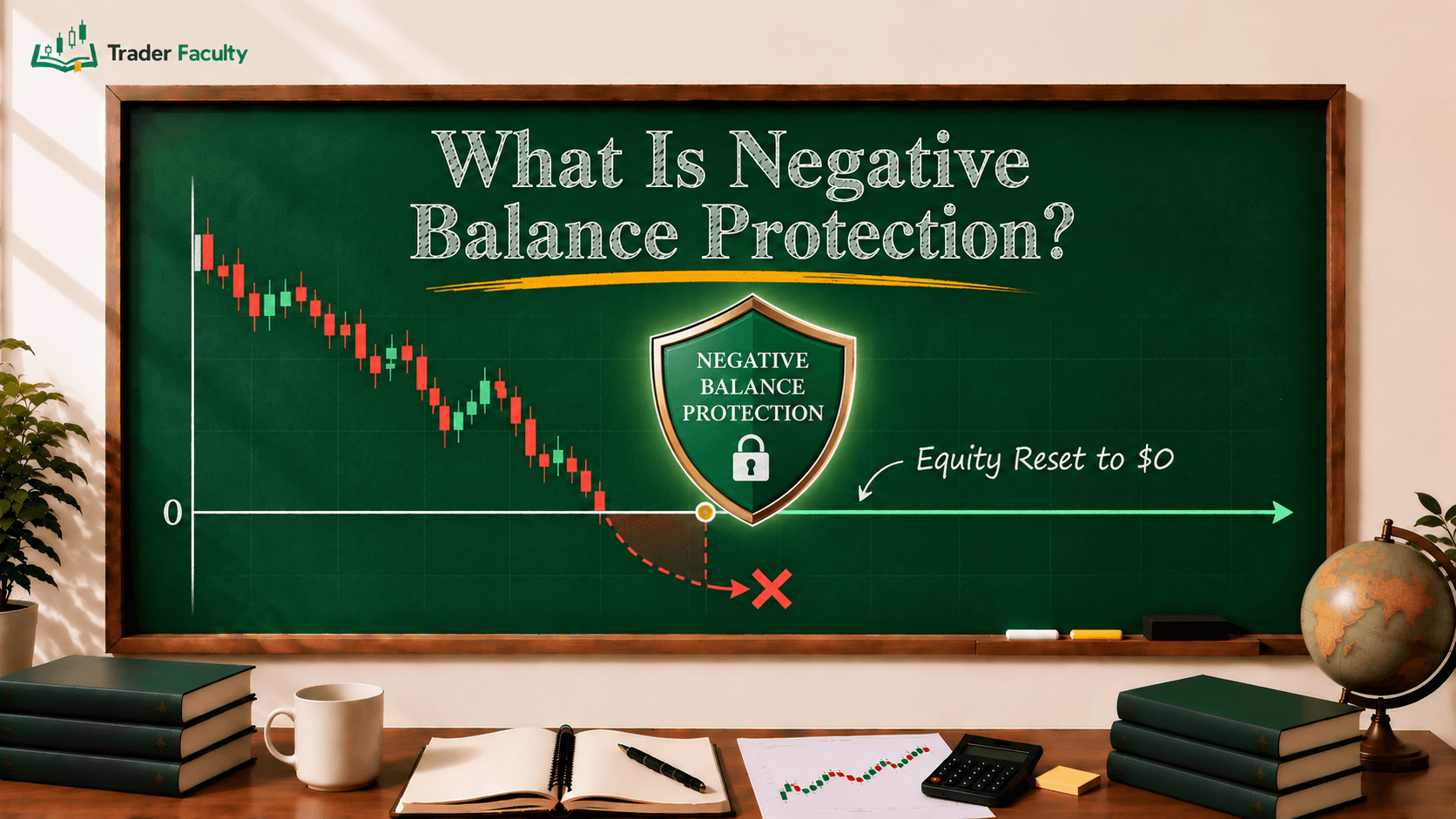
- Absolute Ruin: The balance reaches zero ($0), causing a complete liquidation or margin call where no further trades can be opened.
- Practical Ruin: Capital drops past the "point of no return" (such as a 50% or 60% drawdown). Beyond this level, the mathematical effort needed to recover back to peak equity becomes exponentially difficult.

Drawdown vs. Required Recovery Gain
[ Loss: 10% ] --> [ Required Gain: 11.1% ]
[ Loss: 20% ] --> [ Required Gain: 25.0% ]
[ Loss: 30% ] --> [ Required Gain: 42.8% ]
[ Loss: 50% ] --> [ Required Gain: 100.0% ] <-- Point of No Return
[ Loss: 75% ] --> [ Required Gain: 300.0% ]
When an account suffers a 50% drawdown, your remaining capital must yield a 100% return just to regain the starting baseline. Because generating consistent 100% returns without taking reckless risk is exceptionally rare, entering deep drawdowns effectively ruins account viability.
Key Variables That Determine Risk of Ruin
Your risk of ruin is governed by three interconnected variables. Changing any one of these inputs alters your statistical odds of survival.

1. Win Rate (Accuracy)
Win rate represents the percentage of trades that close in profit out of total trades taken. While intuitive, win rate alone does not prevent ruin. A trader with an 80% win rate can still blow up their account if their rare losses are massively disproportionate to their small gains.
2. Risk-to-Reward Ratio (Payoff Ratio)
The risk-to-reward ratio compares your average winning trade size against your average losing trade size. If your average win is $300 and your average loss is $100, your payoff ratio is 3:1. Higher payoff ratios allow strategies with modest win rates (e.g., 40%) to maintain a low risk of ruin.
3. Risk per Trade (Position Size)
Risk per trade is the percentage of total account equity risked on a single position. This is the only variable directly under your absolute operational control on every single order. Increasing your risk per trade from 1% to 5% increases your risk of ruin exponentially rather than linearly.
How Risk of Ruin Is Calculated
Classic quantitative risk models use simplified probability equations to calculate account survival. A widely referenced formulation popularized by market strategists estimates ruin probability using payoff edge and capital units.
The classical simplified risk of ruin formula is expressed as:
Risk of Ruin = ((1 - A) / (1 + A))^N
Where:
- A represents your advantage or expectancy edge, calculated as:
A = (Win Rate x Win-to-Loss Ratio) - Loss Rate.
- N represents the number of risk units in your balance (total account equity divided by dollar amount risked per trade).
Real-World Limitations of the Formula
While academic formulas provide a useful theoretical baseline, they rely on assumptions that frequently fail in live financial markets:
- Assumption of Independent Outcomes: Standard probability equations assume that every trade outcome is completely independent, like flipping an unbiased coin. In reality, financial markets experience volatility clustering. Losing trades often occur in consecutive clusters during market regime shifts, significantly raising real-world streak risk.
- Slippage and Execution Gaps: Formulas assume your maximum loss per trade never exceeds your planned risk. However, unexpected weekend price gaps or order slippage during news events can cause losses that exceed your set stop level, accelerating capital depletion.
Risk of Ruin Matrix: Win Rate vs. Risk per Trade
The matrix below illustrates how position size alters the risk of ruin across different win rates, assuming a fixed 1:1 risk-to-reward ratio.
| Win Rate | 1% Risk per Trade | 2% Risk per Trade | 5% Risk per Trade | 10% Risk per Trade |
|---|---|---|---|---|
| 40% | ~13.5% | ~28.0% | ~68.0% | ~99.0% |
| 45% | ~1.8% | ~6.5% | ~37.0% | ~88.0% |
| 50% | ~0.0% | ~0.8% | ~13.5% | ~62.0% |
| 55% | ~0.0% | ~0.0% | ~3.1% | ~31.0% |
| 60% | ~0.0% | ~0.0% | ~0.4% | ~11.0% |
Key Takeaways from the Data:
- At a 50% win rate and a 1:1 risk-to-reward ratio, risking 1% per trade yields a near-zero theoretical risk of ruin.
- Raising your risk per trade to 10% on that exact same strategy drives your risk of ruin to over 60%, guaranteeing severe drawdown over a large sample of trades.
- Lowering position size protects capital far more reliably than trying to force a higher win rate out of a volatile market setup.
Practical Steps to Reduce Your Risk of Ruin
Minimizing your probability of account ruin requires systematic operational limits.
1. Implement Fixed Percentage Position Sizing
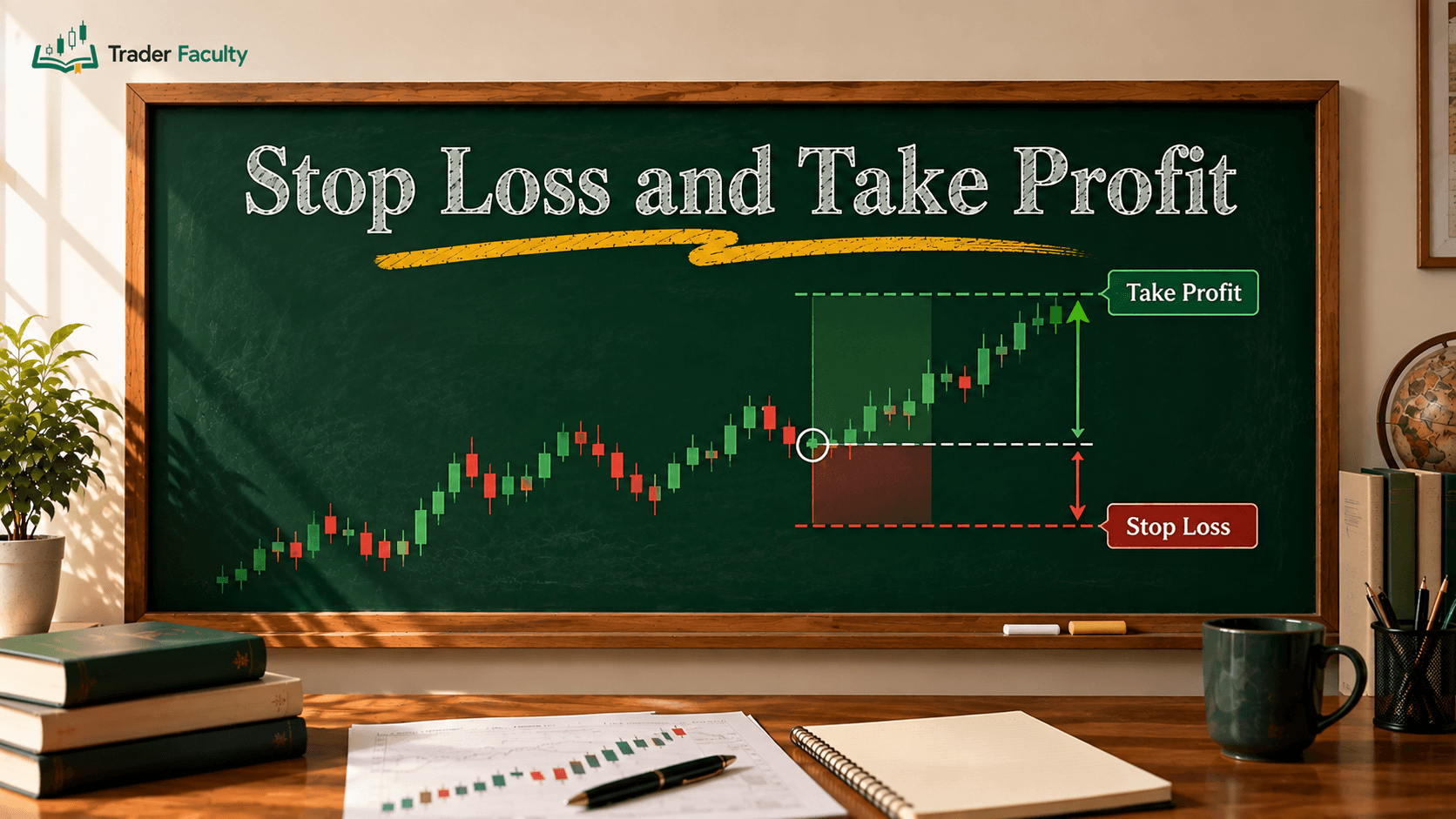
Never risk a arbitrary fixed dollar amount on trades as your capital fluctuates. Restrict risk to a maximum of 1% or 2% of total account equity per trade. Enforce this discipline by calculating exact position sizes relative to your stop loss and take profit boundaries before placing any order.
2. Cap Total Open Market Exposure
If you take multiple concurrent positions, limit your total aggregate risk across all open trades to 5% or 6% of equity. Opening five correlated trades that each risk 2% exposes your portfolio to a sudden 10% structural drawdown during correlated market moves.
3. Use Dynamic Drawdown Halts
Implement a daily or monthly equity peak-to-trough cut-off point. For example, if your total equity drops by 6% in a single week, halt trading immediately to review system performance and market conditions. When you resume, cut your position size in half until account stability returns.
4. Maintain Positive Expectancy Over Win Rate
Focus on building setups where your statistical expectancy is strictly positive. A strategy that wins 35% of the time with a 3:1 payoff ratio carries a far lower risk of ruin than a strategy that wins 80% of the time with a 1:5 payoff ratio.
Common Risk of Ruin Mistakes Traders Make
- Martingale Position Sizing: Doubling position size after a loss to recover drawdowns quickly is the fastest path to catastrophic ruin. A single extended losing streak mathematically guarantees total account destruction.
- Ignoring Correlation Risk: Holding long positions in multiple instruments within the same asset class creates hidden leverage. If macro volatility spikes, all correlated trades can hit stop losses simultaneously, bypassing your individual trade risk caps.
- Confusing System Edge with Account Survival: Having a strategy with a high historical win rate does not mean your risk of ruin is zero. Without strict risk management controls, sudden market regime changes can liquidate account balance faster than your backtested edge can play out.
Conclusion
Risk of ruin calculation highlights the mathematical reality that trading survival depends far more on position sizing discipline than on raw directional prediction. By keeping risk per trade low, limiting correlated exposure, and avoiding revenge trading during losing streaks, you lower your ruin probability to manageable levels and keep your capital intact over the long run. To integrate these tools into your daily workflow, explore our comprehensive framework for risk management trading.
Trading financial instruments carries an underlying risk of losing money, and theoretical probability models cannot predict extreme market conditions or execution failures. Treat statistical calculations as educational frameworks to refine your personal trading discipline rather than absolute guarantees of safety.
Frequently Asked Questions
What is a good risk of ruin percentage in trading?
A safe risk of ruin target is less than 1%. Professional traders restrict position size and maintain conservative risk parameters to ensure that mathematical probability favors long-term account survival across hundreds of sequential trades.
Can a trading strategy with a high win rate have a high risk of ruin?
Yes. If a strategy with an 80% win rate risks 20% or 30% of account equity per trade, a normal statistical run of consecutive losses can deplete capital or trigger a fatal drawdown before the high win rate balances out.
What is the difference between drawdown and risk of ruin?
Drawdown measures historical or peak-to-trough capital decline experienced by an account. Risk of ruin is a forward-looking statistical probability that estimates the likelihood of hitting a critical or total loss threshold in the future.
How does position sizing affect risk of ruin?
Position size is the most influential factor controlling risk of ruin. Lowering risk per trade from 5% to 1% reduces ruin probability exponentially, providing a larger buffer against unavoidable losing streaks.
Why do theoretical risk of ruin formulas fail in live trading?
Theoretical formulas assume independent trade outcomes like coin flips. In live markets, volatility clustering, sudden price gaps, and slippage cause losing streaks to cluster, making real-world risk higher than simple mathematical models predict.
The Trader Faculty Team writes and reviews every guide together — pairing hands-on market experience with a curriculum-first approach to trading education. One good syllabus, taught in the order that makes you better.