What Is a Take Profit Order? How It Works and Example
Learn how a take profit order automates exit discipline and locks in gains. Discover technical target placement rules. Read the full guide.
By Trader Faculty Team
Direct Answer
A take profit order is a conditional instruction sent to a broker to close an open trade automatically once price reaches a specified profit target. Operating as a limit order, it guarantees the requested fill price or better when executed, helping traders secure unrealized gains without emotional hesitation or constant screen monitoring.
A take profit order is a conditional instruction sent to a broker to close an open position automatically once the market price reaches a specific profit target.
Many traders watch a winning position move in their favor, only to hold too long and watch those gains vanish when the market turns. Setting an automated exit removes emotion from the exit process and locks in target returns without requiring constant screen monitoring. This guide breaks down execution mechanics, technical target placement, and common exit mistakes.
Quick Takeaways
- A take profit order automatically secures unrealized gains without needing manual trade management.
- Executed as a limit order, it guarantees your specified fill price or better, though execution depends on available market liquidity.
- Pairing take profit orders with stop losses creates a clear risk-to-reward ratio before opening any position.
- Key chart levels like support, resistance, and recent swing highs provide technical structure for realistic profit targets.
What Is a Take Profit Order? (Meaning & Execution Mechanics)
When asking what a take profit order is in practical trading, it is best understood as an automated instruction to exit a trade at a gain. The core take profit order meaning rests on setting a predefined price boundary where you want to close your position and collect your profit. Once the market reaches or passes your target price, the order triggers and closes the trade.
This concept — sometimes searched as take profit order explained — comes down to how brokers process orders. A standard exit order like this functions as a limit order:
- For long positions: It sits above the current market price as an order to sell.
- For short positions: It sits below the current market price as an order to buy back the asset.
Because it operates as a limit order, this type of order guarantees that you receive your specified price or a better price if filled. However, execution requires that the market actually reaches your price level and that there is sufficient liquidity—the presence of active buyers or sellers—to fill your order. According to trading guidelines outlined by the U.S. Securities and Exchange Commission, limit orders help investors control the execution price, though fill execution always depends on active market conditions.
Stop Loss and Take Profit: Balancing Risk and Reward

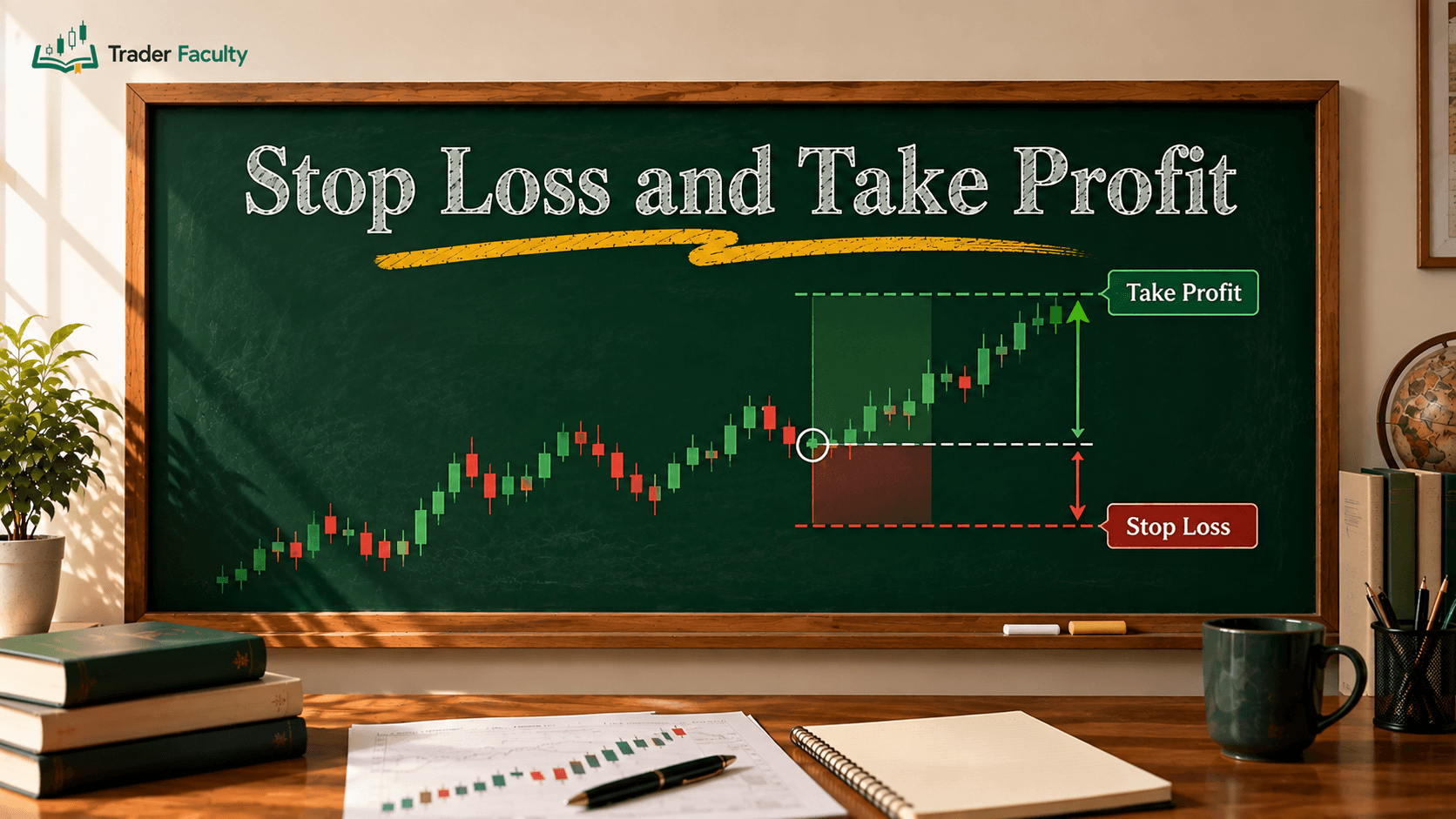
This exit tool rarely works alone. In structured trading strategies, traders pair take profit targets with stop loss orders to control both sides of a trade. While this exit order defines your profit target, a stop loss order sets your maximum allowed loss if price turns against you.
Combining a stop loss and take profit order before entering a position allows you to calculate your risk-to-reward ratio. This ratio compares the potential loss on the trade against the expected gain.
Risk to Reward Ratio = Potential Loss Amount / Potential Profit Amount
For instance, if you enter a stock trade risking $100 with a stop loss and targeting $200 as your profit target, your risk-to-reward ratio is 1:2.
Many beginners try to apply a rigid 1:2 ratio to every trade regardless of market conditions. However, effective targets adapt to technical structure rather than arbitrary math. If key market barriers sit closer than your calculated target, forcing a fixed ratio can result in missed profits.
Where to Set Take Profit Targets: Technical Placement Strategies
Placing a profit target requires analyzing price action to identify realistic exit zones. Setting a target too far away leads to missed exits, while setting it too close cuts winning trades short.
Traders rely on key technical chart areas to set strategic target levels:
- Support and Resistance Zones: For long trades, targets usually sit just below major resistance lines where selling pressure builds. For short trades, targets sit just above support lines where buying interest often appears.
- Swing Highs and Swing Lows: Recent price peaks and troughs mark obvious areas where price previously reversed.
- Technical Indicators: Volatility tools like Average True Range (ATR) help measure average daily price moves. Setting targets based on ATR keeps profit expectations in line with current market movement.
Advanced Exit Rules: Partial Profits and Scaling Out
Instead of exiting an entire position at a single price, advanced traders often split their exits into multiple take profit levels. This technique, known as scaling out, helps secure profit while keeping market exposure open for larger trend moves.
A standard two-target exit approach works as follows:
- Target 1 (TP1): Set at an early technical barrier to close half of the position and lock in baseline profit.
- Target 2 (TP2): Set at a further structural level to capture extended market momentum with the remaining position.
Scaling out reduces emotional stress during strong market swings. The trade-off is that exiting part of your position early reduces overall yield if price continues straight to your second target without retracing.
Execution Realities: Market Gaps, Slippage, and Limit Triggers
While this automation removes manual exit decisions, execution still depends on live market conditions. Understanding how limit orders behave during volatile events helps set realistic expectations.
During high-impact news releases or weekend market gaps, prices can jump past your target level without trading at intermediate prices:
- Positive Slippage: If the market gaps over your long take profit target to a higher price, your limit order fills at the higher available price, yielding a larger profit than planned.
- Price Skipping: If price gaps beyond your limit order in fast conditions, your order fills at the best available price currently in the order book.
Unlike stop loss market orders that execute at any available price, this type of limit order prioritizes price quality over fill speed.
Common Take Profit Mistakes Traders Make
Automating exits removes emotional handling during live trades, but common planning mistakes can still lower overall trade performance.
- Moving Targets Out of Greed: Extending a profit target further away as price approaches it often results in watching price reverse before hitting the new level.
- Ignoring Market Structure: Setting target levels based purely on financial goals rather than chart resistance leads to unrealistic expectations.
- Setting Targets Too Close: Closing trades prematurely out of fear prevents winning trades from covering smaller, normal losses over time.
Conclusion
A take profit order provides the structure needed to exit winning trades with discipline. By establishing your exit target before placing a trade, you eliminate emotional decision-making when prices move quickly.
To build a consistent approach, combine technical chart levels with dynamic tools like ATR to place clear profit targets. Pairing these exits with defined stop loss rules ensures balanced risk management trading across every position.
Trading always carries the risk of losing capital, so treat order management tools as structured boundaries within a broader strategy rather than an assurance of profit.
Frequently Asked Questions
Is a take profit order a limit order or a market order?
A standard take profit order functions as a limit order. When market price reaches your specified target, it executes at your target price or a better price. Unlike market orders that prioritize immediate fill speed, limit take profit orders prioritize price quality, protecting traders from negative slippage.
What happens if the market gaps past your take profit order?
If market price gaps past your target level during overnight market gaps or high-impact news releases, your limit order fills at the best available price above your target for a long trade (or below for a short trade). This results in positive slippage, capturing a larger gain than originally set.
What is the difference between a stop loss and a take profit order?
A stop loss order automatically closes a trade to cap losses when price moves against your position, serving as a primary risk management barrier. A take profit order automatically closes a trade to capture gains when price moves in your favor. Pairing both orders establishes a defined risk-to-reward ratio before entry.
Where should you place a take profit order on a chart?
Traders typically position take profit targets slightly ahead of major technical barriers, such as key resistance zones for long positions or support areas for short positions. Setting targets slightly ahead of major price levels accounts for bid-ask spreads and ensures order fills during fast tests of liquidity.
Can a take profit order fail to execute?
A take profit order may fail to execute if market price does not reach your specified target or if there is insufficient market liquidity at that price level. Because it operates as a limit order, active liquidity (buyers or sellers) must be present at or beyond your target price to complete the fill.
The Trader Faculty Team writes and reviews every guide together — pairing hands-on market experience with a curriculum-first approach to trading education. One good syllabus, taught in the order that makes you better.