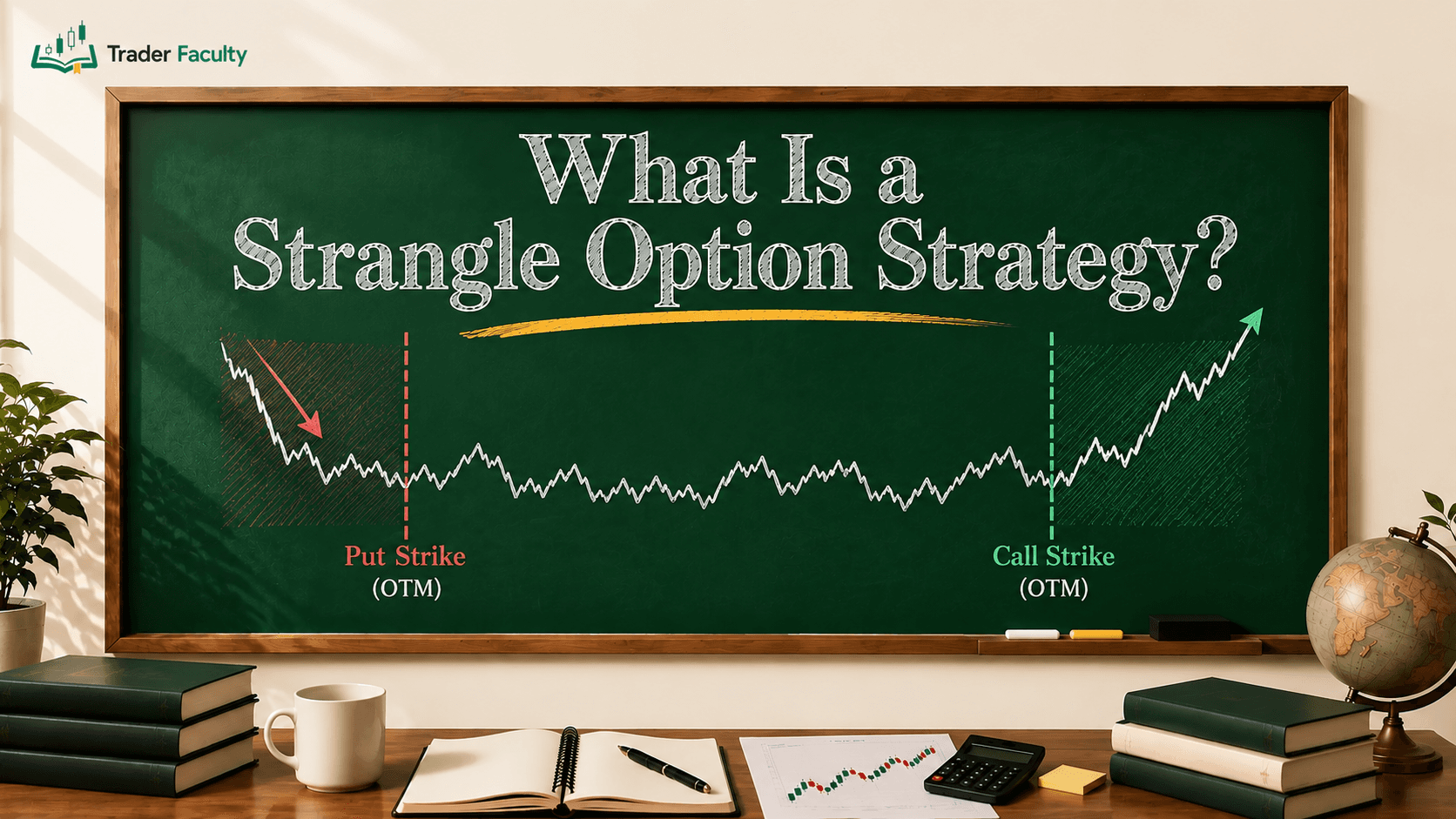
Straddle vs Strangle: Key Differences for Options Traders
Compare straddle vs strangle options strategies. Learn key differences in strike selection, costs, and risks. Read the full guide.
By Trader Faculty Team
Direct Answer
A straddle and a strangle are non-directional options strategies designed to profit from market volatility regardless of price direction. A long straddle involves purchasing an at-the-money call and put with identical strike prices, requiring a smaller price move to break even but demanding higher upfront capital. A long strangle uses out-of-the-money call and put contracts with different strike prices, lowering the upfront cost but requiring a significantly larger price move to become profitable.
A straddle and a strangle are non-directional options strategies designed to profit from significant price volatility regardless of whether the market moves up or down. Both strategies involve buying or selling a call option and a put option simultaneously on the same underlying asset with the same expiration date.
Choosing between these two approaches comes down to balancing your upfront capital cost against the distance the market must travel to make the trade profitable. While both setups neutralize market direction, their strike price selection creates distinctly different risk-reward profiles, cost structures, and breakeven boundaries.
This guide breaks down how straddles and strangles work, compares their key metrics, and details when to deploy each strategy.
Quick Takeaways
- A long straddle buys at-the-money (ATM) options, offering a closer breakeven point but demanding a higher upfront premium.
- A long strangle buys out-of-the-money (OTM) options, reducing capital outlay but requiring a larger price move to become profitable.
- Both strategies benefit from rising implied volatility (Vega) and suffer from time decay (Theta).
- Post-earnings implied volatility crush can cause severe losses on long positions even if the underlying asset moves in price.
- Short straddles and strangles carry substantial tail risk and exposure to severe margin calls due to undefined loss potential.
What Is a Long Straddle?
A long straddle is an options strategy created by buying an at-the-money (ATM) call option and an at-the-money (ATM) put option for the same underlying asset and expiration date.
Because both options are purchased at current market prices, the setup requires a higher capital outlay than out-of-the-money strategies. However, because the strike price sits directly at the current asset price, the trade begins accumulating intrinsic value as soon as the market moves in either direction.
Upper Breakeven = Strike Price + Total Premium Paid
Lower Breakeven = Strike Price - Total Premium Paid
Maximum Profit = Unlimited (to the upside) / Substantial (to the downside, capped at zero asset price)
Maximum Loss = Total Premium Paid
For example, if a stock trades at $100, a trader buys a $100 Call for $3 and a $100 Put for $3. The total debit is $6. The trade reaches breakeven if the stock climbs above $106 or drops below $94 by expiration.
Straddle vs Strangle: Core Differences Compared
Understanding what is straddle vs strangle requires comparing how strike selection alters execution costs and trade probabilities. The core straddle vs strangle meaning comes down to trade-offs between cost and distance.

| Feature | Long Straddle | Long Strangle |
|---|---|---|
| Strike Selection | Same Strike (ATM Call & Put) | Different Strikes (OTM Call & Put) |
| Upfront Debit (Cost) | Higher | Lower |
| Breakeven Distance | Narrower (Smaller move needed) | Wider (Larger move needed) |
| Probability of Profit | Higher relative to strangle | Lower relative to straddle |
| Delta Sensitivity | Near zero initially; responds quickly | Near zero initially; responds slower |
| Theta Decay Rate | High absolute daily dollar decay | Lower daily decay, but higher percentage loss near expiry |
| Vega Exposure | Higher sensitivity to volatility shifts | Moderate sensitivity to volatility shifts |
The Role of Options Greeks and Volatility
Having straddle vs strangle explained requires evaluating options Greeks—specifically Vega and Theta.
- Vega Exposure: Both strategies are long volatility plays. When implied volatility (IV) rises, option premiums expand, benefiting both positions even before price movement occurs.
- Implied Volatility Crush (IV Crush): Before known events like earnings releases, market demand inflates option premiums. Immediately after the event passes, implied volatility collapses rapidly. This IV crush reduces option extrinsic value, causing long straddles and strangles to suffer severe losses even if the stock experiences a sharp move.
- Theta Decay: Time decay works constantly against long option holders. As expiration approaches, extrinsic value decays at an accelerating pace, eroding position value if the asset stays within the breakeven range.
Short Straddle vs Short Strangle: Extreme Tail Risk
While long positions limit risk to the upfront premium paid, short straddles and short strangles flip the payoff profile entirely.
Net sellers collect upfront premium by selling both options, aiming for the asset to remain range-bound. However, short positions expose traders to severe tail risk:
- Short Straddle: Selling an ATM call and put collects maximum premium but carries unlimited risk to the upside and extreme risk to the downside.
- Short Strangle: Selling OTM options offers a wider safety zone, but an extreme breakout leads to substantial losses.
- Assignment & Margin Calls: Short options carry early assignment risk and require significant margin capital. Adverse price movements can trigger severe margin calls, demanding immediate capital deposits.
Options carry regulatory oversight from bodies such as the U.S. Securities and Exchange Commission (SEC) and the Options Clearing Corporation (OCC), both of which have highlighted that strategies with undefined loss potential expose market participants to significant financial liability.
How to Choose Between a Straddle and a Strangle
Selecting the right setup depends on your capital allocation parameters, risk tolerance, and expected price move:
- Choose a Long Straddle when: You anticipate moderate-to-high volatility expansion and prefer a narrow breakeven window. You are willing to pay a higher upfront debit to minimize the distance the market must move to reach profitability.
- Choose a Long Strangle when: You expect an massive, explosive price movement (such as major regulatory rulings or clinical trial results) and want to limit upfront capital risk.
- Analyze Volatility Pricing: Compare market implied volatility against historical volatility. If option premiums are already inflated, buying straddles or strangles increases exposure to severe IV crush.
Common Beginner Mistakes
- Buying Right Before Earnings: Purchasing long straddles or strangles hours before earnings announcements leaves trades vulnerable to IV crush post-event.
- Holding Through Late Expiration: Retaining long positions into expiration week subjects capital to accelerated Theta decay.
- Underestimating Price Requirements: Buyers of low-cost strangles often fail to calculate the true distance needed to clear breakeven levels, leading to frequent small losses.
- Selling Naked Short Straddles: Novice traders selling short options for income without strict stop-loss rules risk major account drawdowns during sudden market gaps.
Conclusion
Both straddles and strangles allow traders to capitalize on market volatility without guessing direction. A long straddle prioritizes proximity over cost by using at-the-money strikes, while a long strangle prioritizes capital efficiency by using out-of-the-money strikes. Selecting between them requires balancing upfront premium against the distance required to reach profitability.
To integrate these concepts into a structured risk management process, start building a clear trading strategy before executing complex derivative setups. Exploring systematic risk management models is an essential next step. You can learn how to structure consistent setups by taking our day trading for beginners guide, or explore broader framework development through our comprehensive breakdown of trading strategies.
Options trading carries the risk of losing capital, so treat everything here as an educational foundation rather than personal advice.
Frequently Asked Questions
What is the main difference between a straddle and a strangle?
The primary difference lies in strike price selection. A straddle uses identical at-the-money (ATM) strike prices for both the call and put option, while a strangle uses different out-of-the-money (OTM) strike prices. This makes straddles more expensive upfront but easier to reach breakeven, whereas strangles cost less but require larger market moves to generate profit.
Is a strangle cheaper than a straddle?
Yes, a long strangle is generally cheaper to enter than a long straddle. Because out-of-the-money options contain only extrinsic value (time premium), buying an OTM call and put requires less capital upfront than purchasing at-the-money options for a straddle.
What happens to a straddle or strangle during earnings releases?
Options traders often experience "implied volatility crush" immediately following earnings announcements. Implied volatility inflates option prices prior to the event; once the news is released, implied volatility drops sharply, causing extrinsic value to collapse. Long straddles and strangles can lose value rapidly even if the stock price moves.
Which strategy has a higher probability of profit?
A long straddle generally has a higher probability of profit compared to a long strangle because its breakeven points sit closer to the current stock price. However, because the straddle requires a larger initial premium payment, the net return on risk must be evaluated against market conditions.
Are short straddles and short strangles safe for beginners?
No. Selling naked short straddles or short strangles carries extreme risk because loss potential is undefined on the upside (and substantial on the downside). If the market experiences a sharp breakout, short positions face unlimited losses, steep margin calls, and early assignment risk.
The Trader Faculty Team writes and reviews every guide together — pairing hands-on market experience with a curriculum-first approach to trading education. One good syllabus, taught in the order that makes you better.