What Is a Strangle Option Strategy? Mechanics and Risks
Learn how a strangle option strategy works, how to calculate breakevens, and key risks to manage. Read full guide.
By Trader Faculty Team
Direct Answer
A strangle option strategy is a neutral options setup combining an out-of-the-money call option and an out-of-the-money put option with identical expiration dates on the same asset. Long strangles allow traders to profit from large price swings in either direction with risk capped at the premium paid. Short strangles collect upfront credit but carry severe risk if prices trend significantly past the strike boundaries.
A strangle option strategy is a neutral options setup combining an out-of-the-money call option and an out-of-the-money put option with identical expiration dates on the same asset.
Facing high market uncertainty before an earnings report or economic data release, traders often know a stock will move, but not which direction. Guessing wrong with a standard directional trade usually leads to a quick loss. This guide covers how long and short strangles work, how to calculate breakevens, and how to avoid the time decay trap.
Quick Takeaways
- A long strangle uses out-of-the-money options to seek profit from large price swings in either direction, capping risk strictly at the upfront premium paid.
- A short strangle collects upfront premium income but carries severe risk if the asset price breaks out strongly.
- Breakeven points require the asset price to move past the strike prices by more than the combined cost of the two contracts.
- A sudden drop in market uncertainty can cause a long strangle to lose value even if the price moves exactly as you expected.
What Is a Strangle Option Strategy? (Meaning & Core Basics)
When you ask what is strangle option strategy trading used for, the short answer is capturing large price moves when direction is unclear. A strangle option strategy is a derivative trade where you hold positions in both a call option and a put option on the same asset, expiring on the exact same day, but at different out-of-the-money strike prices.
To understand the strangle option strategy meaning, you first need to know what out-of-the-money (OTM) means. An OTM option has a strike price that is worse than the current market price of the asset. For a call option, the strike sits above the current price. For a put option, the strike sits below it.
When you see a strangle option strategy explained in trading courses, it usually breaks down into two distinct types: long strangles for buyers, and short strangles for sellers.
How the Strangle Option Strategy Works: Long vs Short
The mechanics of the strategy change entirely based on whether you pay money to buy the options contracts or collect money by selling them.
1. The Long Strangle Setup
In a long strangle, you buy one OTM call option and one OTM put option.
- Setup: Buy OTM Call (higher strike) + Buy OTM Put (lower strike).
- Cost: The total premium you pay for both contracts.
- Maximum Risk: Limited strictly to the money you paid upfront.
- Maximum Gain: Unlimited if the price rises, and large if the price falls toward zero.
Because both options sit out-of-the-money, buying a long strangle costs less than buying contracts close to the current price. Active traders often look at non-directional setups like this alongside basic day trading techniques to handle high-impact news days where price swings become violent.
2. The Short Strangle Setup
In a short strangle, you take the opposite side. You sell one OTM call option and one OTM put option to collect premium income upfront.
- Setup: Sell OTM Call (higher strike) + Sell OTM Put (lower strike).
- Income: The total credit you receive from the buyer.
- Maximum Gain: Capped strictly at the upfront credit.
- Maximum Risk: Unlimited if the price spikes, and severe if it crashes.
Short strangles seek profit when the market stays quiet and trades inside a tight range until expiration. However, short options carry assignment risk — meaning the option buyer can exercise their right early, forcing you to buy or sell 100 shares of the underlying asset unexpectedly. This requires a large margin account to maintain the position.
Calculating Strangle Option Strategy Breakeven Points
Calculating breakeven points for a strangle option strategy requires simple math. Because you hold two option legs, you have two separate breakeven boundaries.
Upper Breakeven = Call Strike Price + Total Net Premium Paid
Lower Breakeven = Put Strike Price - Total Net Premium Paid
A Number Example
Imagine a stock trades exactly at $100 per share. You expect a massive earnings move, so you open a long strangle:
- Current Stock Price: $100
- Buy 1 Call Option: Strike price $105, costing $2.00
- Buy 1 Put Option: Strike price $95, costing $2.00
- Total Cost: $4.00 per share (or $400 total, since one contract controls 100 shares)
Using the formulas:
- Upper Breakeven: $105 + $4.00 = $109.00
- Lower Breakeven: $95 - $4.00 = $91.00
For this long strangle to make money at expiration, the stock must close above $109.00 or below $91.00. If it stays between $95.00 and $105.00, both options expire worthless, and you lose the full $4.00.
Long Strangle vs Long Straddle: Key Differences
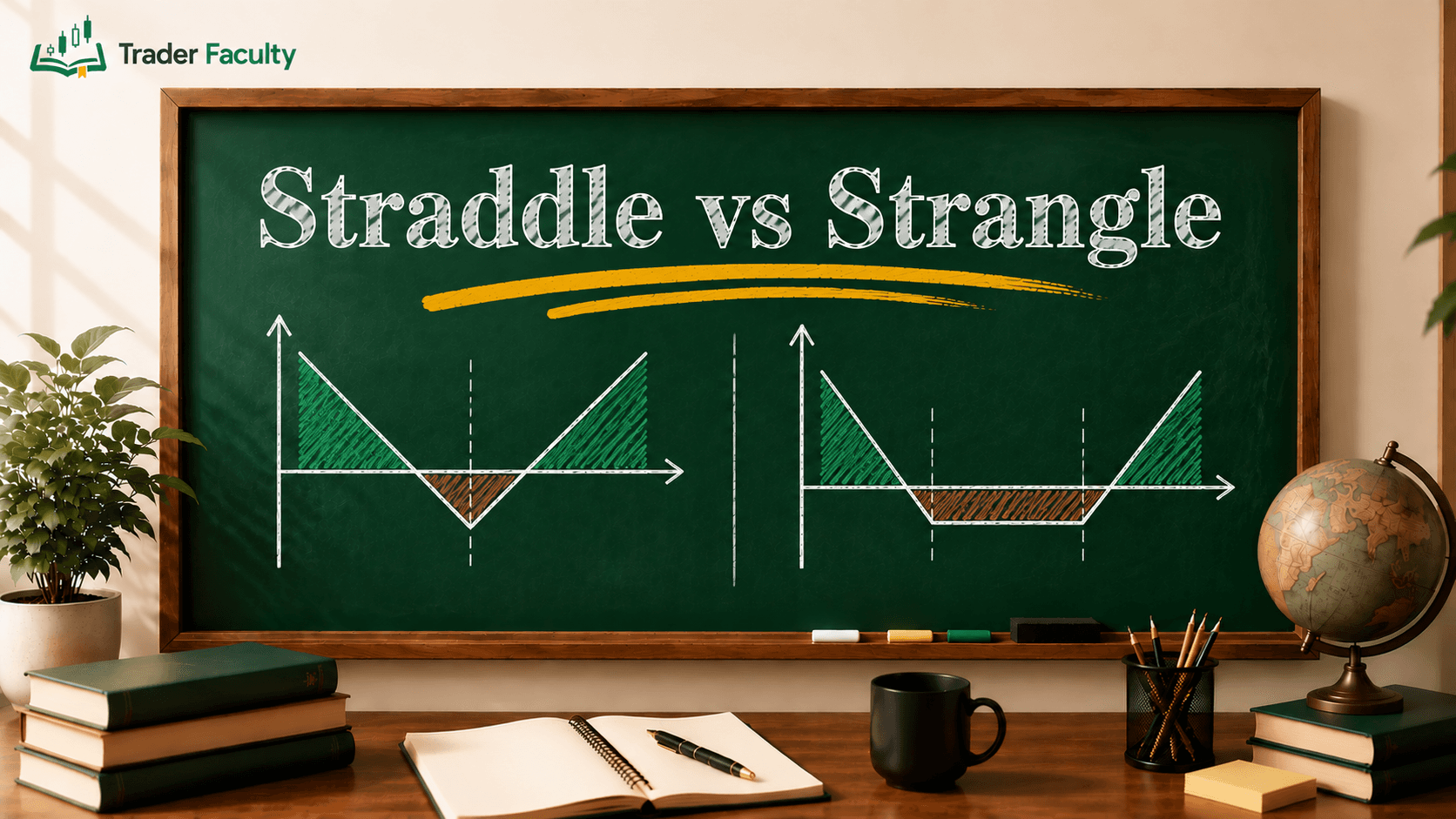
The main difference between a long strangle and a long straddle is the strike prices you choose and the upfront cost required to enter the trade.
| Feature | Long Strangle | Long Straddle |
|---|---|---|
| Strike Prices | Out-of-the-money (OTM) Call and Put | At-the-money (same exact strike) |
| Upfront Cost | Lower initial cost | Higher initial cost |
| Breakeven Distance | Wider (needs a larger price move) | Narrower (needs a smaller price move) |
| Delta Range | Often 16 to 30 delta per leg | Roughly 50 delta per leg |
| Time Decay Impact | Slower dollar-value loss early on | Faster dollar-value loss early on |
A straddle uses identical strike prices right at the current market value. It costs heavily upfront, but the price does not have to move as far to reach breakeven. A strangle uses wider strike prices, giving you a cheaper entry but demanding a much larger price move to win.
Managing Implied Volatility (IV) Crush and Time Decay

Implied volatility crush and time decay are the two main forces that destroy the value of a long strangle before expiration.
Implied Volatility (IV) Crush
Implied volatility measures how much the market expects the asset's price to move. Think of it as a premium for uncertainty. Before major events like quarterly earnings reports or inflation data releases, implied volatility rises because traders bid up option prices.
Once the news breaks, uncertainty drops instantly. This rapid drop is called IV crush. If you buy a long strangle right before earnings, the option contracts can lose massive value the next morning due to IV crush, even if the stock price moves exactly as you hoped.
Theta Decay (Time Decay)
Options are expiring contracts. Theta — the daily loss of an option's value due to time passing — slowly drains your premium. For long strangles, time decay speeds up heavily in the final 30 days of the contract.
Common Mistakes When Trading Option Strangles
Beginners often run into preventable losses by ignoring volatility cycles or choosing the wrong strikes.
- Buying right before earnings: Buying long strangles when implied volatility is at its peak leaves you exposed to severe IV crush the moment the news comes out.
- Selecting strikes that are too far away: Choosing strikes far away from the current price makes the trade cheap, but it makes reaching your upper or lower breakeven points highly unlikely.
- Selling short strangles without limits: Uncovered short options carry extreme risk. Rules from the Commodity Futures Trading Commission warn that selling options can expose you to heavy, sometimes unlimited losses if the market moves against you.
Conclusion
A strangle option strategy gives you a structured way to trade markets when you expect high volatility but remain unsure of the direction. By combining out-of-the-money call and put options, long strangles let you define your maximum risk upfront while seeking large gains. Short strangles take the opposite side, collecting income but demanding strict risk control.
Using these setups safely means combining them with broader trading strategies that match your account size and goals. You must always run the breakeven math, check implied volatility before entering a trade, and plan your exit before time decay destroys your premium. Options trading carries the risk of losing money, and short options can lose more than your initial deposit, so practice on a demo account before risking live capital.
Frequently Asked Questions
What is a strangle option strategy?
A strangle option strategy is a non-directional setup where a trader holds positions in both an out-of-the-money call and an out-of-the-money put with the same expiration date. It allows traders to capitalize on high market volatility without needing to forecast whether the price will move up or down.
What is the difference between a straddle and a strangle option strategy?
A straddle uses at-the-money (ATM) call and put options with the exact same strike price, requiring a higher initial premium payment but offering narrower breakeven points. A strangle uses out-of-the-money (OTM) options with different strike prices, resulting in a lower entry cost but requiring a wider price movement to reach profitability.
How do you calculate breakeven on a strangle option strategy?
A long strangle has two breakeven points. The upper breakeven is calculated by adding the total net premium paid to the call strike price. The lower breakeven is calculated by subtracting the total net premium paid from the put strike price.
What is implied volatility crush in options trading?
Implied volatility (IV) crush occurs when market uncertainty drops rapidly after an event, such as an earnings release or economic data announcement. This sudden collapse in implied volatility reduces option contract values, causing long strangles to lose value even if the underlying asset price moves.
What are the risks of a short strangle strategy?
Selling a short strangle exposes traders to substantial or unlimited loss risk if the underlying asset price moves sharply beyond either strike price. In addition, short options carry early assignment risk if the buyer decides to exercise their options contract before expiration.
The Trader Faculty Team writes and reviews every guide together — pairing hands-on market experience with a curriculum-first approach to trading education. One good syllabus, taught in the order that makes you better.