What Is a Limit Order?
Learn how to control your entry and exit prices. Discover the mechanics of buy and sell limit orders. Read the full guide.
By Trader Faculty Team
Direct Answer
A limit order is an instruction to your broker to buy or sell an asset at a specific price or better. Instead of taking whatever price is currently available on the market, you dictate the exact threshold where you are willing to execute the trade. If the market does not meet your terms, the trade simply does not happen.
A limit order is an instruction to your broker to buy or sell an asset at a specific price or better.
Watching the market race away from your ideal entry price is a common frustration for new traders, often leading to panic buying. This guide breaks down how to take control of your entry and exit prices, the crucial differences between limit and stop orders, and the hidden execution risks you need to watch out for.
Quick Takeaways
- You maintain strict control over the maximum price you pay or the minimum price you receive.
- Limit orders prioritize your requested price over the speed or certainty of the execution.
- The market might never reach your specified price, meaning your trade could be completely missed or only partially filled.
- Setting a limit order on the wrong side of the current market price usually results in an immediate market execution.
What Is a Limit Order?
A limit order is a specific price boundary you set for your broker when buying or selling an asset. Instead of taking whatever price is currently available on the market, you dictate the exact threshold where you are willing to do business. If the market does not meet your terms, the trade simply does not happen.
Think of it like buying a house. If a property is listed at $300,000, you might tell your real estate agent that the absolute maximum you will pay is $285,000. That is your limit.
If the seller refuses to drop the price to $285,000 or lower, you walk away. In trading, a limit order works exactly the same way, protecting you from paying more than you planned or selling for less than you accept.
How a Limit Order Works (The Mechanics)
A limit order works by resting in the broker's order book until the market price reaches your specified target or better. There are two primary variations you will use on your trading platform, depending on whether you want to enter a new position or take profits on an existing one.

Buy limit orders are placed below the current market price. You use this when you believe an asset is currently too expensive, but you want to automatically buy it if the price drops to a level you consider a good deal. For example, if a stock is trading at $50, you might place a buy limit at $45. Your broker will only execute the trade if the price falls to $45 or lower.
Sell limit orders are placed above the current market price. You use this to lock in profits or initiate a short position at a premium. If you own an asset currently priced at $50, you might place a sell limit at $60. Your broker will hold the order and only execute it if a buyer steps up to pay $60 or more.
Limit Order vs. Market Order: Which Should You Use?
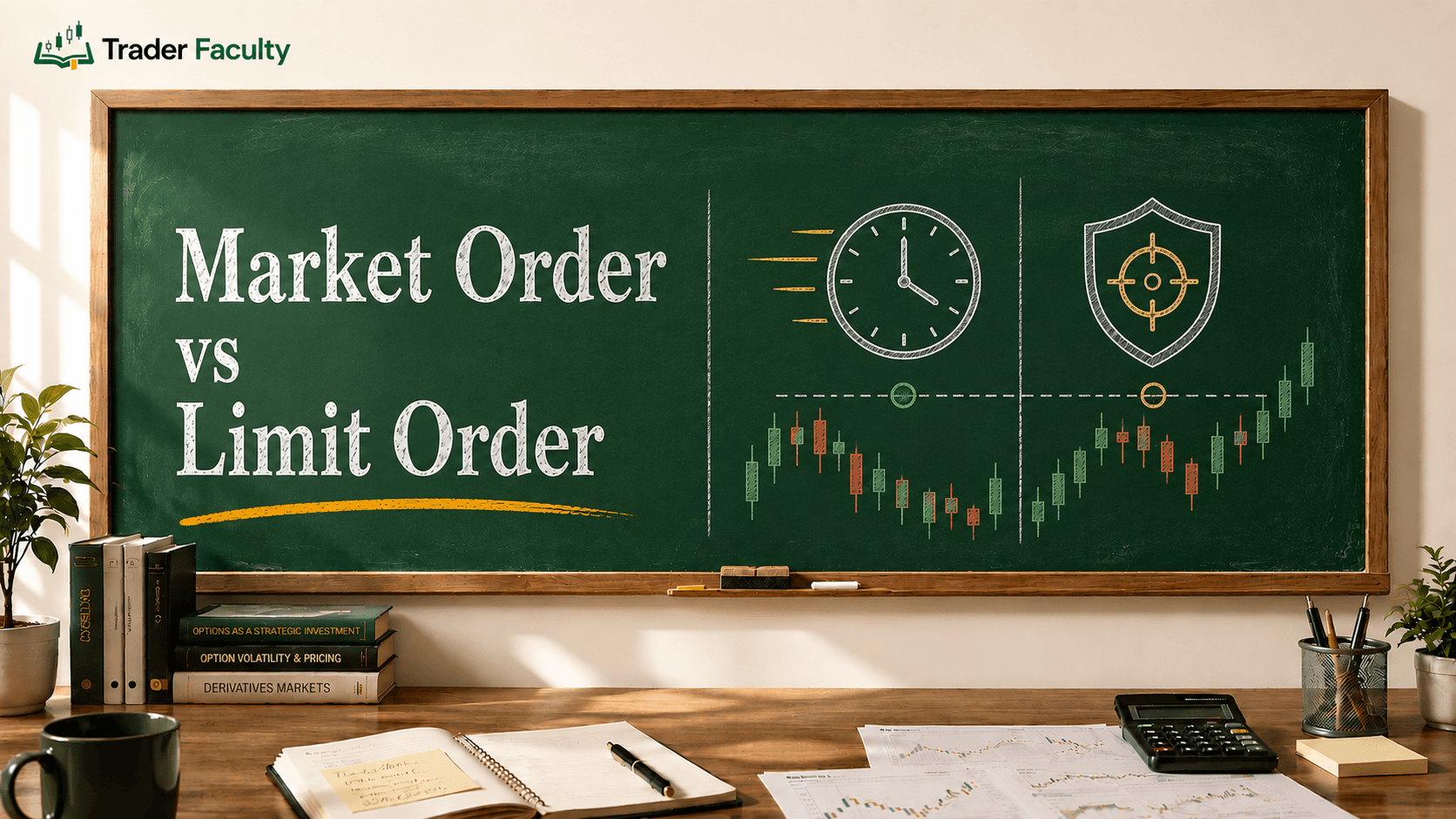
Choosing between a limit order and a market order comes down to prioritizing price control versus execution speed. Both order types have their place, but they solve entirely different problems for traders.
Choosing a market order answers a simple need: speed. When you use this order type, you are telling your broker to execute the trade immediately at the best available current price. You are guaranteed to get into or out of the trade, but you have no control over the exact price you receive. In highly volatile conditions, the price you see on your screen might be quite different from the price you actually get.
Limit orders reverse this dynamic. You are guaranteed your requested price (or better), but you are not guaranteed that the trade will actually execute.
| Feature | Limit Order | Market Order |
|---|---|---|
| Primary Focus | Strict price control | Immediate execution |
| Execution Guarantee | No (market must reach price) | Yes (fills immediately) |
| Price Guarantee | Yes (specified price or better) | No (subject to market spread) |
| Best Used For | Entering at specific levels, taking profit | Urgent entries, panic exits |
Buy Limit vs. Buy Stop: Clearing the Confusion
A buy limit order looks for a price drop to catch a bounce, while a buy stop order looks for a price increase to catch a breakout. Mixing up these two order types is one of the most common hurdles for new traders, as both are pending orders that sit on the order book.
Understanding buy limit vs buy stop becomes much easier when you look at the direction you expect the market to move before your order triggers.
- You use a buy limit when you want to buy at a discount. You place the order below the current price, expecting the market to drop, hit your order, and then bounce back up.
- You use a buy stop when you want to buy at a premium to confirm momentum. You place it above the current price, expecting the market to break through a resistance level and keep climbing.
This logic also applies when managing risk. When you set a stop loss, you are essentially using a stop order to exit a trade if the price moves against you. Some traders take this a step further by using a stop limit order, which combines a stop trigger with a strict limit price, though this introduces more complexity.
The Hidden Risk: When Limit Orders Fail
The primary risk of a limit order is that it does not guarantee execution, leaving you empty-handed if the market misses your price. It is incredibly common to analyze a chart perfectly, set your limit order, and watch the market miss your entry by a few cents before making a massive run in your predicted direction.
Furthermore, even if the market touches your exact price, your entire order might not get filled. Limit orders are typically executed on a first-come, first-served basis at that specific price level. If there are not enough buyers or sellers at your limit price to cover your requested volume, you may experience a partial fill, where only a portion of your trade is executed, or no fill at all if the market instantly reverses.
Common Mistakes Beginners Make With Limit Orders
The most frequent error beginners make with limit orders is misunderstanding how brokers handle incorrectly placed price levels. Understanding these pitfalls is a crucial part of learning how to start trading effectively.
- Setting the wrong price side: If the market is at $50 and you accidentally place a buy limit at $55, the broker reads this as: "I am willing to buy this up to $55." Since $50 is already better than $55, the broker will execute your trade instantly as a market order.
- Chasing pennies: Trying to squeeze the absolute last cent out of a market move often leads to missed trades. Setting your limits slightly ahead of major support or resistance zones can drastically improve your fill rate, even if it sacrifices a tiny bit of profit margin.
- Forgetting Time-in-Force settings: When you place a limit order, you must specify how long it stays active. A "Day" order cancels at the end of the trading session. A "Good 'til Canceled" (GTC) order stays open indefinitely. Forgetting about an old GTC order can lead to a surprise trade execution weeks later when market conditions have completely changed.
Conclusion
Understanding what a limit order is puts you in control of the price you pay or receive, rather than leaving it to chance.
Limit orders are foundational tools that allow you to dictate the terms of your trades. By prioritizing price control over execution speed, they help remove emotion from your entries and exits, ensuring you only do business at levels that make sense for your strategy. While the risk of missing a trade is always present, mastering how to balance precision with realistic market expectations is a critical step in your development as a trader.
Frequently Asked Questions
What is an example of a limit order?
If a stock is trading at $50 and you only want to buy it at a discount, you can place a buy limit order at $45. Your broker will only execute the trade if the price drops to $45 or lower, ensuring you do not pay more than your target.
Is it better to use a limit order or a market order?
It depends on your priority. A limit order is better when you want strict control over the price you pay or receive. A market order is better when you need immediate execution and are willing to accept the current available price, regardless of the market spread.
Does a limit order guarantee a fill?
No. A limit order guarantees your requested price or better, but it does not guarantee execution. If the market never reaches your specified price, or if there is not enough liquidity at that level, your order will not be filled.
Can a limit order be partially filled?
Yes. If the market touches your limit price but there are not enough buyers or sellers to cover your entire requested volume, your broker may execute a partial fill. The remainder of your order will stay on the order book until the price is reached again or the order expires.
How long does a limit order stay active?
It depends on the time-in-force setting you choose. A "Day" order will cancel automatically at the end of the trading session if it is not filled. A "Good 'til Canceled" (GTC) order will remain active indefinitely until it is triggered or you manually cancel it.
The Trader Faculty Team writes and reviews every guide together — pairing hands-on market experience with a curriculum-first approach to trading education. One good syllabus, taught in the order that makes you better.