How to Control Emotions in Trading: A Practical Framework
Discover how to manage trading emotions by building mechanical, rule-based execution habits. Read the full guide.
By Trader Faculty Team
Direct Answer
Controlling emotions in trading is the process of implementing mechanical, rule-based guardrails to prevent fear and greed from disrupting your execution. It focuses on decoupling your internal psychological states from your physical actions on the order entry platform, ensuring that capital is protected from impulsive behavior.
Controlling emotions in trading means building a systematic framework that prevents psychological impulses like fear and greed from overriding your execution rules. It is the practice of protecting your capital from your own human nature.
Most beginners know they need discipline, but they quickly spiral into impulsive decisions after a single painful loss or an unexpected winning streak. You cannot stop yourself from feeling stress when real money is on the line, but you can change how you react to it.
This guide covers how to identify your psychological triggers, why trying to trade like a robot is a mistake, and the practical steps you can take to keep your execution entirely rule-based.
Quick Takeaways
- True emotional control is about building mechanical guardrails rather than trying to suppress your feelings completely.
- Reducing your risk per trade is the fastest way to lower psychological stress and prevent impulsive mistakes.
- Establishing daily loss limits acts as a critical circuit breaker before emotional decisions wipe out your account balance.
What Are Trading Emotions?
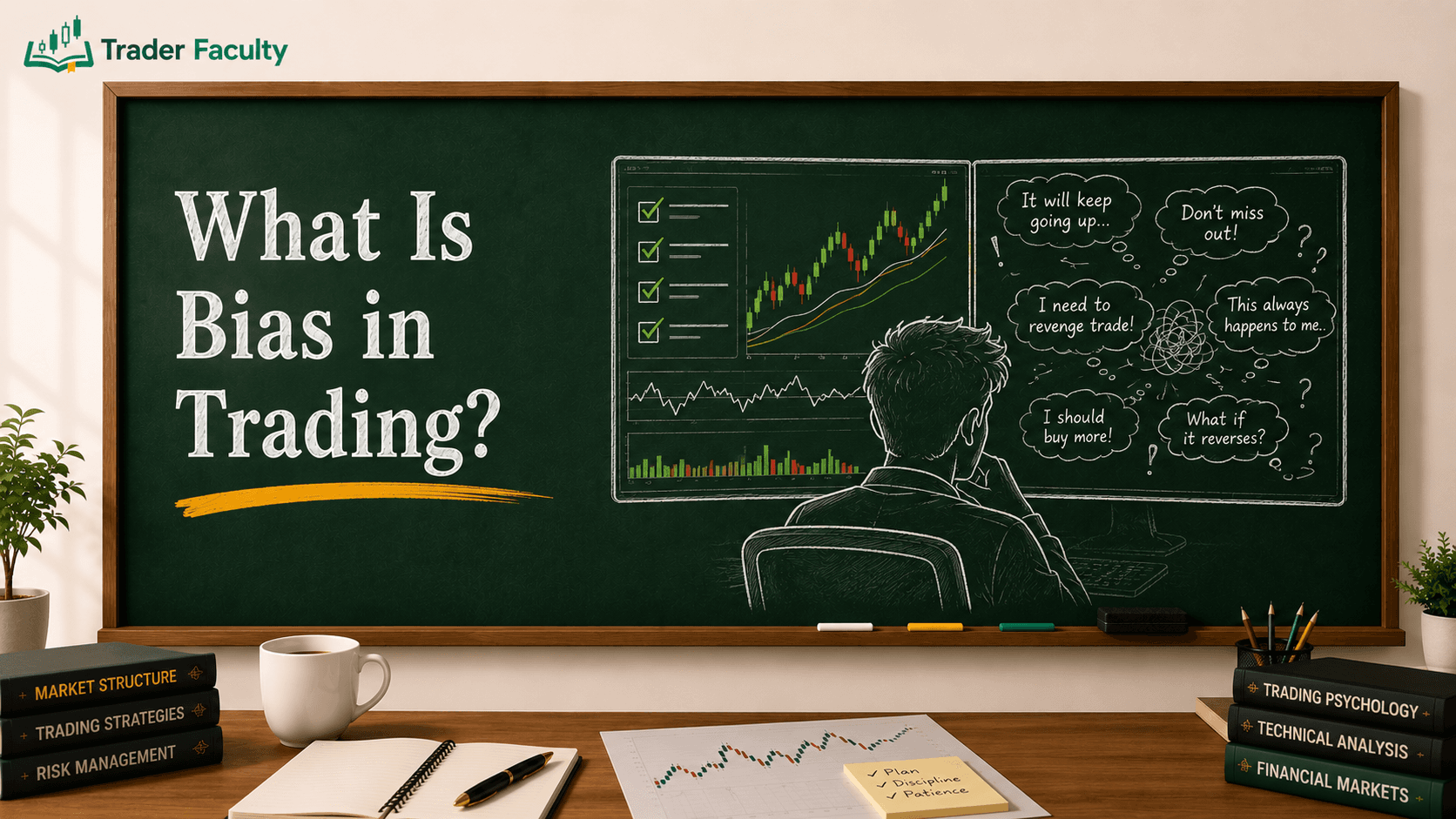
Learning how to control emotions in trading starts with accepting that you will always feel something when real money is on the line. Trading emotions are the immediate psychological responses triggered by financial risk, market volatility, and the outcomes of your positions. In a live environment, these feelings typically polarize into greed, which drives you to chase profits unsafely, or fear, which forces you to hesitate or abandon your plans prematurely.
When you step into the market, you are entering an environment that completely contradicts basic human survival mechanisms. Your brain is wired to avoid pain and seek immediate rewards. In financial speculation, this natural wiring works against you.
Experiencing volatile price movements can trigger a fight-or-flight response, clouding your long-term judgment. Developing a solid foundation in trading psychology is not about removing your survival instincts, but rather understanding how to manage these common transitions between overconfidence and panic.
The Myth of Emotionless Trading
Emotionless trading is a biological impossibility, and chasing it as a goal often causes more harm than good. You cannot completely shut off your nervous system, and pretending that you feel absolutely nothing during a major market drawdown usually leads to hidden stress and eventual blowout days.
Instead of fighting to achieve a state of total detachment, successful execution relies on decoupling your internal feelings from your physical actions. You might feel a sudden spike of anxiety when a trade moves against you, but emotional control means your hand stays away from the mouse button until your predefined rules tell you to act. The goal is not to eliminate the presence of your feelings, but to build a behavioral firewall between your inner thoughts and your order entry platform.
Why Controlling Emotional Trading Protects Capital
Managing the impact of emotional trading is the single most important factor in ensuring the long-term survival of your account. A technically flawless strategy with a high historical win rate is completely useless if you scale up your risk irresponsibly out of greed or completely abandon your parameters during a minor losing streak.
Unchecked behavior directly degrades your equity curve (the visual record of your account balance's growth or decline over time) through execution errors. When impulses dictate your decisions, you tend to cut winning trades short out of a fear of giving back small gains, while letting losing trades run far too long because you refuse to accept a loss. By enforcing structural controls over your execution habits, you protect your trading balance from the compound damage of consecutive, undisciplined decisions.
4 Practical Steps to Manage Impulsive Execution
Building a reliable buffer between a volatile market and your execution choices requires mechanical rules that actively limit your ability to make bad decisions.
- Step 1: Reduce your position sizing. If you notice your heart rate rising or find yourself constantly staring at your open PnL (profit and loss), your risk is simply too high. Drop your position size significantly until the financial outcome of an individual trade no longer alters your emotional state.
- Step 2: Automate your exits. Never enter a trade without setting a hard stop-loss and a clear take-profit level directly inside your platform. Once these orders are live, leave them completely alone. Moving your stop mid-trade is one of the clearest signs that panic has taken over.
- Step 3: Enforce a daily circuit breaker. Set a strict maximum loss limit for any single trading session. If you hit that dollar value, your day is over. Close your platform, stand up from your desk, and step away from the market completely to allow your nervous system to cool down.
- Step 4: Audit your triggers systematically. You cannot fix an execution problem that you are not actively tracking. Utilizing a structured trading journal allows you to record your psychological state alongside your entry and exit data, making it easy to spot exactly which market setups cause you to break discipline.
Common Behavioral Mistakes Beginners Make
Beginner execution errors almost always stem from an inability to handle the short-term discomfort of normal market variance.
The most destructive error is revenge trading, which occurs immediately after experiencing a frustrating loss. Instead of accepting the outcome as a standard cost of doing business, a trader will aggressively re-enter the market with a larger position size to win the money back quickly. This emotionally charged behavior ignores all strategic rules and frequently turns a routine, manageable loss into a catastrophic account drawdown.
Conversely, overconfidence after a string of consecutive wins can be just as dangerous. It causes you to feel bulletproof, leading to skipped analysis and oversized positions right before the market shifts.
Conclusion
Controlling your emotions requires building mechanical habits that preserve capital, rather than trying to force yourself to feel like a machine. By utilizing disciplined position sizing, establishing rigid daily loss limits, and tracking your psychological patterns, you systematically remove impulse from the execution equation. Focus your energy on mastering your consistency behind the screen, and let the long-term probabilities of your system handle the rest.
Frequently Asked Questions
How do I stop being emotional when trading?
To stop being emotional when trading, you must shift your focus from attempting to eliminate feelings to controlling your physical actions. Start by lowering your position size significantly so that individual losses do not trigger physiological stress. Additionally, automate your exits by using hard stop-losses and take-profit orders, and commit to leaving your trade parameters untouched once the position is live.
Why is emotional trading so dangerous to my account balance?
Emotional trading introduces severe variance and execution errors into your system. When impulses take over, you are highly likely to cut your winning trades short out of fear, while allowing your losing positions to run far past their logical invalidation points out of hope. This behavior completely breaks down the long-term mathematical edge of your trading strategy, leading to rapid capital drawdowns.
Can you trade completely without emotions?
No, trading completely without emotions is a biological myth. Every human experience involving financial risk will trigger a physiological response, such as fluctuations in heart rate or stress hormones. Professional traders do not feel empty; instead, they have mastered the ability to recognize their anxiety or excitement while relying strictly on a rigorous, predefined checklist to execute their trades.
How do you handle revenge trading after a major financial loss?
The most effective way to handle revenge trading is to implement a strict daily loss circuit breaker inside your plan. If your maximum daily loss limit is breached, you must immediately close your platform and walk away from your computer screens. Physical separation forces a cooling-off period, allowing your nervous system to reset before you make catastrophic emotional decisions.
How does a trading log help with behavioral biases?
A trading log helps identify behavioral biases by tracking your internal psychological state alongside raw technical execution data. By reviewing your notes over multiple weeks, you will begin to notice distinct patterns, such as a tendency to overtrade after a specific loss or skip analysis during winning streaks, letting you fix triggers systematically.
Keep learning
Trader Mindset
Strategy is the easy part. Sticking to it is the hard part.
6 lessons quiz
Start Trader MindsetThe Trader Faculty Team writes and reviews every guide together — pairing hands-on market experience with a curriculum-first approach to trading education. One good syllabus, taught in the order that makes you better.