What Is FOMO in Trading and How Does It Ruin Your Performance?
Discover how FOMO in trading triggers emotional decisions, why you chase price action, and how to stop it. Read the full guide.
By Trader Faculty Team
Direct Answer
FOMO in trading is the psychological pressure or anxiety an investor experiences when watching an asset's price rapidly surge without their participation. This emotional state often forces a trader to abandon their established rules and enter a position prematurely at the top of a move. Recognizing this impulse is the first step toward implementing rules-based guardrails that protect capital.
FOMO in trading, short for the fear of missing out, is an anxious psychological state where you feel an overwhelming pressure to jump into a moving market because you believe others are capturing massive profits without you. This emotional trigger bypasses rational logic and forces impulsive, undisciplined market execution.
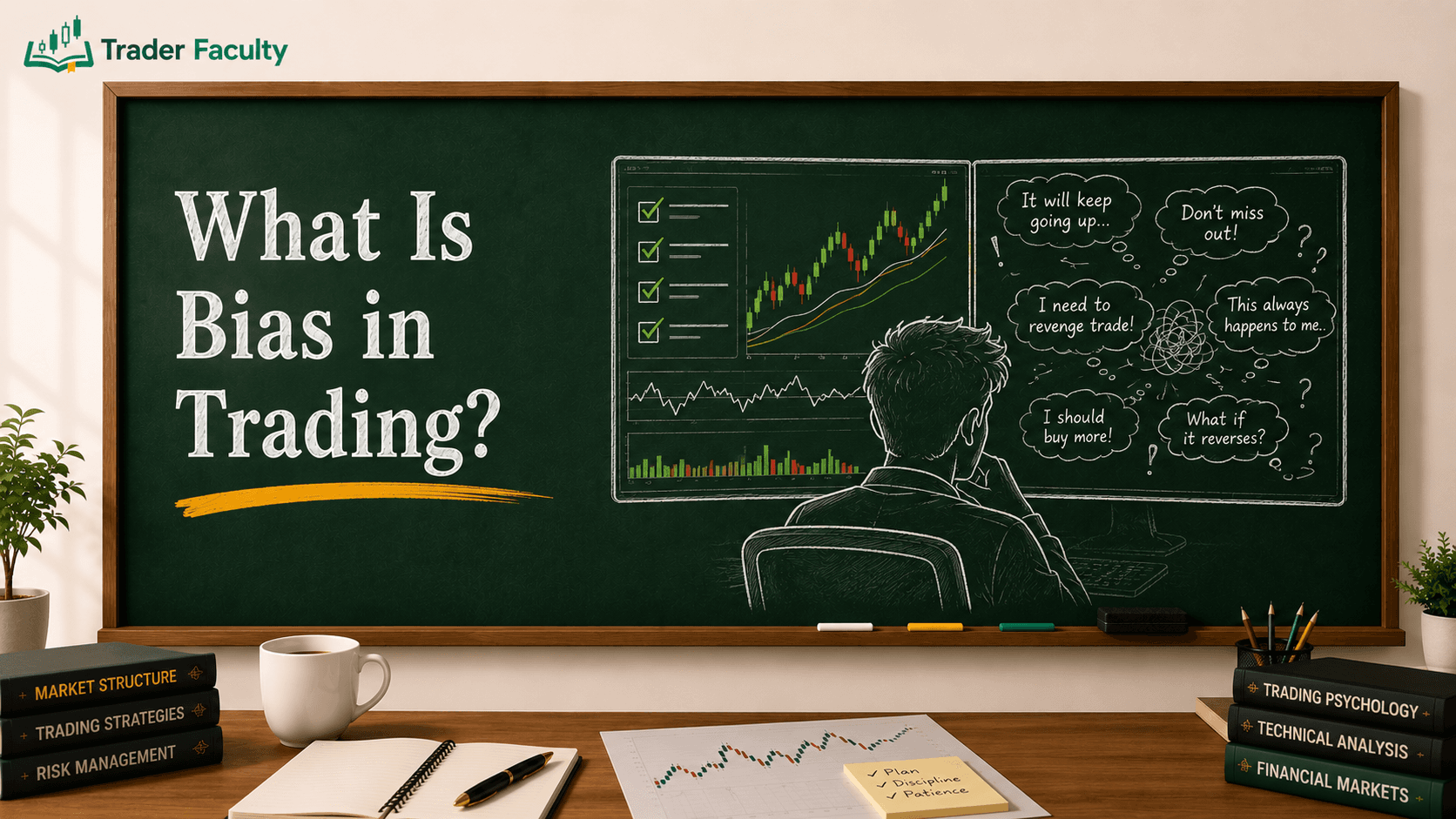
You have likely watched an asset surge green, hesitated during the initial breakout, and then bought at the absolute top out of sheer emotional desperation. It is a frustrating, exhausting cycle that illustrates exactly what is fomo in trading—an impulse that systematically drains retail accounts and destroys consistency. Mastering your long-term trading psychology requires you to understand why this chase happens, how it forces catastrophic execution errors, and how to build rules that completely block the urge.
Quick Takeaways
- FOMO shifts your behavior from an objective rules-based system to emotional guessing, drastically inflating your risk exposure.
- The urge to chase running prices is rooted in cognitive vulnerabilities like herding and deep regret aversion rather than clean market data.
- Giving into an initial emotional entry serves as the primary gateway to secondary execution failures like overtrading and account liquidation.
- Constructing rigid execution boundaries, such as wait clocks and position penalties, keeps your trading capital insulated from emotional spikes.
What Is FOMO in Trading?
FOMO in trading stands for the "Fear of Missing Out" and represents the immediate emotional impulse to buy or sell an asset solely because its price is moving rapidly, without any confirmation from a verified plan. When you operate under fomo trading triggers, you are no longer trading the chart; you are trading your own internal anxiety.
It is vital to draw a line between systematic momentum execution and an emotional chase. Disciplined momentum traders buy breakouts because the price action hits exact pre-planned criteria, and they possess a defined mathematical invalidation point. Conversely, experiencing fomo in trading means you are entering a position long after the safe risk-to-reward window has slammed shut, simply because you cannot bear to watch the green candles print without you.
The anatomical lifecycle of a classic FOMO trade is painfully predictable. The market experiences a sudden surge, you hesitate due to initial caution, the asset continues to climb, social proof mounts, you experience psychological breakdown, and you execute a late market order at the absolute exhaustion point right before an aggressive structural reversal occurs.
The Psychology of the Chase: Why Your Brain Triggers FOMO
Your brain triggers market chasing because human evolution inherently prioritizes group survival dynamics and detests the emotional pain of being excluded. In behavioral economics, this destructive trading behavior is fueled by two primary cognitive biases: herding and regret aversion.
Herding is your natural instinct to find safety in numbers. When you see an absolute flood of green candles or watch online spaces explode with excitement, your ancient cognitive programming dictates that it is dangerous to stand still while the tribe runs. Regret aversion takes this a step further; the psychological agony of anticipating a missed opportunity often feels far more intense than the rational fear of losing money. Social media platforms accelerate this behavioral contagion exponentially, turning standard market volatility into full emotional epidemics by constantly flashing curated profit screenshots across your daily feeds.
FOMO Across Markets: Crypto Volatility vs. Stock Market Trends
The intensity of your emotional triggers scales directly with an underlying asset class's structural speed, liquidity depth, and operational trading hours. While the core psychological vulnerability remains identical, market velocity changes how rapidly your account balance can deteriorate.
If you struggle with fomo crypto environments, you are dealing with a hyper-accelerated breeding ground for emotional execution. Parabolic, 24/7 market cycles combined with unregulated liquidity pools create massive, volatile surges that easily bypass standard cognitive cooling mechanisms. In contrast, managing a fomo stock response typically involves corporate earnings gaps, unexpected macroeconomic data releases, or high-volume index momentum plays. The structural constraints of traditional equity markets, like evening closing bells and weekend halts, offer built-in cooling-off periods that crypto completely lacks.
The Costly Slippery Slope: From Missing Out to Account Damage
Giving in to a single emotional chase completely shatters your mental guardrails and exposes your portfolio to a compounding chain reaction of catastrophic execution errors. Because a late entry forces you to use an incredibly wide stop-loss, a single normal market retracement instantly inflicts deep financial damage.
FOMO Late Entry ──> Immediate Retracement Loss ──> Overtrading to Recover ──> Catastrophic Revenge Trading
This initial unexpected loss fractures your mental discipline, rapidly pushing you into a desperate state of unorganized overtrading to win the capital back. As those unplanned positions inevitably stack up and fail, your mindset degrades further into aggressive, hyper-irrational revenge trading. What began as a minor fear of missing a standard market move ends as an emotional war against the screen, frequently wiping out months of disciplined gains in a single afternoon.
3 Rules-Based Strategies to Stop Chasing the Market
You cannot completely eliminate the biological sensation of missing out, but you can build clear systemic execution boundaries that prevent that internal feeling from ever controlling your mouse click.
- Strategy 1: The "If-Then" Zone Rule: Establish a strict invalidation zone for entries. If a price leaves your predefined structural entry boundary without your order filled, the setup is officially dead. You must wait for a clean structural retest or completely abandon the asset.
- Strategy 2: Mandatory Volatility Wait Clocks: Implement a strict cooling-off rule. When an asset experiences an unexpected vertical spike, enforce a mandatory 15-minute wait clock—mirroring standard exchange-level circuit breaker intervals—before you are operationally permitted to open an execution screen to ensure emotional stability.
- Strategy 3: The Position Sizing Penalty: If you consciously choose to accept a delayed, sub-optimal entry past your ideal signal, you must mathematically penalize your risk exposure by cutting your standard position size by a minimum of 50% to shield your core capital base.
Conclusion
Developing a professional approach to trading psychology is not about mutating into a heartless robot; it is about respecting your human flaws and engineering external rules that actively protect you from them. Markets operate in infinite cycles, meaning another high-probability opportunity is always right around the corner. True longevity belongs entirely to the individual traders who ruthlessly protect their capital base today so they have the financial capacity to execute flawlessly tomorrow.
Frequently Asked Questions
How do you overcome FOMO when trading?
Overcoming FOMO requires shifting from subjective emotional choices to strict, programmatic execution rules. Implement strict criteria such as mandatory volatility wait clocks or specific invalidation zones. When these structural boundaries are breached, the trade setup is considered completely invalid, removing the psychological element of chasing completely.
What triggers FOMO in crypto vs stocks?
The primary differentiator is market structural velocity. The cryptocurrency space acts as a hyper-accelerated breeding ground for emotional execution due to unregulated liquidity pools and continuous 24/7 charts. Stock market responses are generally dictated by structured corporate events, earnings gaps, or index moves, which are mitigated by regular market closing breaks.
Can FOMO lead to overtrading?
Yes, giving in to a single emotional chase acts as a direct psychological trigger for overtrading. A late entry forces you to place wide stop-losses, and the subsequent inevitable losses degrade your mental discipline. This causes you to aggressively spin off additional unplanned positions in a chaotic attempt to win the lost capital back.
Why do retail traders suffer from herding behavior?
Herding is an evolutionary survival dynamic deeply embedded within cognitive frameworks. Humans naturally seek safety in numbers, making it highly uncomfortable to sit patiently while the crowd executes trades. Social media communities exacerbate this bias by aggressively sharing curated winning positions, creating a false perception of effortless success.
What is regret aversion in trading psychology?
Regret aversion is the behavioral phenomenon where the anticipated psychological pain of missing a profitable market trend feels far more intense than the logical fear of losing money. This cognitive distortion forces you to prioritize potential profits over clear risk metrics, leading directly to high-risk market entries at severe macro resistance points.
Keep learning
Trader Mindset
Strategy is the easy part. Sticking to it is the hard part.
6 lessons quiz
Start Trader MindsetThe Trader Faculty Team writes and reviews every guide together — pairing hands-on market experience with a curriculum-first approach to trading education. One good syllabus, taught in the order that makes you better.