Trailing Stop Loss vs Trailing Stop Limit: Key Differences
Learn the core execution differences between a trailing stop loss and a trailing stop limit order, and when each one fits. Read the full guide.
By Trader Faculty Team
Direct Answer
A trailing stop loss becomes a market order when triggered, which prioritizes getting out but can fill below the stop price (slippage). A trailing stop limit becomes a limit order, which protects your price at or above the limit but may not execute if the market moves past it.
A trailing stop order is a conditional order that moves with the market price to help protect open gains or limit losses. Traders often choose between two main variations: the trailing stop loss and the trailing stop limit. This guide is educational, not a recommendation.
Choosing the wrong order type in volatile markets can lead to heavy slippage (a fill at a worse price than expected) or an order that never executes. Knowing how each type behaves during fast moves, thin liquidity, and price gaps helps you balance exit speed against price protection.
Quick Takeaways
- A trailing stop loss converts to a market order when triggered, which prioritizes getting out but exposes the trade to slippage.
- A trailing stop limit converts to a limit order when triggered, which protects your price but adds non-execution risk.
- Trailing stop loss orders are often used in liquid markets where exit speed matters, while trailing stop limit orders are often used where price bounds matter more, such as less liquid or highly volatile assets.
- Fast-moving markets and price gaps can cause trailing stop limit orders to remain unfilled if the price jumps past the limit price.
What Is a Trailing Stop Order?
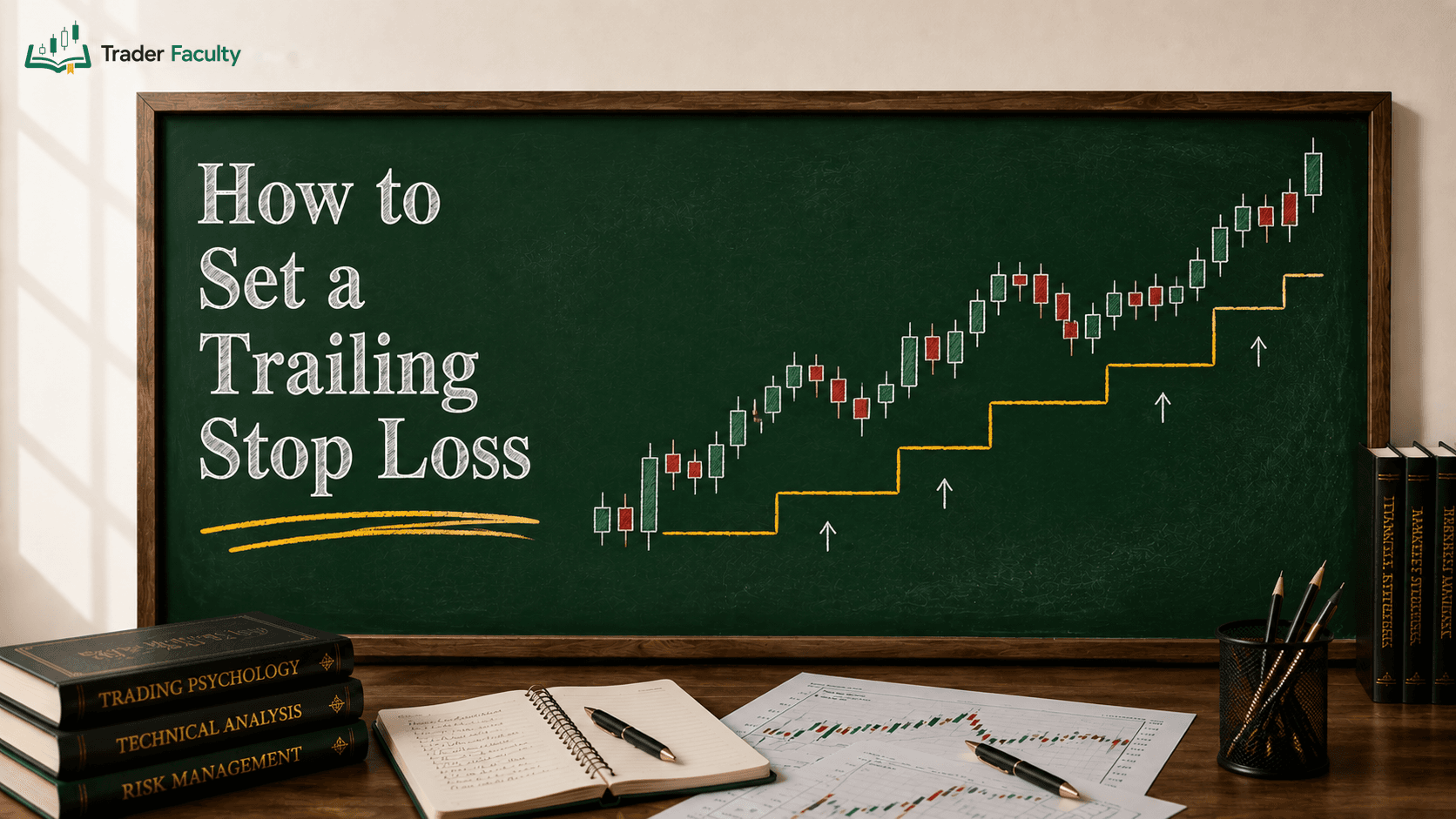
A trailing stop order is an automated order type designed to help lock in potential profits while keeping a position open as long as the market moves in your favor. Unlike a standard fixed stop loss order, which stays at one set price, a trailing stop tracks the market price at a set distance.
You set the distance (the trailing offset) as a fixed dollar amount or a percentage. In a long position, as the price climbs, the trailing stop price moves up with it, keeping the same distance. Each new high lifts the trigger level.
If the price turns down, the trailing stop price stays where it is. The order triggers only when the price falls back by the full trailing amount. If you've searched for "what is trailing stop loss vs trailing stop limit," the short answer is that the two differ in what happens after that trigger.
Trailing Stop Loss Explained: Execution Certainty

A trailing stop loss order prioritizes getting out once the market hits the stop price. When the asset's price reaches the trailing stop trigger, your broker or the exchange converts the conditional order into a market order.
Key Characteristics of Trailing Stop Loss Orders
- Trigger Event: Converts to a market order as soon as the stop price is touched.
- Execution Certainty: Aims to close the position promptly, which reduces (but doesn't remove) the risk of staying in a losing trade as the price keeps sliding. A fill isn't guaranteed in every situation, such as a trading halt.
- Price Slippage Risk: Does not guarantee the final exit price. In fast-moving markets or low-liquidity conditions, the order may fill at a price lower than the trigger level.
Trailing stop loss orders are often used in highly liquid major currency pairs, large-cap stocks, and large cryptocurrencies, where there's enough liquidity to absorb market orders without much slippage. As Investor.gov explains, a stop order becomes a market order once the stop price is reached, and the execution price can differ from the stop price, especially in a fast-moving market.
Trailing Stop Limit Explained: Price Certainty

A trailing stop limit order emphasizes control over the worst price you're willing to accept. Instead of becoming a market order, reaching the trailing stop price triggers a limit order with a set limit price offset.
To set a trailing stop limit, you define two parameters: the trailing offset (which sets the Stop Price) and the limit price offset.
- Stop Price (Trigger): The activation price, calculated using the trailing offset.
- Limit Price: The lowest price you'll accept for a sell order (or the highest you'll pay for a buy order), set a chosen distance below or above the Stop Price.
Key Characteristics of Trailing Stop Limit Orders
- Trigger Event: Converts to a limit order once the Stop Price is hit.
- Price Protection: Fills only at the limit price or a better price, which protects you from execution at unfavorable prices.
- Non-Execution Risk: If the price drops too fast or gaps below the limit price, the order can stay unfilled on the order book, leaving your position open during a continuing decline.
Key Differences Between the Two Order Types
The core distinction between the two lies in the trade-off between execution certainty and price certainty. A market order prioritizes getting out immediately, whereas a limit order prioritizes the price of the exit. The trailing stop loss vs trailing stop limit meaning really comes down to that choice.
| Order Parameter | Trailing Stop Loss | Trailing Stop Limit |
|---|---|---|
| Triggered Order Type | Market Order | Limit Order |
| Execution Priority | High priority (market order, but a fill isn't guaranteed) | Lower (fill depends on price availability) |
| Price Protection | Limited (price can slip) | Yes, within the limit (fills at limit price or better) |
| Primary Execution Risk | Slippage / Market Gap | Unfilled Order / Non-Execution |
| Best Used For | Often used in liquid markets and urgent exits | Often used in thinner markets where price bounds matter |
Price Simulation: Market Gap Scenario
Here's the trailing stop loss vs trailing stop limit explained with an example. Say you bought a stock at $100. It climbs to $150, then a sudden high-impact news event makes the price gap down (open far below the prior price) from $150 to $130 in seconds.
- Trader A uses a Trailing Stop Loss with a $10 trailing distance.
- Stop Price Trigger: $140.
- Outcome: The market gaps straight past $140 down to $130. The stop triggers and sends a market order, which fills at the best available bid price of $129.50. The position is closed, but with $10.50 of slippage below the stop price.
- Trader B uses a Trailing Stop Limit with a $10 trailing distance and a $2 limit offset.
- Stop Price Trigger: $140.
- Limit Price Set: $138.
- Outcome: The market gaps down to $130. The order triggers at $140 and places a limit order to sell at $138 or better. Because the market price is $130, the limit order can't execute, so the trader stays in the position while the asset keeps falling. This is a simplified example, and real fills vary.
Common Mistakes When Using Trailing Stops
1. Setting a Trailing Distance Too Tight
Placing the trailing offset too close to the current price exposes the trade to normal market noise. Ordinary volatility can trigger the order early, stopping you out of a profitable trade just before the larger trend resumes.
2. Relying on Trailing Stop Limit Orders During High-Impact Events
Using limit orders around earnings reports, central bank announcements, or major economic releases adds meaningful non-execution risk. Fast price jumps can gap over your limit, leaving the trade unfilled while you stay exposed to the market.
3. Miscalculating the Limit Offset
Setting the limit offset too close to the stop price on a trailing stop limit order raises the chance the order won't fill. In fast markets, the order book moves quickly, so an overly narrow limit can be hard to match before price falls beyond it.
Conclusion
The difference between these two order types comes down to whether execution speed or price control matters more to you. A trailing stop loss prioritizes closing the trade once triggered, which can suit liquid assets where you want to limit deep drawdowns (drops from a peak). A trailing stop limit gives tighter control over your exit price, which can help where avoiding slippage matters, but it may not fill.
Whichever order you use, be aware of stop loss hunting, where price spikes through obvious stop levels.
Neither order type removes market risk, and both depend on liquidity, volatility, and how your broker and the exchange handle orders, so check your broker's rules. Match your order choice to market liquidity, asset volatility, and your overall risk management plan. Past performance doesn't guarantee future results. To learn more about trade management and order execution, review our guide on risk management trading.
Frequently Asked Questions
What is the main difference between a trailing stop loss and a trailing stop limit?
A trailing stop loss becomes a market order when triggered, which aims to close your position right away at the best available price. A trailing stop limit becomes a limit order, which only executes at your limit price or better, giving price protection at the cost of possible non-execution.
Can a trailing stop limit order fail to execute?
Yes. A trailing stop limit order can stay unfilled if the price drops rapidly or gaps below your limit price. In fast-moving or low-liquidity markets, the price may pass your limit before the order can be matched, leaving your position open.
When should you use a trailing stop loss instead of a trailing stop limit?
Traders often choose a trailing stop loss when getting out quickly is the main goal, particularly in very liquid markets like major forex pairs or high-volume stocks. The market order usually gets you out even if slippage occurs, though a fill at a specific price isn't promised.
Is a trailing stop loss better than a trailing stop limit?
Neither is universally better; each fits different conditions. A trailing stop loss prioritizes execution speed, while a trailing stop limit prioritizes price control and protection against heavy slippage.
How do price gaps affect trailing stop orders?
During a gap, a trailing stop loss triggers and fills at the next available market price, which may be well below the trigger level. A trailing stop limit triggers and places a limit order, but it won't execute if the gap skips over your limit price.
Keep learning
Risk & Money Management
One good article won't save your account. A risk framework will.
7 lessons quiz
Start the courseThe Trader Faculty Team writes and reviews every guide together — pairing hands-on market experience with a curriculum-first approach to trading education. One good syllabus, taught in the order that makes you better.