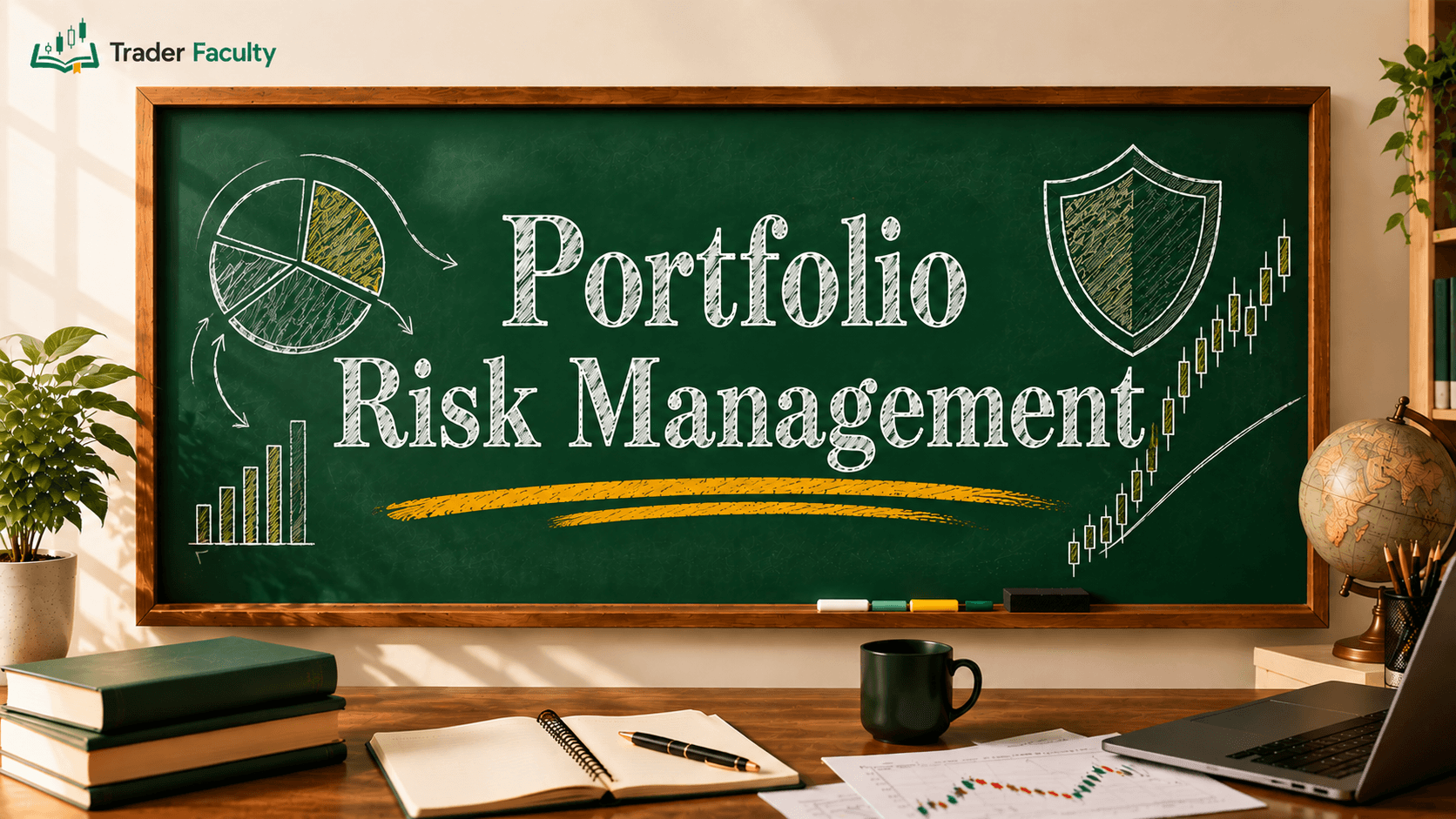
What Is Portfolio Management? Asset Allocation & Risk
Learn how portfolio management balances asset allocation, diversification, and rebalancing to control risk. Read the full guide.
By Trader Faculty Team
Direct Answer
Portfolio management is the systematic process of selecting, balancing, and monitoring a collection of financial assets to meet strategic investment goals while controlling downside risk. It relies on three core practices: asset allocation across primary markets, diversification within asset classes, and periodic rebalancing to maintain target risk parameters as prices fluctuate.
A portfolio management strategy is a systematic process of selecting, balancing, and monitoring a collection of financial assets to meet specific financial goals while managing risk.
Many traders enter the market focusing entirely on finding winning individual trades. However, long-term success often depends on how those trades fit together inside a overall account structure. Portfolio management moves your focus from single-trade setups to the overall health, risk exposure, and balance of your entire account.
Quick Takeaways
- Portfolio management shifts your focus from winning single trades to controlling account-wide risk.
- Asset allocation and diversification reduce specific asset risk but cannot eliminate broad market downturns.
- Active management aims to outperform a benchmark, while passive management tracks market indexes at a lower cost.
- Systematic portfolio rebalancing prevents successful trades from creating unintended risk concentration.
What Is Portfolio Management in Trading?
Portfolio management is the disciplined practice of organizing and overseeing a group of trading positions or investments to achieve a specific risk-and-return profile. Instead of treating every trade as an isolated event, portfolio management evaluates how different positions interact with one another under changing market conditions.
Effective portfolio management relies on three fundamental pillars:
- Asset Allocation: Dividing total trading capital across primary asset classes, such as equities, foreign exchange, commodities, and fixed income.
- Diversification: Spreading capital across different instruments within those asset classes to avoid single-asset reliance.
- Rebalancing: Periodically adjusting position sizes to maintain intended risk limits as asset prices change.
Understanding portfolio structure requires distinguishing between systematic risk and unsystematic risk. Unsystematic risk affects a single company or instrument, such as an unexpected earnings miss or executive change. Broad asset allocation helps reduce unsystematic risk. Systematic risk, on the other hand, represents broad market movements, such as macroeconomic interest rate shifts or global recessions, which impact entire asset classes simultaneously.

Active vs. Passive Portfolio Management
Traders generally approach portfolio management through two distinct operational frameworks: active management and passive management.
| Feature | Active Portfolio Management | Passive Portfolio Management |
|---|---|---|
| Main Objective | Outperform a market benchmark (Alpha) | Match a market benchmark's return (Beta) |
| Execution Style | Tactical timing, frequent trading | Systematic holding, long-term tracking |
| Cost Structure | Higher turnover and transaction costs | Lower turnover and transaction costs |
| Risk Profile | Higher operational and execution risk | Direct market exposure risk |
Active portfolio management involves tactical decision-making, direct market timing, and active security selection. Active managers seek to generate returns above a market benchmark—a concept known as generating alpha. This approach requires frequent monitoring, technical or fundamental analysis, and dynamic adjustments. However, active strategies usually incur higher trading fees and demand significant execution discipline.
Passive portfolio management aims to match the return of a target index or market sector—a concept known as acquiring beta exposure. Passive managers use automated or rule-based frameworks, such as holding broad equity index funds, to match market performance over time. This approach minimizes transaction costs and execution requirements.
Many active traders combine both concepts by running a core-satellite strategy. They maintain a passive core allocation to stable assets while actively trading a smaller satellite allocation using focused risk parameters or targeted techniques like what is hedging in trading.
Core Strategies for Managing Portfolio Risk
Managing a portfolio requires establishing clear rules for allocating capital and adjusting positions when markets move.
Strategic Asset Allocation
Strategic allocation establishes a baseline mix of assets based on your investment horizon and drawdown tolerance. For instance, a classic conservative portfolio might maintain a baseline of 60% equities and 40% fixed income. The trader maintains these strategic weightings regardless of short-term market noise.
Tactical Asset Allocation
Tactical allocation allows temporary deviations from the baseline strategy to take advantage of short-term market opportunities or macro trends. If economic data points to potential commodity strength, a trader might temporarily increase commodity exposure from 5% to 15%, returning to baseline once the trend matures.
Correlation Control
Position count alone does not guarantee safety. True diversification requires controlling asset correlation—the degree to which two financial assets move relative to each other. Holding long positions in three different mega-cap technology stocks often creates identical price exposure. If a single macro event triggers a technology sell-off, all three positions suffer drawdowns simultaneously.
Evaluating correlation matrices ensures your trades provide real risk balance rather than hidden leverage concentration.
How to Maintain and Rebalance a Portfolio
Over time, market price movements cause position weightings to drift away from their target allocations. If a trader allocates 10% of an account to a high-volatility stock and that stock doubles in value, it now represents a much larger percentage of total account equity. This dynamic, known as portfolio drift, increases account vulnerability to a sudden reversal in that single instrument.

To fix drift, traders use systematic rebalancing triggers:
- Calendar Rebalancing: Adjusting positions on a fixed time schedule, such as the end of every month or quarter, to reset weights back to target levels.
- Threshold Rebalancing: Executing rebalance trades whenever an asset class drifts beyond a set percentage trigger (such as ±5% from its target allocation).
Rebalancing forces a structured trading workflow: taking partial profits on winning positions that have grown too large and reallocating capital toward undervalued or under-represented assets.
Common Portfolio Management Mistakes to Avoid
Even structured portfolios experience drawdowns when traders fall into common management traps.
| Common Management Error | Operational Impact | Risk Mitigation Rule |
|---|---|---|
| Over-Concentration | Single-asset failure impacts entire account balance | Enforce strict single-position capital caps (e.g., max 2–5%) |
| Correlation Blindness | Unintentional leverage in correlated assets | Audit cross-asset correlation before adding new positions |
| Allowing Winning Trades to Drift | High risk exposure as winning position grows oversized | Implement automated percentage drift rebalancing triggers |
Avoiding these systemic execution mistakes requires viewing single positions as part of a connected network, supported by established principles of risk management trading.
Conclusion
Understanding portfolio management transforms trading from a series of disconnected speculative bets into a structured business framework. By combining clear asset allocation, systematic correlation control, and strict rebalancing rules, traders can navigate volatile market environments without risking their entire trading capital on single outcomes.
To deepen your understanding of position sizing, portfolio survival strategies, and systematic drawdown controls, explore our risk management trading core module.
Frequently Asked Questions
What is the main objective of portfolio management?
The main objective of portfolio management is to optimize return relative to an investor's specific risk tolerance and financial horizon. By balancing asset allocation, diversification, and rebalancing, portfolio management aims to maximize performance while protecting capital against severe market drawdowns.
What are the three core pillars of portfolio management?
The three core pillars of portfolio management are asset allocation, diversification, and rebalancing. Asset allocation divides capital across different market classes, diversification spreads exposure within those classes, and rebalancing adjusts position sizes over time to maintain targeted risk levels.
How does active portfolio management differ from passive portfolio management?
Active portfolio management seeks to outperform a market benchmark (generating alpha) through tactical timing, security selection, and frequent adjustments. Passive management aims to match index performance (acquiring beta) using low-cost, automated rules with minimal trade turnover.
What is the difference between systematic and unsystematic risk?
Unsystematic risk is specific to an individual company or asset, such as an earnings surprise, and can be minimized through diversification. Systematic risk reflects broader macroeconomic forces, such as interest rate changes, that impact entire financial markets and cannot be eliminated by diversification alone.
Why is portfolio rebalancing necessary?
Portfolio rebalancing is necessary because asset price movements cause allocation weights to drift over time. Rebalancing resets positions to their original target percentages, preventing winning trades from creating unintentional risk concentration across your account.
Keep learning
Risk & Money Management
One good article won't save your account. A risk framework will.
7 lessons quiz
Start the courseThe Trader Faculty Team writes and reviews every guide together — pairing hands-on market experience with a curriculum-first approach to trading education. One good syllabus, taught in the order that makes you better.